

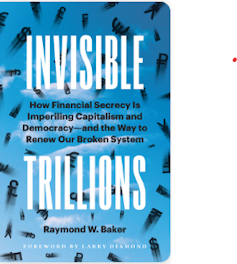
Secrecy has become as important for corporations as transparent and taxable profits used to be, according to Raymond W. Baker in his new book Invisible Trillions. Global capitalism, he argues, operates beyond the rule of law. This contributes to extreme inequality that threatens liberal democracy.
Deals in the financial secrecy system account for half of global economic operations. This is far beyond illicit transfers of funds through corporate under-pricing and overpricing of exports and imports, or the drug and other criminal networks 50 years ago. Tax havens, “shell companies”, anonymous trust accounts, fake foundations and new digitised money laundering technologies have proliferated. Add to that falsified trade. All of this is facilitated by international lawyers, accountants and financial strategists based mostly in rich countries.
The book’s timely contribution is how financial secrecy threatens both free enterprise and political freedoms. Both are critical to dealing with current inequalities afflicting humanity and to meeting challenges in public health, climate, and elsewhere.
Baker indicts the United States as the biggest user of the financial secrecy system, and the biggest recipient of dirty money from around the world. A key indication of the cost of this is that gaps between top and average wages in the US have shot up from 20 to 1 in 1960 to 350 to one today. Had this not occurred, Baker told me he estimates, the middle class would now be better off by $ 50 trillion.
Pioneering work
A pioneer in exposing illicit financial flows, Baker is a member of the High-Level Panel on the subject commissioned by the African Union (AU) and UN Economic Commission for Africa. It was chaired by former South African president Thabo Mbeki from 2011 to 2015. It is suspended pending further funding. Invisible Trillions should spur renewed work by the panel.
The panel’s 2015 report estimated that in the previous half-century, Africa lost over a US$ trillion in illicit money flows. This is about what Africa received in official development assistance over the same period. Baker made a similar finding in his 2005 book, Capitalism’s Achilles Heel.
He began his career as an entrepreneur in Nigeria after independence, applying his 1960 Harvard MBA to launch several successful local businesses in the 1960s and 1970s. After relocating to Washington, DC in the 1980s, he became a guest fellow at the Brookings Institution. He eventually founded Global Financial Integrity in 2006. The research institute continues to produce seminal research and policy analysis on all aspects of the secretive world of illicit financial flows.
Clean up must begin from above
Baker is cogently critical not only of the complicity of the US and its corporations, but also law firms, auditors and consulting companies that abet tax avoidance, concentration of wealth, and corruption of government officials. He accuses the US and China, which together account for over 40% of the world’s nominal GNP, of knowingly exploiting secrecy in global economic relations.
Little wonder that 193 members of the United Nations have pledged to halt illicit financial flows, but with little discernible effect. Meanwhile, the COVID pandemic, the war in Ukraine and climate change worsen inequality within and among nations.
Concise and accessible, Invisible Trillions has three parts:
-
Democratic Capitalism at Risk
-
Corroding the Commons
-
Renewing Democratic Capitalism.
Rogue capitalism
I found Baker’s criticisms of capitalism in the US to be reasonable, his indictments of corruption and authoritarianism illuminating, and his emphasis on fairness, justice, equity and human rights hopeful. America’s leading democracy scholar, Larry Diamond of Stanford University, wrote the book’s foreword. As he asserts:
Only radical improvements across the globe in financial transparency and accountability and in regulatory capacity and integrity can break this cycle of political decay and despair.
Baker, however, carefully avoids analysis of the structural deficiencies of US democracy. He defers to others to build on his analysis of how secretive concentrations of wealth became possible with the complicity of banks, corporations and “complicit governments” in key chapters of Part II.
Although the book is mainly about the “rogue capitalism” of the US, it includes the impact of secrecy on economic behaviour further afield, using seven country case studies. Featured are the two dictatorships – Russia and China – plus a flawed pluralistic democracy, South Africa, an example of state capture. Other examples of where secrecy serves autocrats are Guatemala, Venezuela, Myanmar and Iran.
The South African case shows well the role played by foreign corporations, international lawyers and public relations firms in corruption. Baker concludes Part II with a very short chapter, “Hiding in Silos”. It is critical of western attempts to spread the rule of law while ignoring
the degree to which the capitalist system (is) operating increasingly beyond the rule of law.
This sets up Part III, in which he proposes ways and means for “Renewing Democratic Capitalism”.
Renewing democratic capitalism
In Baker’s view, democracy is self-correcting, but capitalism is not. His main message is: reform capitalism or forfeit democracy.
His suggestions focus on the US and its potential for either causing disaster or preventing it. This will depend, he argues, on the US government requiring greater transparency, accountability and governance reforms by corporations.
He advocates forcing banks and other financial institutions to once again separate lending and investing. And audit firms should not offer costly financial advice – another conflict of interest.
Baker recommends government action on increasing minimum wages to $ 15 an hour, ensuring universal healthcare, waiving student debt, and a reckoning with “race”. He also urges a reducing inequality among nations. In sum, an agenda much like that of the Biden administration.
Unless national Democratic majorities continue to grow and press effectively for bi-partisan democratic reforms, it is difficult to imagine the country playing the kind of constructive democratic role at home or abroad that Baker calls for.

John J Stremlau does not work for, consult, own shares in or receive funding from any company or organization that would benefit from this article, and has disclosed no relevant affiliations beyond their academic appointment.
: The Conversation – Articles (AFRICA)
Have you tried: Sailing in Africa ?