
 |
|
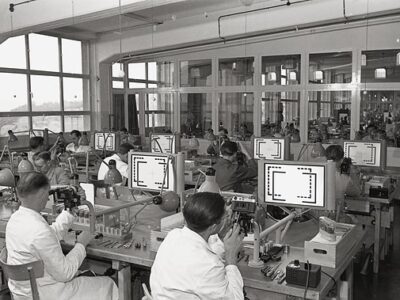
Checking and adjusting the image fields of the M3 illuminated frame rangefinder, approximately 1953. Image: Leica Photo Archive © Liesel Springmann |
This year marks a historic anniversary for Leica: 100 years have passed since the first mass-produced Leica camera was introduced. No matter your thoughts on the company today, there’s no denying its impact on photography as we know it. That legacy can be challenging for a company interested in navigating modern technology, though. To learn more about how it balances tradition and innovation, we spoke to Dr. Benjamin Dück, Global Director of Technology & Innovation; Peter Karbe, Senior Managing Expert Optics and Platform and Mark Shipard, the Head of Design.
 |
|
The Leica I 1925 Elmax camera. Photo: Leica |
First, a bit of history. In 1925, Leica presented the Leica I – the first mass-produced, readily available 35mm camera – at the Leipzig Spring Fair in Germany. That camera is often credited as being the birth of modern photography, popularizing the 35mm format and putting cameras in the hands of the general public. Because of its compact design, it helped popularize new genres such as reportage, street photography and candid image-making in everyday life.
Leica’s willingness to push boundaries remains a key part of its legacy. “One key lesson from Leica’s history is the value of long-term thinking and the willingness to take calculated risks,” said Dr. Dück. “The launch of the Leica I was not just a technical step, but a strategic decision that shaped modern photography.”
“The launch of the Leica I was not just a technical step, but a strategic decision that shaped modern photography.”
Since 1925, Leica has continued to develop and advance photographic technology. Throughout that time, tradition has remained constant. “At Leica, tradition and innovation go hand in hand,” Dr. Dück explained. “Our legacy of precision and craftsmanship forms the foundation for technological progress.”
 |
|
Leitz Werke production Leica I, between 1925 and 1932. Photo: Leica Photo Archive © Nikolaus Befort |
Of course, there’s a benefit to being around for 100 years: Leica has extensive historical data to look back on, aiding its technological progress. “Our archive of construction and optical design documents can look back on 100 years and is one of our greatest treasures at Leica,” explained Karbe. “Today, we still feel obliged to do justice to the traditional standards stored in the archive and to continually enrich them with new requirements. The evolutionary development at Leica always builds on what has already been created.”
While it has an eye towards advancement and calculated risks, the company makes it clear that it isn’t interested in progress solely for the sake of progress. “Our design goals are oriented towards customer benefit,” said Karbe. “What will our customer expect from the product (lens)? What performance parameters must we achieve. The design goals are derived from this.”
 |
|
Left: Max Berek; Right: Oskar Barnack, Wetzlar, 1935 Photos: Leica |
Karbe provided a historical example, too. “Oskar Barnack (inventor of the Leica) and Max Berek (optical designer of the first lens for the Leica) defined a sharp photo in postcard format as their goal,” he explained. With that in mind, they derived the design objectives for Leica’s first lens. Karbe says that their approach today is similar. “We ask ourselves what tasks the new lens to be developed should fulfill, what performance we want to offer the customer,” he said. “Based on these assumptions, we define the design goals.”
Shipard expanded on this idea, explaining that Leica’s heritage is based on clarity, precision and restraint. While technology has changed drastically from the first Leica camera and lens, Leica says those three tenets remain constant. “Every new product reinterprets these principles using today’s materials, technologies, and needs,” he said.
“Innovation should serve the needs of creators – not just follow technological trends,”
Leica’s design philosophy informs not only its own lens design process but also its broader perspective on the future of photography and camera-making. “For future camera makers and photographers, it’s important to focus on quality, usability, and a clear understanding of the craft. Innovation should serve the needs of creators – not just follow technological trends,” said Dr. Dück.
 |
|
The Leica ZM 12 watch. Photo: Leica |
In recent years, Leica has moved beyond cameras. The company’s name is associated with watches, eyeglass lenses, apps, smartphones and more. While it could seem like a departure from the brand’s legacy, Leica doesn’t see it that way. “All business areas are based on core competences that stem from Leica’s history,” said Dr. Dück. He added that the company wants to deliver the Leica experience on both professional cameras and smartphones, highlighting Leica’s recognition of the importance of smartphone photography moving forward.
Progress in the digital age and time of artificial intelligence is also a focus for Leica. “We honor our heritage while embracing the future – from pioneering digital watermarking called content credentials in the M11-P to exploring AI-assisted imaging,” explained Dr. Dück. He went on to say that Leica believes that AI can never replace the authenticity of a photograph, but “AI can help photographers to achieve an authentic image more quickly.” It will certainly be interesting to see how Leica approaches this and what it could mean for content credentials moving forward.
“Progress comes not from adding more, but from refining what matters.”
Ultimately, the Leica story is not about clinging to tradition or chasing progress, but about how the two can work together. As Shipard puts it, “Leica’s heritage is our great asset moving forward. We don’t preserve history, we extend it. Progress comes not from adding more, but from refining what matters.”

Our DPREVIEW Tribute:
After nearly 25 years of operation, DPReview closed on 10 April 2023. This difficult decision was part of the annual operating plan review that parent company, Amazon, shared earlier this year.
Over the course of 25 years, DP Review built up a reputation as being one of the most informative places to go for information about that new camera or lens you’re after. DP Review began as an independent reviews site based in the UK in 1998, the brainchild of Philip and Joanna Askey, but it was eventually purchased by Amazon in 2007 and relocated over to Seattle in the USA in 2010.
Cheers DPReview – thanks for the great work and content that guided photographers, videographers and techno junkies the world over!