
Earth’s got a new ‘moon’ – here’s what to expect:
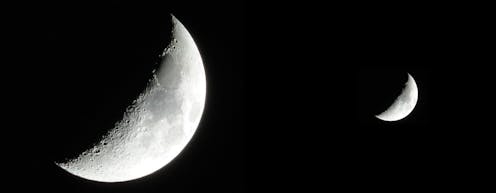
The Minor Planet Centre has just announced that the Earth has been orbited by a second moon for the past three years or so. But while excitement about the discovery is growing, it is important to keep in mind that this moon isn’t as impressive as our main satellite. It is extremely faint – it is estimated to be only between one and six metres across – and won’t be with us for much longer.
The body was first spotted by US astronomers Theodore Pruyne and Kacper Wierzchos using a 1.52-metre (60 inch) telescope at Mount Lemmon Observatory near Tuscon, Arizona on February 15.
Subsequent observations enabled its orbit to be calculated, and at 22:53 Universal Time (UT) on February 25, the Minor Planet Center announced the discovery, designating it as 2020 CD? and confirming that it is temporarily bound to the Earth.
The object 2020 CD? is essentially just a tiny member of a class of asteroids whose orbits cross the Earth’s orbit. Occasionally, they come near or collide with the Earth, but in this case a collision would not have been a catastrophe for us because 2020 CD? is so small that it would have broken up in the atmosphere before reaching the ground.
Instead of colliding with our planet, however, the initial approach of 2020 CD? towards the Earth meant that it was captured into orbit at a somewhat greater distance than our much larger, permanent moon.
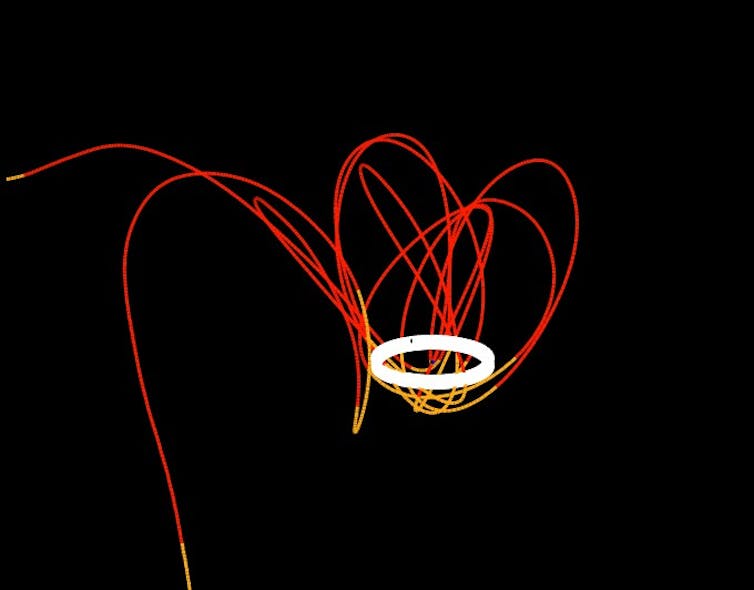
So-called “mini-moons” like this one come and go, and 2020 CD? is probably already on its final loop before breaking free. One study has suggested that at any one time, the Earth is likely to be accompanied by at least one temporary mini-moon greater than one metre in size that makes at least one loop around the Earth before escaping.
None of these stays long, because gravitational tugs from our much larger permanent moon and the Sun make their orbits unstable. After being captured, they typically orbit the Earth for no more than a few years before breaking free to reclaim an independent orbit about the Sun.
Hard to predict
Once a mini-moon has been discovered, its orbit is impossible to predict exactly because bodies this small are pushed perceptibly by the Sun’s radiation, and we know too little about their sizes, shapes and reflectivity to calculate the resulting effect. A previous visitor designated 2006 RH??? made four orbital loops around the Earth between September 2006 and June 2007 before proceeding on its way. By now it will have travelled to the far side of the Sun, but will pass close to Earth again in 2028.
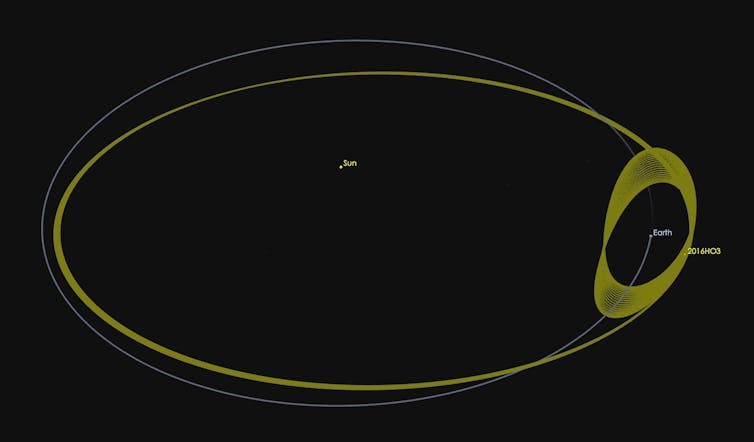
Other claimed “moons” of the Earth are asteroids whose orbital period about the Sun averages out at exactly one year. So while they appear to have a relationship with Earth, they are actually just orbiting the Sun in company with, but independently of, the Earth.
These are known as “quasi-satellites” of the Earth. One of those, 1991 VG seems to have made at least one genuine orbit of the Earth in 1992, and could well do so again in the future.
So while 2020 CD? is an interesting new discovery, don’t expect a catastrophic collision or extra moonlight for that evening stroll. Nevertheless, for a while at least, our main moon has a very tiny cousin.

David Rothery is Professor of Planetary Geosciences at the Open University. He is writing this in his own time, because currently he is on strike with fellow members of the University and College Union in a dispute mainly about pension funding and casualization. He is co-leader of the European Space Agency's Mercury Surface and Composition Working Group, and a Co-Investigator on MIXS (Mercury Imaging X-ray Spectrometer) that is now on its way to Mercury on board the European Space Agency's Mercury orbiter BepiColombo. He has received funding from the UK Space Agency and the Science & Technology Facilities Council for work related to Mercury BepiColombo, and is currently funded by the European Commission under its Horizon 2020 programme for work on planetary geological mapping (776276 Planmap). He is author of Planet Mercury – from Pale Pink Dot to Dynamic World (Springer, 2015), Moons: A Very Short Introduction (Oxford University Press, 2015) and Planets: A Very Short Introduction (Oxford University Press, 2010). He is Educator on the Open University's free learning Badged Open Course (BOC) on Moons and its equivalent FutureLearn Moons MOOC, and chair of the Open University's level 2 course on Planetary Science and the Search for Life.
: The Conversation – Articles (UK)
Have you tried: Farking?