
Children learn in class, and outside. But, over time, they learn more at school:
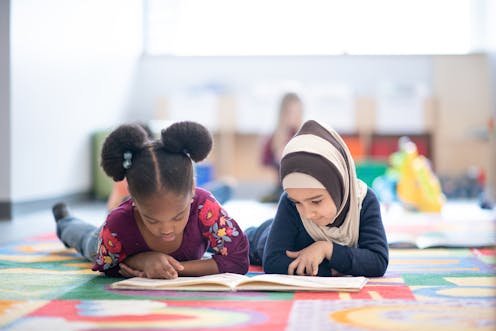
School is a key component of our societies. In school, children learn to read and write. And being able to read is meant to help people of all ages to think at a higher level and make their lives better.
It is not surprising that literacy is thus an important goal for global development agencies. The “multiplier effect” of literacy is believed to empower people, enabling them to participate in society and improve their livelihoods.
The truth is, learning basic skills such as solving arithmetic problems at school doesn’t necessarily make you good at solving such problems in everyday life. A classic study in Nigeria, for example, looked at what children learn from running errands. Another study in Côte d’Ivoire examined how well children from farming (Baoule) or merchant (Dioula) communities solved mathematical problems. And a Brazilian study investigated how young candy sellers on the streets solved arithmetical and ratio problems. If children can learn useful skills outside school, which are useful for having a job and making a living, what is the value of going to school and learning to read and write?
Some scholars say literacy goes further than the skills you learn through everyday experiences and contexts. It allows you to think across contexts – to build cognitive skills. But others say school itself is just a context, too, and it doesn’t take your thinking any further.
My study in India was able to cast some light on this apparent dichotomy. I found that the effect of school learning builds up over time – starting slowly with small skills related to technical features of reading and writing, but gradually having more and more other skills build on it.
The effect of everyday experiences on skills doesn’t build up in the same way – children may learn broad operations such as object permanence and the conservation of fluid early on, but once they mastered those, their learning levelled off gradually – the complete opposite pattern.
The research
In my study, I was able to conduct a kind of experiment to test how schooling affects cognitive performance. In northeast India, where I did the study, years of schooling and years of life experience aren’t as closely related, and could thus be studied separately, but at the same time.
In affluent countries this is not possible because once children have enrolled, an increase in years of schooling is always the same as the years you got older. In many developing countries, it is only children of richer families that go to school. In the specific rural region in India where I conducted the study, two children of the same age might have had different levels of schooling. And in one grade, there might be children of different ages. This situation made it possible to see what effect schooling had.
Thus, what I did was study the same children before and after three years of schooling, 181 of them. They were enrolled in school at any age between 6 and 9 years (on the first point of assessment) and came from similar socioeconomic environments. The skills I tested were in reasoning, vocabulary, shapes, memory, and arithmetic.
One finding that immediately stood out was that the children performed much better on tests done in a story-based format, even though the mathematical operations themselves were the same as tasks central to schooling (like, what is 3 + 4?).
The main finding was that the effects of schooling started slowly but accelerated, while effects of chronological age started fast but died down over time. These two distinct patterns show that learning in school and through everyday life must be very different. The effect of schooling became bigger with more years of education and only starts to make a real difference with more years in school.
Literacy matters
Literacy is essential for the cognitive development of children, but to really bring out its effect it is important to persist in teaching over time. At school, children learn small cognitive skills, each with a limited range, one at a time. They provide scaffolds on which children in school can gradually build with more and more ease, a larger repertoire of small skills that are relevant across a range of problems and tasks.
Key to successful schooling and proficient reading and writing skills is being able to build on early achievement. Teachers should offer enough tasks and challenges and make them gradually more difficult and complex. In this way, communities benefit from keeping children in school longer.
A minimal amount of schooling will not bring the effects development agents look for. Instead, persistence in learning to read and write is essential to achieve the desired impact: branching out across contexts and being able to take charge and create solutions.

Symen A. Brouwers does not work for, consult, own shares in or receive funding from any company or organisation that would benefit from this article, and has disclosed no relevant affiliations beyond their academic appointment.
: The Conversation – Articles (AFRICA)
Have you tried: Diving with Sharks?