
A nice South African City image:
18g – Matheson Residence – 2067 S Hobart Blvd – 1909 – Robert L Rohrig
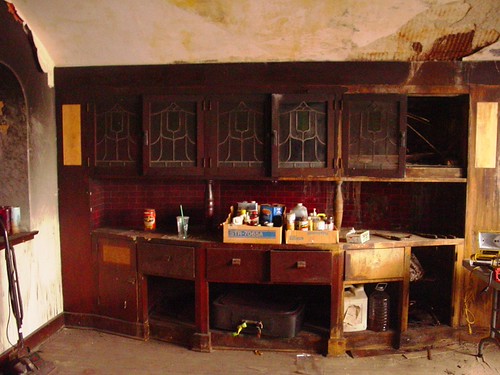
Image by Kansas Sebastian
18 – John L & Mary A Matheson Residence. 2067 S Hobart Blvd. 1909, Robert L Rohrig, Builder: Los Angeles Planing Mill Company.
The Matheson Mansion is currently (2013) threatened by redevelopment. When West Adams Heights was included in the Harvard Heights HPOZ, this house was listed as a “Noncontributing Structure,” because it was assumed the façade had been remodeled far beyond its original intent. In fact, aside from new windows and some minor elevation changes it looks much as it did when built, according to neighborhood preservationists trying to save the structure. The house suffered a devastating fire in the upper floors, when the elderly resident left a space heater unattended. Even worse, the house is still spot zoned R4 (the designation for an apartment building). Even though the original fixtures and furniture have been sold at auction, as the family prepared for the sale of the house, the character of this impressive mansion still shows through. Windows of stained art glass remain in the back of the house, which are probably Judson Studio glass, as well as remnants of the original and extensive gardens, most-likely designed by an expert landscaper like A E Hanson. The smoke and water-damaged interior reveals a rich and well thought-out design of a master architect. Hopefully, a buyer with a preservation mindset can be found for this house. John L Matheson was a merchant in early Los Angeles, dealing in men’s and women’s clothing and furnishings from a shop at 301-303 South Broadway.
West Adams Heights
“Nowadays we scarcely notice the high stone gates which mark the entrances on Hobart, Harvard, and Oxford streets, south of Washington Boulevard. For one thing, the traffic is too heavy, too swift; and then, again, the gates have been obscured by intrusions of shops and stores. At the base of the stone pillars appears the inscription “West Adams Heights.” There was a time when these entranceways were formidable and haughty, for they marked the ways to one of the first elite residential areas in Los Angeles. . . In the unplanned early-day chaos of Los Angeles, West Adams Heights was obviously something very special, an island in an ocean of bungalows—approachable, but withdrawn and reclusive—one of the few surviving examples of planned urban elegance of the turn of the century.”
– Carey McWilliams, “The Evolution of Sugar Hill,” Script, March, 1949: 30.
Today West Adams Heights is still obviously something special. The past sixty years, however, have not been kind. In 1963 the Santa Monica Freeway cut through the heart of West Adams Heights, dividing the neighborhood, obscuring its continuity. In the 1970’s the city paved over the red brick streets and removed the ornate street lighting. After the neighborhood’s zoning was changed to a higher density, overzealous developers claimed several mansions for apartment buildings. Despite these challenges, however, “The Heights,” as the area was once known, has managed to regain some of its former elegance.
The West Adams Heights tract was laid out in 1902, in what was then a wheat field on the western edge of town. Although the freeway now creates an artificial barrier, the original neighborhood boundaries were Adams Boulevard, La Salle Ave, Washington Boulevard, and Western Avenue. Costly improvements were integrated into the development, such as 75-food wide boulevards (which were some of the first contoured streets not to follow the city grid), lots elevated from the sidewalk, ornate street lighting, and large granite monuments with red-brass electroliers at the entrance to every street. These upgrades increased the lot values, which helped ensure the tract would be an enclave for the elite.
One early real estate ad characterized the neighborhood stating: “West Adams Heights needs no introduction to the public: it is already recognized as being far superior to any other tract. Its high and slightly location, its beautiful view of the city and mountains make t a property unequaled by any other in the city.”
The early residents’ were required to sign a detailed restrictive covenant. This hand-written document required property owners to build a “first-class residence,” of at least two stories, costing no less than two-thousand dollars (at a time when a respectable home could be built for a quarter of that amount, including the land), and built no less than thirty-five feet from the property’s primary boundary. Common in early twentieth century, another clause excluded residents from selling or leasing their properties to non-Caucasians.
By the mid 1930’s, however, most of the restrictions had expired. Between 1938 and 1945 many prominent African-Americans began to make “The Heights” their home. According to Carey McWilliams, West Adams Heights became known “Far and wide as the famous Sugar Hill section of Los Angeles,” and enjoyed a clear preeminence over Washington’s smart Le Droit Park, St. Louis’s Enright Street, West Philadelphia, Chicago’s Westchester, and Harlem’s fabulous Sugar Hill.
West Adams Heights, now also known as Sugar Hill, played a major role in the Civil Rights movement in Los Angeles. In 1938 Norman Houston, president of the Golden State Mutual Life Insurance Company, and an African-American, purchased a home at 2211 South Hobart Boulevard. Legal Action from eight homeowners quickly ensued. During that period, other prominent African-Americans began to make Sugar Hill their home – including actress Hattie McDaniels, dentists John and Vada Summerville, actress Louise Beavers, band leader Johnny Otis, and performers Pearl Baily and Ethel Waters, and many more. On December 6, 1945, the “Sugar Hill Cases” were heard before Judge Thurmond Clark, in LA Superior Court. He made history by become the first judge in America to use the 14th Amendment to disallow the enforcement of covenant race restrictions. The Los Angeles Sentinel quoted Judge Clark: “This court is of the opinion that it is time that [African-Americans] are accorded, without reservations and evasions, the full rights guaranteed them under the 14th Amendment.” Gradually, over the last century people of nearly ever background have made historic West Adams their home.
The northern end of West Adams Heights is now protected as part of the Harvard Heights Historic Preservation Overlay Zone (HPOZ). The Historic West Adams area of Los Angeles (which includes West Adams Heights) boasts the highest concentration of turn-of-the-century homes west of the Mississippi, as well as the highest concentration of National Historic Landmarks, National Register of Historic Places, National Historic Districts, State Historic Landmarks, Los Angeles Cultural-Historic Monuments, and Historic Preservation Overlay Zones in the city. The entirety of West Adams Heights should be nominated as a National Register Historic District, for the quality of homes, the prominence of the architects, notoriety of the people who lived in the neighborhood, and the role it played in civil rights.
Perhaps a quote adapted from a fireplace mantle in the Frederick Rindge mansion best symbolizes the optimism which exists in West Adams: “California Shall be Ours as Long as the Stars Remain.”
Image automatically curated and published by www.free-mail.co.za – CLICK HERE to learn more about WP Robot for WordPress.
Have you tried: Farking?