
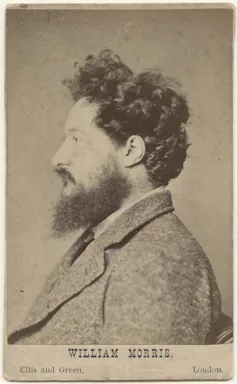
William Morris – how a great thinker and poet was overlooked for his wallpaper:

The obituaries and reminiscences that followed the death of William Morris on October 3 1896 refer to him as a great poet, thinker and tireless worker in the service of humanity, securing his reputation as “the most all-round gifted man of the 19th century”. It is perhaps ironic, then, that he is largely only remembered for designs popular on wallpaper, tea-towels and high-street clothing.
Morris’s doctor stated that the cause of death was “simply being William Morris and having done more work than most ten men”. He had a privileged upbringing near London. He was often found riding his pony while dressed in a miniature suit of armour, emulating the medieval tales of chivalry he read with enthusiasm. His childhood, followed by Marlborough School and Oxford, imbued in him a love of the English landscape, of historical objects and stories, which influenced his work throughout his life.
Though his designs, based on natural forms such as flowers and birds, established his business, Morris’s real work was in the mind.
Morris founded the Society for the Protection of Ancient Buildings and the Socialist League. But alongside these public activities, Morris was a poet and a very popular one. He even turned down the role of poet laureate when it was offered to him in 1891. For Morris, poetry was a natural result of his interests and of his desire to share his ideas with the world.
Morris the poet
The Earthly Paradise (1868-1870) was very successful when it was first published and was responsible for establishing his reputation as one of the foremost poets of the time. It has, however, has fallen out of favour more recently. This is perhaps because the length is off-putting to modern readers.
Written in 12 books – one for each month of the year – with a prologue and epilogue, it is an epic poem, inspired by earlier long poetic works including the Odyssey and the Canterbury Tales.
The Earthly Paradise follows a band of Norse warriors as they set out to escape the plague in search of a new land “where none grow old”. On their journey, they arrive at a “nameless city in a distant sea” inhabited by descendants of the ancient Greeks. By this time, however, the travellers are already old men. They decide to settle there peacefully, telling stories alongside the elders of the city on monthly feast days. The stories are taken from Greek and Norse myths, with one of each for each book.
Morris’s process of writing involved everyone around him including family, friends and colleagues, sharing his plans and drafts until, as his friend and artist Georgiana Burne-Jones put it, she found herself “biting [her] fingers and stabbing [herself] with pins in order to keep awake”.
Despite Burne-Jones’ complaint about his process, his writing is gripping. Morris’s poetry is beautiful in its expressiveness and imagery, and not difficult despite his occasional use of archaic words. He believed in accessible poetry and writes clearly and simply.
He draws on images and ideas gleaned from his own life, from memories of his rural childhood to his views of the Thames near his home at Kelmscott Manor in the Cotswolds. Biographers have also suggested that the myths incorporated into the poem may also have had personal resonances. As the writer Fiona MacCarthy points out, “The tales, read closely, are all stories of love’s failure,” echoing his difficult relationship with his wife, Jane.
Escape and understanding
Morris’s preoccupations in the poem often seem very prescient read in today’s culture when read today. The narrator describes himself as “the idle singer of an empty day”, as if the poem exists only to pass the time, and explains almost humbly:
Of Heaven or Hell I have no power to sing,
I cannot ease the burden of your fears,
Or make quick-coming death a little thing,
Or bring again the pleasure of past years
Yet in many ways the poem does exactly these things, transporting the reader from “six counties overhung with smoke” in the polluted environment of the 19th century, to a beautiful, clean, ancient city. Morris knew, more than most, perhaps, the value and power of reading to remove us from the troubled world we live in and to change our views and even spur us into action.
This is evident in his medieval novel News from Nowhere (1890), which combines utopian socialism and soft science fiction. But in The Earthly Paradise, Morris uses a less instructive approach, aligning the old and young, poor and rich, and calling us to understand the world around us.
The political messages of The Earthly Paradise have often been overlooked, possibly because the beauty of the poetry disguises the dark sexuality of the myths, the concern about how the environment is treated, and Morris’s resonant call for equality and understanding.
The tales are often grim, but sexual equality, the forging of personal hope and the possibility of a better world, and the learning received from “earth’s bitter lore” offer the ultimate sense that love of humanity and the earth itself can, at least, reconcile us to the realities of life.

Serena Trowbridge does not work for, consult, own shares in or receive funding from any company or organisation that would benefit from this article, and has disclosed no relevant affiliations beyond their academic appointment.
: The Conversation – Articles (UK)
Have you tried: Travelling to South Africa?