
Why you should never take nutrition advice from a centenarian:
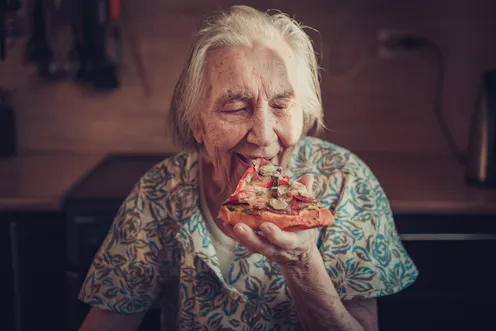
It’s a cliche of reporting on people who reach 100 years of age, or even 110, to ask them some variation of the question: “What did you do to live this long?”
Inevitably, some interesting and unexpected answer is highlighted. Fish and chips every Friday. Drinking a glass of strong liquor every day. Bacon for breakfast every morning. Wine and chocolate.
While a popular news story, this is a relatively meaningless question that doesn’t help us understand why certain people have lived so long. Let me try to explain why, via beautiful buildings, fighter pilots and statistics.
In the second world war, Allied statisticians were applying their skills to minimising the number of bombers being shot down by enemy fire. By studying the damage patterns of bombers returning from action, maps could be drawn up of the most frequently damaged parts of aeroplanes so that expensive, heavy armour could be added to these areas.
Simple enough, right? Then, along comes statistician Abraham Wald who argues for the exact opposite point. The planes that they’re studying are all those that did return from combat with extensive damage, but what about those that didn’t return?
Wald argues that armour should be added to those places that are undamaged on all the returning planes, as any plane hit in these undamaged areas was shot down, never making it back to be surveyed.
Survivorship bias
This phenomenon is known as survivorship bias, or the cognitive and statistical bias introduced by only counting those that are around to count but ignoring those that haven’t “survived”.
You can take these examples to the absurd. Imagine a group of 100 people, all of whom have smoked their entire life. As a group, the smokers would die earlier of cancers, lung disease or heart disease, but one or two might defy the odds and live to 100 years of age. Now imagine the intrepid journalist interviewing the lucky soul on their 100th birthday with that classic question: “What do you attribute your successful ageing to?”
“Smoking a pack a day,” says the newly minted centenarian.
It seems obvious but survivorship bias is everywhere in society. We can all think of that one famous actor or entrepreneur who succeeded despite adversity, who worked hard, believed in themselves and one day made it. But we never read about or hear about the countless examples of people who tried, gave it their all and never quite made it.
That’s not a good media story. But this creates a bias, we primarily hear the successes, never the failures. This bias applies to our perceptions of architecture (mostly great buildings from a given period “survive”), to finances (we often hear examples of people who have succeeded in risky investments, those who fail don’t sell books or self-help plans) and to career plans (“If you work hard, and drop out of college now, you can be a successful athlete like me,” say those who have succeeded).
I work with a variety of older people and often include extreme outliers who have lived to extreme ages. We’re currently studying over 65-year-olds who have maintained unusually high levels of exercise into older age and have maintained excellent health.
They’re phenomenal examples of older humans, many of them are faster, fitter and stronger than me by many of the measures we perform in the lab, despite being almost twice my age.
While we know that their lifelong exercise is associated with their unusually good health into older age, we can’t directly say one causes the other yet. It could be that highly active people are protected against chronic diseases such as cancers, diabetes and heart disease. But it also could be that these people are still active into older age as they’ve not been afflicted by cancers, diabetes or heart disease earlier in their lives.
Conversely, there could be some unknown third factor that we’ve not yet identified about these people that both keeps them healthy and separately keeps them exercising.
For clarity, there are things that scientists like me will say in carefully caveated, scientific language that will probably help you to live longer. Being very physically active, not eating too much and not smoking are all on that list, along with generally having a positive outlook in life, and of course, picking the right parents and grandparents.
Correlation does not equal causation. That point is hammered home relentlessly to students in science degrees. It’s how our brain works, we see a pattern between two variables, and assume they’re linked in some way. But often, like in survivorship bias, we’re not looking at all the data, and so finding patterns where there are none.

Bradley Elliott receives funding from the Physiological Society, the British Society for Research on Ageing, the Altitude Centre, and private philanthropic individuals. He is on the board of truestees of the British Society for Reserach on Ageing.
: The Conversation – Articles (UK)
Have you tried: Diving with Sharks?
 25 years of DPReview: Our editors’ first cameras