
Why same-sex marriage is not the ultimate tool for queer liberation:
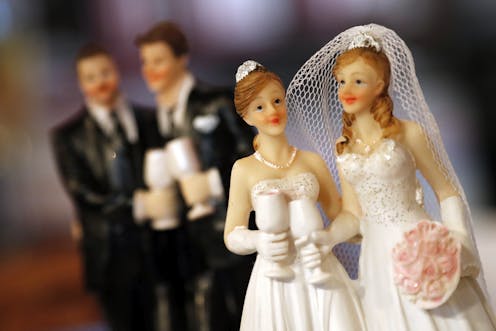
Is same-sex marriage a valid option for gay and lesbian people? In my research I am among those who have vociferously argued about the pitfalls of same-sex marriage. I, and others like me, voice our apprehensions in the original radical spirit of “queer”. We look at something that seems so right and interrogate it in a strange or odd way.
These voices are muted and their opinions struggle to emerge in popular discourses about same-sex marriage because they are incorrectly thrown into the homophobic pot.
It is vital to make room for “queer” ideas about same-sex marriage. “Queer” refers to anyone who is at odds with the norm and who resists the mostly white middle class stereotype of “the family”.
Among the papers I’ve written on this issue, one is triggered by the fact that the legalisation of same-sex marriage in South Africa in 2006 was greeted as a euphoric victory for numerous gay and lesbian people and this victory was documented in the 2008 book To Have and to Hold: The Making of Same-Sex Marriage in South Africa.
The editors of the volume argue that the various stakeholders who supported same-sex marriage “adequately interrogated the role and function of marriage”. I put this claim to the test and conclude that, rather than opening a space for the “recognition of diverse sexualities and relationship forms”, the Civil Union Act is limited to those people who self-identify as gay or lesbian.
In a forthcoming paper, I argue that the literature on same-sex marriage in South Africa before and after the passing of the Civil Union Act 2006, while acknowledging queer critique, resolves such critique in favour of the “right” to marry. I also argue for the necessity for a queer anti-homophobic critique of same-sex marriage to broaden debates about recognition.
There is much to be learned from the many versions of “nonstandard” families in South Africa, where I live and conduct my research. These versions are not based in the myth of marriage and all that entails: the monogamy, the children, the picket fence and the respectability. A person needs only to look around exactly where they are and they will see how diversely people choose to live their lives.
And yet the idea that same-sex marriage is somehow a form of liberation is carried through in the vast majority of popular writing, including that by academics. But there is actually a large amount of anti-homophobic academic and everyday writing from thinkers and activists that probes the numerous problems associated with same-sex marriage.
Perhaps the problem is that by questioning same-sex marriage you it could mean that you’re automatically a homophobe. However, the under-represented voices I’m referring to here are certainly not homophobic. Many are queer.
Queer ideas
One of the problems with same-sex marriage is that it is, by definition, very limited. It only refers to self-identified gay and lesbian people and this runs against the contemporary grain of society at large which is slowly coming to terms with the fact that identity could be flexible.
The other problem is that the many rewards of marriage are only available to married gay and lesbian married people. Why can’t all these delicious rewards be available to all people regardless of their marital status.
And finally, the fierce pro-same-sex marriage debates that are happening all over the world are so loud that they have drowned out centuries of critical feminist perspectives and activism on marriage.
Marriage is the place where the state regulates the family, gender, race and patriarchy. How on earth did these truths get sidelined for a stamp of approval? Radical feminist Paula Ettelbrick asked more than 20 years ago:
Since when is marriage a path to liberation?
But for many, same-sex marriage is a path to liberation; it is claimed by pro same -sex marriage activists that this act has the potential to transform the institutions of both marriage and gender.
The reality, as social theorist Michael Warner has argued, is that married gay and lesbian people are just as likely to
divorce, cheat, and abuse each other as anyone else.
And, rather than being a path to liberation, same-sex marriage provides the perfect tool for the state to control and monitor who is and who is not respectable.
“Marriage” beyond the state
So what would a queer re-imagining of marriage look like? Nothing. That’s because the most powerful way to oppose marriage is simply to not get married.
Philosopher and gender theorist Judith Butler noted that the task at hand should be to “rework and revise the social organisation of friendship, sexual contacts, and community to produce non-state-centered forms of support and alliance”.

TL McCormick does not work for, consult, own shares in or receive funding from any company or organisation that would benefit from this article, and has disclosed no relevant affiliations beyond their academic appointment.
: The Conversation – Articles (AFRICA)
Have you tried: Farking?