
When two elephants fight: how the global south uses non-alignment to avoid great power rivalries:
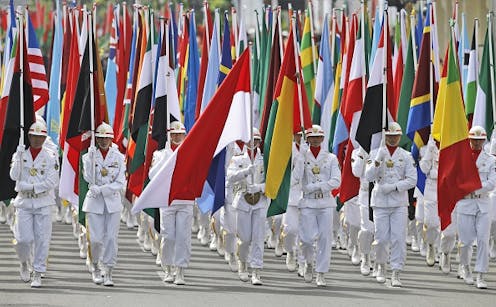
An African proverb notes that “when two elephants fight, it is the grass underneath that suffers”.
Many states in the global south are, therefore, seeking to avoid getting caught in the middle of any future battles between the US and China. Instead, they are calling for a renewal of the concept of non-alignment. This was an approach employed in the 1950s by newly independent countries to balance between the two ideological power blocs of east and west during the era of the Cold War
The new non-alignment stance is based on a perceived need to maintain southern sovereignty, pursue socio-economic development, and benefit from powerful external partners without having to choose sides. It also comes from historical grievances during the era of slavery, colonialism and Cold War interventionism.
À lire aussi : Washington wants to address anti-west sentiment in Africa: Blinken is doing his bit
These grievances include unilateral American military interventions in Grenada (1983), Panama (1989) and Iraq (2003) as well as support by the US and France for autocracies in countries like Egypt, Morocco, Chad and Saudi Arabia, when it suits their interests.
Many southern governments are particularly irked by America’s Manichaean division of the world into “good” democracies and “bad” autocracies. More recently, countries in the global south have highlighted north-south trade disputes and western hoarding of COVID-19 vaccines as reinforcing the unequal international system of “global apartheid”.
A return of non-alignment was evident at the March 2022 UN General Assembly special session on Ukraine. Fifty-two governments from the global south did not support western sanctions against Russia. This, despite Russia’s clear violation of Ukraine’s sovereignty, which southern states have historically condemned.
À lire aussi : Five essential reads on Russia-Africa relations
A month later, 82 southern states refused to back western efforts to suspend Russia from the UN Human Rights Council.
These included powerful southern states such as India, Indonesia, South Africa, Ethiopia, Brazil, Argentina and Mexico.
The origins of non-alignment
In 1955, a conference was held in the Indonesian city of Bandung to regain the sovereignty of Africa and Asia from western imperial rule. The summit also sought to foster global peace, promote economic and cultural cooperation, and end racial domination. Governments attending were urged to abstain from collective defence arrangements with great powers.
Six years later, in 1961, the 120-strong Non-Aligned Movement emerged. Members were required to shun military alliances such as NATO and the Warsaw Pact, as well as bilateral security treaties with great powers.
Non-alignment advocated “positive” – not passive – neutrality. States were encouraged to contribute actively to strengthening and reforming institutions such as the UN and the World Bank.
À lire aussi : Rethinking how we look at Africa’s relationship with China
India’s patrician prime minister, Jawaharlal Nehru, is widely regarded to have been the intellectual “father of non-alignment”. He regarded the concept as an insurance policy against world domination by either superpower bloc or China. He also advocated nuclear disarmament.
Indonesia’s military strongman, Suharto, championed non-alignment through “regional resilience”. South-east Asian states were urged to seek autonomy and prevent external powers from intervening in the region.
Egypt’s charismatic prophet of Arab unity, Gamal Abdel Nasser, strongly backed the use of force in conducting wars of liberation in Algeria and southern Africa, buying arms and receiving aid from both east and west. For his part, Ghana’s prophet of African unity, Kwame Nkrumah, promoted the idea of an African High Command as a common army to ward off external intervention and support Africa’s liberation.
The Non-Aligned Movement, however, suffered from the problems of trying to maintain cohesion among a large, diverse group. Many countries were clearly aligned to one or other power bloc.
By the early 1980s, the group had switched its focus from east-west geo-politics to north–south geo-economics. The Non-Aligned Movement started advocating a “new international economic order”. This envisaged technology and resources being transferred from the rich north to the global south in order to promote industrialisation.
The north, however, simply refused to support these efforts.
Latin America and south-east Asia
Most of the recent thinking and debates on non-alignment have occurred in Latin America and south-east Asia.
Most Latin American countries have refused to align with any major power. They have also ignored Washington’s warnings to avoid doing business with China. Many have embraced Chinese infrastructure, 5G technology and digital connectivity.
Bolivia, Cuba, El Salvador, Nicaragua, and Venezuela refused to condemn Russia’s invasion of Ukraine. Many of the region’s states declined western requests to impose sanctions on Moscow. The return of Luiz Inácio Lula da Silva as president of Brazil – the largest and wealthiest country in the region – heralds the “second coming” (following his first presidency between 2003 and 2011) of a champion of global south solidarity.
For its part, the Association of Southeast Asian Nations (ASEAN) has shown that non-alignment has as much to do with geography as strategy. Singapore sanctioned Russia over the invasion of Ukraine. Indonesia condemned the intervention but rejected sanctions. Myanmar backed the invasion while Laos and Vietnam refused to condemn Moscow’s aggression.
Many ASEAN states have historically championed “declaratory non-alignment”. They have used the concept largely rhetorically while, in reality, practising a promiscuous “multi-alignment”. Singapore and the Philippines forged close military ties with the US; Myanmar with India; Vietnam with Russia, India, and the US; and Malaysia with Britain, Australia, and New Zealand.
This is also a region in which states simultaneously embrace and fear Chinese economic assistance and military cooperation. This, while seeking to avoid any external powers dominating the region or forming exclusionary military alliances.
Strong African voices are largely absent from these non-alignment debates, and are urgently needed.
Pursuing non-alignment in Africa
Africa is the world’s most insecure continent, hosting 84% of UN peacekeepers. This points to a need for a cohesive southern bloc that can produce a self-sustaining security system – Pax Africana – while promoting socio-economic development.
À lire aussi : Peace and security in Africa: how China can help address weaknesses
Uganda aims to champion this approach when it takes over the three-year rotating chair of the Non-Aligned Movement in December 2023. Strengthening the organisation into a more cohesive bloc, while fostering unity within the global south, is a major goal of its tenure.
Uganda has strong potential allies. For example, South Africa has championed “strategic non-alignment” in the Ukraine conflict, advocating a UN-negotiated solution, while refusing to sanction its BRICS ally, Russia. It has also relentlessly courted its largest bilateral trading partner, China, whose Belt and Road Initiative and BRICS bank are building infrastructure across the global south.
À lire aussi : South Africa and Russia: President Cyril Ramaphosa’s foreign policy explained
Beijing is Africa’s largest trading partner at US$ 254 billion, and builds a third of the continent’s infrastructure.
If a new non-alignment is to be achieved in Africa, the foreign military bases of the US, France and China – and the Russian military presence – must, however, be dismantled.
At the same time the continent should continue to support the UN-led rules-based international order, condemning unilateral interventions in both Ukraine and Iraq. Pax Africana would best be served by:
-
building local security capacity in close cooperation with the UN;
-
promoting effective regional integration; and
-
fencing off the continent from meddling external powers, while continuing to welcome trade and investment from both east and west.

Adekeye Adebajo ne travaille pas, ne conseille pas, ne possède pas de parts, ne reçoit pas de fonds d'une organisation qui pourrait tirer profit de cet article, et n'a déclaré aucune autre affiliation que son organisme de recherche.
: The Conversation – Articles (AFRICA)
Have you tried: Sailing in Africa ?