
 |
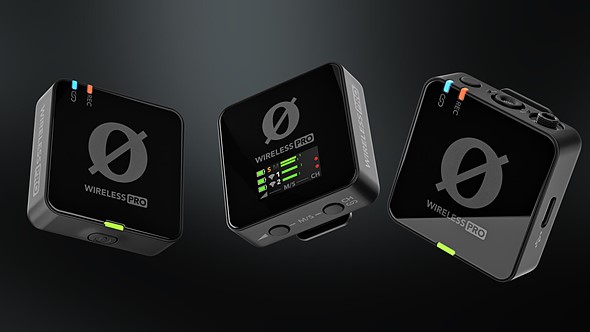
| The new Røde Wireless PRO wireless microphone kit offers a vast array of pro-level audio features, including 32-bit float audio recording. |
Røde, the Australian audio equipment company, recently announced its Wireless PRO wireless microphone system. Røde is calling it the ‘most powerful compact microphone system ever.’ Despite its diminutive size, it offers a versatile range of professional features to address the needs of demanding filmmakers and video creators, including timecode sync, intelligent GainAssist technology and over 40 hours of onboard recording time.
One of the standout new features of the Wireless PRO system is its built-in 32-bit float audio recording capabilities, a technology we’ve previously argued should come to hybrid cameras and something that Røde’s consumer-grade wireless mics lack.
Touted as a feature that lets you avoid clipping from loud audio and recover audio that’s too quiet without noise, 32-bit float audio seems too good to be true. It essentially frees you from having to set recording levels on your camera or audio recorder.
But is that true? What is 32-bit float audio, how does it work, and why is it suddenly a big deal for video creators?
What is 32-bit float audio?
The Røde Wireless PRO mic is not the first, nor the only, audio recording system to utilize 32-bit float audio. However, given the company’s popularity and solid reputation in the video world – especially among vloggers, YouTubers and other independent video creators – 32-bit float audio will only grow in popularity.
[embedded content]
Before diving into the details, a simple analogy as to what 32-bit float audio is will give you the gist of what this technology allows. To put it in photo terms it’s a little bit like moving from JPEG to Raw capture, with all the extra flexibility it brings, but this is a very loose analogy. In digital photography, sensors clip completely when they receive too much light, and all of the data output is typically encoded into the Raw file. In audio recording, microphones can continue to respond even to incredibly loud sounds: it’s the process of squeezing it into the digital file that imposes the most significant limitation.
32-bit float provides a vast increase in the available space to record louder sound. In simple terms, fixed point audio records its data values as simple numbers, whereas floating point math records its data as scientific notation.
 |
|
An example of clipping of a digital waveform. The red lines indicate full scale, and the waveform is shown before and after hard clipping (grey and black outlines, respectively). 32-bit float allows you to capture way beyond the traditional ‘full scale’ limits. Credit: Gutten på Hemsen, CC BY-SA 4.0, via Wikimedia Commons |
So, whereas in 16-bit, the audio standard for CDs, you have 65,535 values per sample. With 24-bit audio, the overall idea is similar, but more values per sample are available, at over 16 million. You have much more space for audio information with the 24-bit format.
When audio is recorded in 16-bit or 24-bit, the recording can clip if something gets too loud. The audio will sound distorted, just like the white point in your photos clipping. The sound values are just too much for the audio format to store all that information. In other words, the dynamic range of the audio container is too narrow. A 16-bit fixed point audio file has a calculated maximum dynamic range of 96.3 dB (-96.3 db up to 0 dB), and a 24-bit fixed point has a maximum dynamic range of 144.5 dB (-144.5 dB up to 0 dB). However, whereas using 32-bit fixed point would boost this to 192 dB, using scientific notation allows you to encode vastly large values, and the potential dynamic range expands to a whopping 1,528 dB.
 |
Why is it a big deal for video creators?
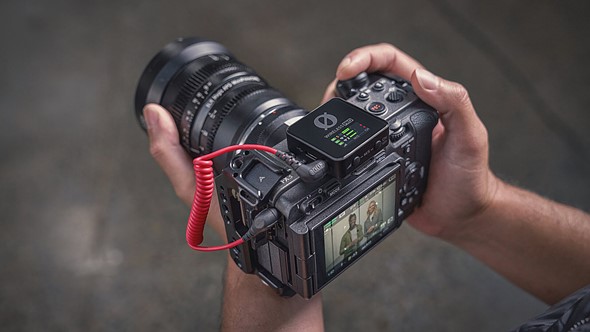
This extreme latitude afforded by 32-bit float audio leads to the notion that video creators never have to worry about audio levels again. To a certain degree, that’s true, but it’s not quite that simple. With 32-bit float audio recorders, like the Røde Wireless PRO mic kit, Sound Devices MixPre-10 II recorder or TASCAM’s Portacapture X8 recorder, for example, it’s true that you don’t necessarily need to adjust audio levels on the recorder in 32-bit float mode prior or during recording.
Notably the Røde mics promise a GainAssist function to try to keep the audio you’re trying to record distinct from any background noise. The extreme dynamic range offered by this audio recording format lets you freely capture audio at essentially any audio volume level.
[embedded content]
24-bit audio is the industry standard for post-production workflows and final deliverables. You will need to re-map 32-bit float audio back into a 24-bit fixed point space at some stage of post-production.
If you’ve recorded audio tracks with moments of super-loud sounds and simply convert that straight to 24-bit, you’ll probably end up with clipped, distorted audio. You’ll need to fine-tune the levels after capture to ensure they’ve been adjusted to within the limits of the 24-bit audio format, just as you would ultimately have to choose which highlights and black tones to retain in a Raw photograph to preserve the details ahead of printing, even if you’d captured an absolutely vast dynamic range when you took the photo.
Is this the ultimate in audio for professionals? Well, seeing how Hollywood productions have dedicated audio engineers on-set, probably no. That said, it can be a big help for smaller production teams, independent filmmakers, live event filming scenarios or single-person video creators where it is difficult to monitor audio levels all the time. Having the flexibility of 32-bit float audio to recover sounds that are too loud or too quiet in post-production can be a lifesaver.

Our DPREVIEW Tribute:
After nearly 25 years of operation, DPReview closed on 10 April 2023. This difficult decision was part of the annual operating plan review that parent company, Amazon, shared earlier this year.
Over the course of 25 years, DP Review built up a reputation as being one of the most informative places to go for information about that new camera or lens you’re after. DP Review began as an independent reviews site based in the UK in 1998, the brainchild of Philip and Joanna Askey, but it was eventually purchased by Amazon in 2007 and relocated over to Seattle in the USA in 2010.
Cheers DPReview – thanks for the great work and content that guided photographers, videographers and techno junkies the world over!