
What changed when Ugandan farmers rated input quality and local vendor services:
Each agricultural season, small-scale maize farmers in southeastern Uganda face the same dilemma. Should they shell out a few extra shillings and buy commercial maize seed from the nearby agro-input shop, or should they just plant seed saved from the previous harvest?
The advantages of the first strategy are obvious. The small investment in commercial seed can substantially increase future income from maize. About 28,000 UGX (roughly US$ 8) buys enough seed to plant half an acre, and can yield an additional 1.25 to 2.5 bags of maize – an extra income of between 88,000 and 176,000 UGX ($ 25-50).
The money may look good, but the risks related to this strategy are just as real. Farmers do not necessarily know if the seed that they buy from the shop is any good. So perhaps it is better to be safe than sorry and use own-saved seed instead of investing in a production input for which the quality can only be determined when it is too late.
The experience of these small-scale farmers may sound familiar. Many of us have been in a similar situation when buying a product or service – the reality doesn’t match the promise. Sometimes this is because the seller is exploiting the fact that you don’t know as much as they do.
These sites, providing information on a vendor’s product or service quality, also give sellers an incentive to improve the quality of their offering.
Building on this idea, we piloted an information clearinghouse for maize farmers and agro-input dealers in Busoga, Uganda, a region that is known for maize production. Initial results are encouraging: we see that over time, agro-input dealers’ ratings improve, suggesting they respond to poor ratings by increasing the quality of services they render and goods they sell. We also find that the rating system leads to increased sales of maize seed by agro-input dealers and increased use of improved maize seed varieties by farmers.
Information clearinghouse for agro-input shops
Before the second planting season of 2021, we asked randomly selected farmers to rate the agricultural input dealers in their vicinity, on a scale of one to five. We asked them to rate general attributes (location, price competitiveness, quality of products, stock, reputation), as well as attributes related to the quality of seed sold by these dealers (yield, stress tolerance, germination reliability, crop duration and maturation period).
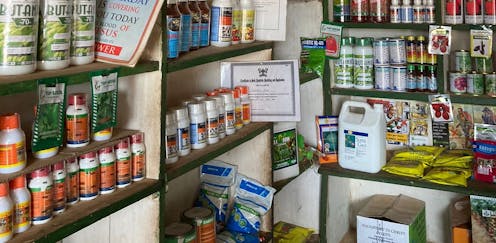
This information was used to calculate an overall rating for each dealer, which was distributed to the farmers before they started buying seed for the season. The scores were also distributed to the input dealers in the form of certificates that displayed their overall rating, which they were encouraged to display in their shops.
Six months later, after farmers had harvested their maize, we repeated the entire exercise. We visited all the participating farmers again to obtain updated ratings and these updated ratings were distributed again to farmers and input dealers ahead of the first season of 2022.
Findings from our ongoing study – still a work in progress – show that ratings improved between the two periods. At the time of the initial ratings, about 11% of all ratings given by farmers to agro-input dealers were below 3. During the second round of ratings, only 5.4% of ratings were below 3. At the upper end of the rating scale, the share of 5-star ratings given by farmers increased by 5 percentage points, from about 25% to 30%.
Ratings seemed to have improved even more when farmers were asked specifically about maize seed quality sold by the agro-input dealer. Most of the improvement seemed to have happened among dealers that scored particularly low during the first round of ratings. While about 12% of farmers gave an initial rating below 3 for seed quality, this reduced to less than 5% by the second round of ratings.
Our preliminary findings seem to suggest that agro-input dealers respond to the ratings by making sure they deliver quality products to customers.
Better seed for farmers
While these improvements of the ratings over time is encouraging, the eventual aim of the project is to increase sales of improved seed varieties by agro-input dealers, and to increase use of quality seed by farmers.
Initial results on these indicators are also encouraging. Agro-input shops in areas where the clearinghouse was implemented reported that they sold on average 1,330kg of improved seed (hybrid or Open Pollinating Varieties) in the second agricultural season of 2021. Shops in areas where the intervention was not implemented reported sales amounting to only about 860kg during that period.
In addition, we found that 62% of farmers in areas where the clearinghouse was implemented used improved seed varieties purchased from agro-input dealers (as opposed to farmers’ home-saved seed) in the second season of 2021. In areas where the clearinghouse was not implemented, only 58% of farmers purchased improved seed.
While an increase of 4 percentage points in improved seed use may not seem like a large effect, when one considers how slowly input purchasing decisions change among small-scale farmers, we consider this a big shift in a short time.
More importantly, we hope that in the longer run, a virtuous cycle will lead to an increase in farm productivity and income, as input dealers further increase the quality of their products and services in response to the ratings, and more farmers realise that investing in improved seed varieties is a reasonably safe, high return strategy.

The project receives funding from The Netherlands – CGIAR research programme on Seed Systems Development, grant number W08.240.105, funded by the Netherlands Organisation for Scientific Research (NWO-WOTRO).
: The Conversation – Articles (AFRICA)
Have you tried: Visiting Port Elizabeth?