
What bush crickets are telling researchers via their unique calls:
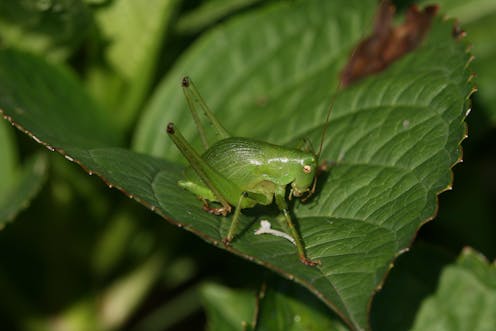
Bush crickets – or katydids, as they are also known – are fascinating creatures. They belong in the same order of insects as grasshoppers and crickets and are among the many species that communicate acoustically.
Male bush crickets are prolific callers – and each species has its own call to advertise their fitness to females. They call in different frequency bands and for different lengths of time, so that they can make themselves heard to the right potential mate.
In South Africa, there are about 169 species of bush crickets. Of these, about 123 have an IUCN Red List status. The species Thoracistus thyraeus is considered critically endangered. But a study by our guest in today’s episode of Pasha, Aileen van der Mescht, a postdoctoral researcher at the department of zoology and entomology at the University of the Free State, found that they might be more resilient than was thought.
She recorded the calls of nocturnal bush crickets to determine how the different species were distributed across the landscape and what variables drive the distribution. The research identified 11 species in the study area. Those that used a higher frequency for their specific call tended to be recorded in more open habitats like grassland. Lower frequency callers occupied woodier areas – both plantations and indigenous forests. Thoracistus thyraeus was present in a forestry plantation where it wasn’t expected to be.
Thoracistus thyraeus is also known as the Inflated Seedpod Shieldback. Its blown-up thorax looks like a seedpod and amplifies its call.
Bush crickets are often well camouflaged to avoid being eaten by predators. They feature in many food webs and play an important role in recycling nutrients. Aileen talks about some of their interesting features and their value in ecosystems.
Photo:
“Male, Thoracistus thyraeus in KwaZulu Natal, Karkloof swamp.” by Claudia Hemp found here
Music: “Happy African Village” by John Bartmann, found on FreeMusicArchive.org licensed under CC0 1.
“One Night In Africa” by John Bartmann, found on Free Music Archive licensed under under a Attribution-ShareAlike License.
 : The Conversation – Articles (AFRICA)
Have you tried: Farking?