
We found Britain’s greenest city centre – and its least green:
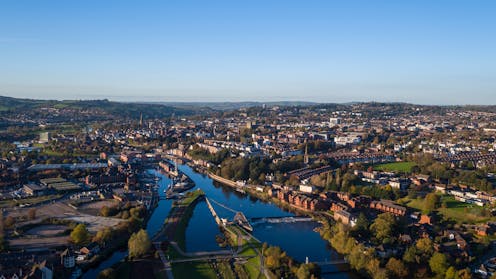
Some of Britain’s city centres are filled with trees and parks, while others have little vegetation to break up the bricks, tarmac and concrete. Such differences aren’t just aesthetic: they affect whether animals can move around, and they have implications for human health and social equity.
That’s why we wanted to properly assess how green these cities are. In our latest research, now published in the open-access journal PLOS ONE, we looked at all 68 municipalities in Great Britain with populations of at least 100,000. City centres were defined using Consumer Data Research Centre spatial datasets, which use complex statistics to demarcate retail boundaries. You can think of the boundaries as similar to “central business districts”. In Sheffield, for instance, the city centre is the entire area within the central ring road. London is a special case; because it is so large, it has several of these areas.

For each of these cities, we assessed three metrics of “greenness”: 1) tree cover using an algorithm to randomly sample recent aerial imagery, 2) the presence of green spaces using open-source data from Ordnance Survey (Great Britain’s national mapping agency), and 3) the normalised difference vegetation index (NDVI), which uses satellite observations of light absorption and reflection to measure vegetation cover in a given area.
Exeter greenest, Glasgow least green
Combining all three metrics into a single greenness score, we found that Exeter’s urban centre ranks highest, followed by Islington in London, Bristol, Bournemouth and Cambridge.
Glasgow’s urban centre is the least green, with Middlesbrough, Sheffield, Liverpool and Leeds also in the lowest five. Tree coverage is probably the most relatable way to describe the differences: trees cover 12% of the total land area of Exeter city centre, but just 2% of Glasgow’s.

Exeter, a small city in England’s remote south-west, largely avoided the rapid industrial growth of better-connected cities. This is apparent today in its leafy streets and the meadows along the River Exe. In contrast, places like Glasgow and Sheffield were massive industrial powerhouses with considerable urban sprawl, though they do still have luscious parks outside of their city centres.
North-south green divide
It is worth noting that the top five urban centres are all in the south of England, while the bottom five are ex-industrial areas in the north or Scotland. In fact, only 25% of all northern cities are in the top half of the greenness table. Further analysis uncovered a statistical link between a lower greenness score and higher levels of deprivation, as measured according to crime risk, health, economics, education, and other related metrics. In addition, areas with larger populations had lower tree coverage and vegetation index scores.

Sheffield – where the study was conducted – is often billed as having one of the highest densities of trees out of all European cities. But this is due to the vast swathes of trees in the suburban areas and surrounding fringe of the Peak District national park. Our work shows that Sheffield actually has the lowest city centre tree cover out of all the cities included in the study.
The reasons for the north-side divide are complex and can depend on decisions made centuries ago and development since. Clearly, some urban centres invested in parks and tree-lined avenues more than others in the past. Industry and war efforts then contributed to urban sprawl and reduced natural features in certain urban centres, particularly in northern England and Scotland.
In the 19th century, city planners often incorporated street trees, particularly in affluent areas. These decisions were influenced by an admiration of continental European boulevards and the wellbeing benefits of “garden cities” and “spa towns”. This is exemplified by the “luxury effect” whereby affluent neighbourhoods record higher biodiversity in cities around the world, often dictated by structural classism and racism.
Differences in historical development have therefore left us with leafy urban centres like Exeter’s, and others with far less greenness. The question remains why over time such imbalances have not been addressed.
It’s an important question as around 70% of the world’s population will soon live in urban environments. In the UK, 84% of people already do. This rapid rise in urbanisation has led to a disconnect between humans and nature as we often fail to create healthy and biodiverse spaces, especially in city centres.
But there is at least one reason to be hopeful. Urban centres in Great Britain and other areas of the world are changing, especially as digital shopping means many retail outlets are closing. This is a problem in many ways, but it’s also an opportunity. The decline of in-person shopping gives us a chance to re-envision and redevelop urban centres to enhance their green spaces.

At the time of the study on which this article is based, Jake Robinson was undertaking a PhD at the University of Sheffield, UK.
Paul Brindley does not work for, consult, own shares in or receive funding from any company or organization that would benefit from this article, and has disclosed no relevant affiliations beyond their academic appointment.
: The Conversation – Articles (UK)
Have you tried: Visiting Port Elizabeth?