
We discovered this dinosaur had stripes – and that tells us a lot about how it lived:
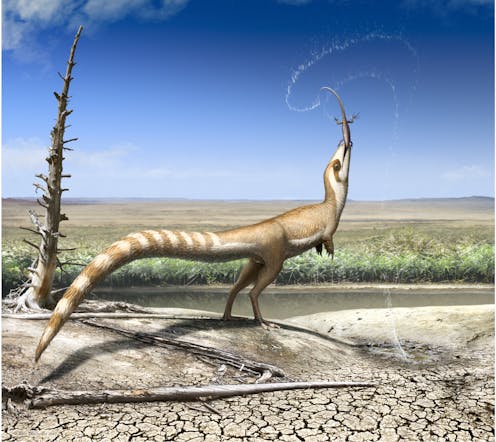
Working out what colour dinosaurs were was once thought impossible. But recent discoveries about how colour-producing pigments are preserved in fossils has allowed palaeontologists to reconstruct some dinosaurs’ colour patterns. And by better understanding what dinosaurs looked like, we can learn more about their behaviour and the environments they lived in.
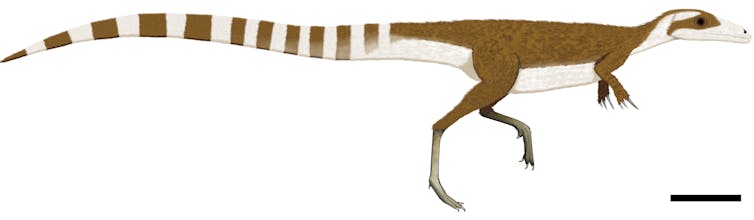
My colleagues and I have been studying the colour patterns of a small, feathered, meat-eating dinosaur known as Sinosauropteryx from the Early Cretaceous period in what is now China. By mapping out the dark pigmented plumage across the body, we found evidence of colour patterns associated with camouflage in living animals today. This included countershading (a dark back and light underside), a striped tail and a “bandit mask” stripe running across its eyes.
It’s a good reminder that we need to rethink the popular image of dinosaurs as solid green or brown giant scaly lizards. What’s more, this evidence could encourage us to change our view of the environment Sinosauropteryx was living in almost 130m years ago.
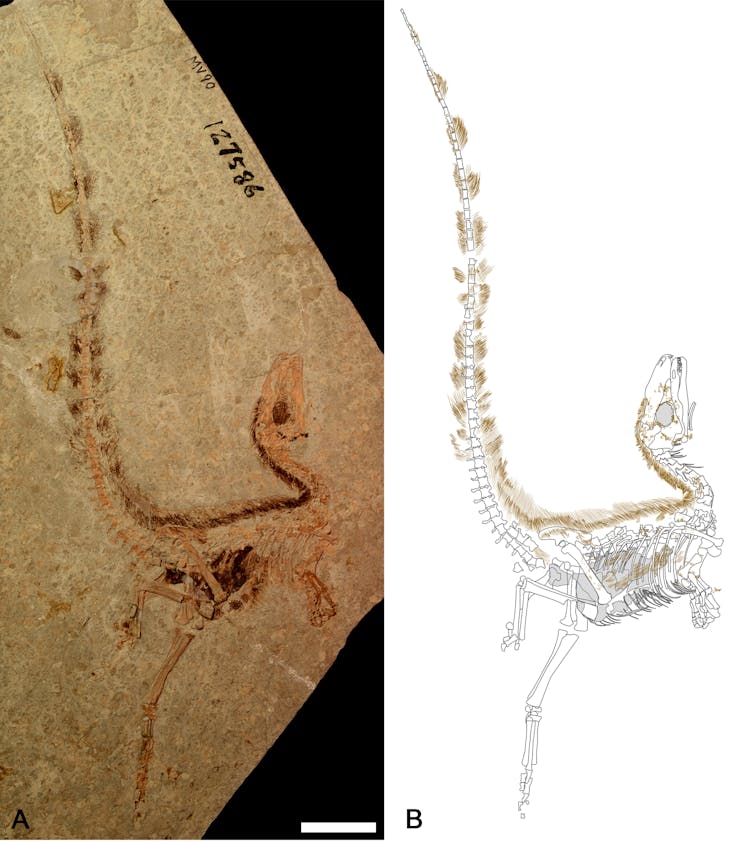
The only elements of a feather preserved in most fossils are the structures that originally contained pigment, known as melanosomes, while the keratin that forms the structure of the feather decays=. By identifying the types of melanosomes, you can work out the possible original colour of the feathers. Previous work on the melanosomes of Sinosauropteryx suggested the dark areas of the fossil were a rusty brown or ginger colour when the animal was alive. In other cases, scientists have shown that some avian (bird ancestor) dinosaurs had mottled and even iridescent plumage.
White feathers don’t have pigment and so aren’t preserved in fossils. That means any apparent gaps in the fossilised plumage were most likely originally covered in white feathers. Using this principle, we mapped out the dark and light areas of Sinosauropteryx to create an overall picture of the dinosaur’s colour pattern.
The bandit mask and stripy tail can tell us about the life of Sinosauropteryx by comparing them with the colours of modern animals. As descendants of theropod dinosaurs, birds are the best example for this. They often have facial stripes to hide their eyes, which are key visual cues used by both predators and prey to detect would-be attackers or a potential meal. Eye stripes also reduce glare and so allow animals to see better in bright light.
Disruptive camouflage
Stripy tails are less well understood in living animals but they can also serve as a form of “disruptive” camouflage, breaking up the outline of a body part and making it less obvious. It might also be a form of distraction, making the tail more obvious and drawing the attention of predators from the more important body and head.
We know that early tyrannosauroids (forebears to the mighty Tyrannosaurus rex) lived at the same time as Sinosauropteryx and may well have hunted the diminutive dinosaur. Direct evidence, in the form of a complete animal in the stomach of one fossil, also shows that Sinosauropteryx hunted small lizards. Vision was crucial to these hunting and hunted dinosaurs, so it is not surprising that we see camouflage patterns evolving at the time.
We can also make some important judgements based on Sinosauropteryx‘s countershading. This is one of the most common colour patterns seen in living animals and helps them to hide by both blending into the background and by making the body look less 3D. The animal’s lighter underside counter-balances the shadows that its body casts across it.
Importantly, different environments have different light conditions – so how the pigment gradient should appear varies with habitat. Animals living in open habitats (such as savannahs) often display a sharp contrast between their dark and light patches high on the body, while those living in closed habitats (think forests) generally have a lower and more gradual colour gradient.
We made 3D models of the body of Sinosauropteryx and put them in different virtual habitats to see how the shadows on the body would have looked according to these principles. The actual colour pattern of the fossils, which went from dark to light high up on the body, would have been best suited to counterbalance the shadows from an open habitat with lots of light.
This contrasts to previous work on the colour of another dinosaur from the same location, Psittacosaurus, which suggested it had evolved to suit a closed or forested habitat. This suggests the environment at the time was more varied than previously assumed.
By reconstructing the colour patterns of Sinosauropteryx, we have gained unique insights into how and where it may have lived. This has helped to build one of the most informed and accurate pictures of a dinosaur ever reconstructed.

Fiann Smithwick receives funding from the Natural Environment Research Council (NERC).
: The Conversation – Articles (UK)
Have you tried: Farking?