
War and peat: how bog moss helped save thousands of lives in World War I:
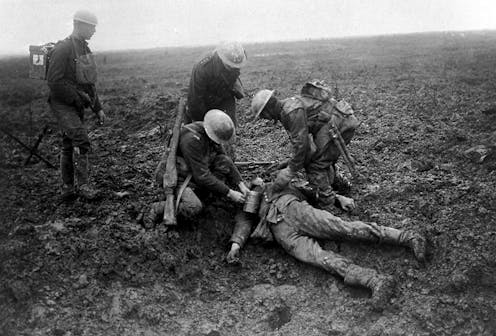
At 07:30 on July 1, 1916, a private in the British army – let’s call him Tommy Atkins – scrambled out of a trench in front lines and advanced across no man’s land towards the German trenches in the Battle of Albert, the opening phase of the Battle of the Somme. He had covered no more than 30 yards when he felt as if someone had hit him on the back of the head with a mallet. Checking himself dazedly, he realised that he must have taken a bullet in the left shoulder because the whole area was suddenly bright crimson. Private Tommy Atkins had just become one of the 57,470 British casualties on the now-notorious first day of the Somme.
His actions in the next few seconds would ultimately save his life. He tore off the field dressing sewn to the inside of his uniform jacket, ripped it open and applied the contents to his wound before making his way back to the aid post. Tommy Atkins was lucky, not merely because the bullet had not killed him. He was lucky because this was 1916 and not 1914, and the nature of his field dressing therefore meant he had a good chance of staying alive rather than subsequently dying of sepsis caused by infection of his wound.

Death as a result of even relatively minor injuries due to sepsis and gas gangrene had been a major problem in the first years of World War I. Appalling conditions in the trenches meant that wounds were generally accompanied by fragments of dirty clothing and the bodily filth plastered about the battlefields.
In 1915, however, an army surgeon named Charles Cathcart recalled that even quite terrible wounds had been successfully dressed on the battlefield in ancient times using a group of bog mosses known as sphagnum. On the basis of some successful trials, he instigated a nationwide programme of bog moss collection to create what would become the standard field dressing issued to all UK and Imperial land forces as an integral part of their uniform. People gathered the humble bog moss across the country, from Bodmin Moor to the far north of Shetland.

Moss provided a number of improvements over the cotton-based dressings used in the early period of the war. Sphagnum is primarily adapted to storing water – vast quantities of it – and it was capable of absorbing more than twice as much blood and fluids as cotton wool, thus initially helping to dry out the wound.
It was fibrous like cotton, and therefore helped to seal the wound, but unlike cotton wool it also appeared to prevent infection of the wound in some mysterious way. It was later discovered that sphagnum releases a chemical called “sphagnan” which inhibits nitrogen uptake by decomposer organisms, sending them into a form of stasis. This is what saved Private Tommy Atkins and thousands like him from a lingering death by sepsis even though the original injury trauma may have been successfully treated.

Despite this record of success, the medical use of sphagnum was largely discontinued after World War I. In part, this may have been because supply chains relied on the rather laborious process of harvesting the moss in the wild. Its later use in certain sanitary products ended more recently, however, when significant concerns were raised about the environmental damage caused by such wild harvesting.
Indeed, it is the environmental damage caused by the unsustainable harvesting of sphagnum and its semi-decomposed remains – which we know as peat – that has led colleagues and I to investigate a new type of farming called “paludiculture”, namely harvesting wetland products on the re-wetted soils of former wetlands.
In their natural state, such peat soils represent long-term carbon storage, often on millennial timescales. If such soils are damaged, this long-term carbon store is progressively oxidised, releasing lots of carbon dioxide into the atmosphere. Studies have indicated that turning peat soils into farmland is potentially the largest source of greenhouse gas emissions per unit area in the UK lowlands.
Working with various partners, our research is investigating ways of growing sphagnum as a commercial crop on re-wetted organic soils. We are seeking to produce a sustainable growing medium with a view to replacing the use of peat – which is essentially just ancient sphagnum – within both the professional horticulture industry and the retail trade.
We are also exploring with Greenwich University the possibility of re-establishing sphagnum as a modern medical material for use in wound treatment and anti-microbial action, thereby coming full circle to that day on the Somme when the life of Private Tommy Atkins was saved by the extraordinary properties of the material in his field dressing.
Listen to The Anthill podcast on remembering World War I here, or subscribe wherever you get your podcasts.

Richard Lindsay receives funding from Innovate UK and Micropropagation Services Ltd. He is affiliated with the IUCN UK Peatland Programme. He works on the Innovate UK Sphagnum Farming Project in partnership with Micropropagation Services Ltd, Manchester Metropolitan University, Melcourt Industries, Natural England and the Lancashire Wildlife Trust.
: The Conversation – Articles (UK)
Have you tried: Visiting Port Elizabeth?