
Vegan diet has just 30% of the environmental impact of a high-meat diet, major study finds:
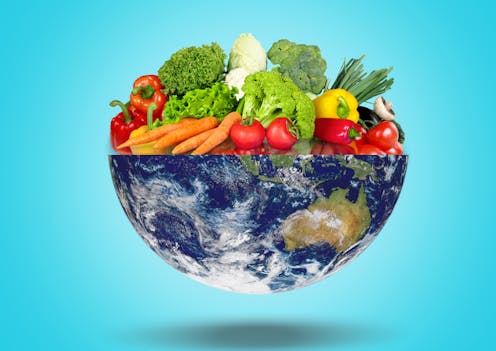
We know that meat has a substantial impact on the planet, and that plant-based diets are more environmentally sustainable. But exactly how much impact does the food we eat have on environmental outcomes and what difference would following a vegan diet make compared to consuming a high meat, or even low meat diet?
We studied 55,000 people’s dietary data and linked what they ate or drank to five key measures: greenhouse gas emissions, land use, water use, water pollution and biodiversity loss. Our results are now published in Nature Food. We found that vegans have just 30% of the dietary environmental impact of high-meat eaters.
The dietary data came from a major study into cancer and nutrition that has been tracking the same people (about 57,000 in total across the UK) for more than two decades. Those who participated in our study reported what they ate and drank over 12 months and we then classified them into six different groups: vegan, vegetarian, fish-eaters, and low-, medium-, and high-meat-eaters based on their self-reported dietary habits.
We then linked their dietary reports to a dataset containing information on the environmental impact of 57,000 foods. Crucially, the dataset factored in how and where a food is produced – carrots grown in a greenhouse in Spain will have a different impact from those grown in a field in the UK, for instance. This builds on past studies, which tend to assume for example that all types of bread or all steak or all lasagna has the same environmental impact.
By incorporating more detail and nuance, we were able to show with more certainty that different diets have different environmental impacts. We found that even the least sustainable vegan diet was still more environmentally-friendly than the most sustainable meat eater’s diet. In other words, accounting for region of origin and methods of food production does not obscure the differences in the environmental impacts between diet groups.
Vegans vs carnivores
Unsurprisingly, diets containing more animal-based foods had higher environmental impacts. Per unit of food consumed, meat and dairy has anywhere from three to 100 times the environmental impact of plant-based foods.

This can mean huge differences between the two extremes, vegans and high meat-eaters. Vegans in our study had just 25% of the dietary impact of high meat-eaters in terms of greenhouse gas emissions, for instance. That’s because meat uses more land, which means more deforestation and less carbon stored in trees. It uses lots of fertiliser (usually produced from fossil fuels) to feed the plants that feed the animals. And because cows and other animals directly emit gases themselves.
It’s not just emissions. Compared to the high meat-eaters, vegans also had just 25% of the dietary impact for land use, 46% for water use, 27% for water pollution and 34% for biodiversity.
Even low meat diets had only about 70% of the impact across most environmental measures of high meat diets. This is important: you don’t have go full vegan or even vegetarian to make a big difference.
Global impact
These findings are crucial as the food system is estimated to be responsible for around 30% of global greenhouse gas emissions, 70% of the world’s freshwater use and 78% of freshwater pollution. Around three quarters of the world’s ice-free land has been affected by human use, primarily for agriculture and land use change such as deforestation which is a major source of biodiversity loss.
In the UK, meat eating declined over the decade to 2018, but in order to meet environmental targets the National Food Strategy and the UK’s Climate Change Committee recommend an additional 30%-35% reduction.
The choices we make about what we eat are personal. They are highly ingrained habits that can be difficult to change. But our study and others are continuing to solidify evidence that the food system is having a massive global environmental and health impact which could be reduced by a transition towards more plant-based diets. We hope that our work can encourage policymakers to take action and people to make more sustainable choices while still eating something nutritious, affordable and tasty.

Keren Papier receives funding from Wellcome and Cancer Research UK.
Michael Clark ne travaille pas, ne conseille pas, ne possède pas de parts, ne reçoit pas de fonds d'une organisation qui pourrait tirer profit de cet article, et n'a déclaré aucune autre affiliation que son organisme de recherche.
: The Conversation – Articles (UK)
Have you tried: Farking?