
Valentine’s Day’s connection with love was probably invented by Chaucer and other 14th-century poets:
As an undergraduate, on a tour of Europe, I happened to step into the church where Saint Valentine’s head was kept. The tour guide told us a (likely fictitious) story about Saint Valentine performing forbidden marriages for persecuted Christians under the Roman emperor Claudius Gothicus (possibly 269-270 AD). Valentine was then imprisoned and beheaded in Rome.
His saint’s day has since become a celebration of romance. But earlier medieval accounts of Valentine’s life contain no mention of his association with love.
In The Golden Legend (c. 1225) –- an enormously popular book, which is the main database of saints’ lives throughout the middle ages and beyond – I found no references to love or marriage in the story of Saint Valentine.
In The Golden Legend, Valentine of Rome manages to restore the sight of an official’s daughter. As a result of this miracle he converts many to Christianity and incurring the wrath of the emperor. Valentine refuses to sacrifice to Roman idols and is imprisoned and beheaded. There is no love and there are no lovers.
But to add further complication, there is yet another prominent Saint Valentine, this time of Terni, Italy. Often confused or conflated with Valentine of Rome, Valentine of Terni was a bishop and scholar. His reputation reached a man named Crato whose son had been crippled since he was three. Valentine agreed to try and cure the child on the condition that Crato converted to Christianity.
Valentine succeeded in curing the boy and converted Crato, his household and many others including the local magistrate. Upon hearing of this cure, the Roman senators demanded that Valentine prays to their gods. Valentine, refusing to do so, was beheaded becoming a saint as well.
The two Valentines are remarkably similar and while their cults were popular throughout Europe, it is difficult to distinguish one from another. What is intriguing about these stories is that neither connects Valentine with love. The statements of Saint Valentine conducting secret marriages seem unsupported by medieval texts.
So where do we get this association between Valentine and love? Well, one short answer is the medieval poet Chaucer, who is sometimes heralded as the father of English Literature.
Chaucer and Saint Valentine
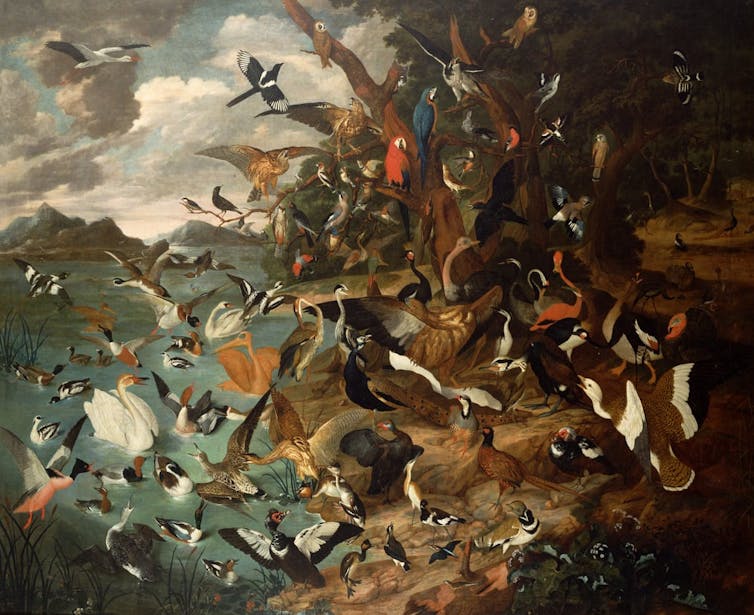
In Chaucer’s Parliament of Fowles the birds gather in a meeting (or parliament) to choose their mate. And what date should they gather on, but Saint Valentine’s Day:
For this was on seynt Valentynes day,
Whan every foul cometh there to chese his make’ (309-10)For this was on Saint Valentine’s Day
When every fowl comes to choose his mate.
Chaucer mentions four times that birds meet on Saint Valentine’s Day to choose their partner. The final reference reads:
Saynt Valentyne, that are ful hy on-lofte,
Thus syngen smale foules for thy sake:
Now welcome, somer…’ (683-85)Saint Valentine, that are full lofty on high
Thus small fowls (birds) sing for thy sake.
Now welcome, summer…
Chaucer mentions that birds sing for Saint Valentine and choose their spouse on his day. So we have a connection between Saint Valentine and love.
The date of Saint Valentine’s day
One question that scholars discuss is the exact date of Saint Valentine’s celebration in Chaucer. Is it in fact on Saint Valentine’s feast day on February 14? Do birds choose their mates this early in the year when it still feels like midwinter?
One argument is that according to traditional medieval calendars, spring began with the appearance of the Pisces star sign, which occurred on February 15. Other traditional calendars regard February as the first month of spring. Several medieval calendars state that birds begin to sing on February 12.
This year by February 6 in Durham, I noted the longer daylight. I have heard birdsong in the early morning and witnessed blackbirds quarrelling in a hedge (possibly over their choice of mate).
However, another suggestion is that the Valentine’s Day referred to by Chaucer belongs to a certain Saint Valentine of Genoa whose feast day was held on May 2. It is argued that Chaucer potentially knew of this bishop through his visits to Genoa in 1372 and 1373. It is possible that Chaucer had in mind this Genoese Valentine whose feast day is in May. Throughout medieval literature, May is the month when birds sing and lovers pair off.
Chaucer’s Parliament of Fowles is one of the largest pieces of evidence that links Saint Valentine with courtly love. However, Chaucer was not alone among his 14th-century contemporaries to do so. The English poet John Gower (d. 1408), the French poet Oton de Grandson (d. 1387) , and possibly the Valencian poet Pardo make references to Valentine’s Day and courtly love.
By 1415 the French Duke of Orleans, imprisoned in the Tower of London, called his wife “Ma doulce Valentine gent” (my sweet gentle Valentine).
It is possible that Chaucer began the trend of linking Saint Valentine with love and other poets copied him, but it is uncertain. What is interesting is that writers – including Chaucer and Gower – who were deeply interested in the concept of courtly love, make much of Saint Valentine’s Day.
This medieval connection between Valentine’s Day and love likely either reflects a notion that was popular in medieval society or that medieval poetry is responsible for propagating the connection. Thus courtly medieval literature has an important part to play with Saint Valentine and his romantic associations.

Natalie Goodison does not work for, consult, own shares in or receive funding from any company or organization that would benefit from this article, and has disclosed no relevant affiliations beyond their academic appointment.
: The Conversation – Articles (UK)
Have you tried: Travelling to South Africa?