
Ukraine war: death of a ‘fixer’ underlines the dangers of this unsung but vital job for journalism:
Oleksandra Kushynova died on March 14 in the village of Horenka north of Kyiv when the vehicle in which she was travelling was hit by incoming fire killing her and Irish cameraman Pierre Zakrzewski, as well as wounding Fox correspondent Benjamin Hall. Kushynova was 24 years old and had been working as a “fixer” for Fox News for a month. Fox News national security correspondent, Jennifer Griffin, described her as “bright light and talented”.
Many journalists, particularly broadcasters covering foreign conflicts for international news organisations, have reason to be intensely grateful to fixers like Kushynova. These locally hired staff help reporters, producers and correspondents to identify stories, find sources, negotiate local bureaucracy and – crucially – translate unfamiliar languages and dialects. Often, they keep the incoming journalists safe, sometimes at great risk to themselves.
Some fixers – like Kushynova – are local journalists who lack the contacts to sell their work abroad. Others are passionate idealists determined to promote a cause or country. Almost all are capable of combining the role of translator with that of expert local guide. For many fixers, the arrival in their country of international journalists hungry for compelling stories is a golden opportunity to work with prestigious organisations.
No matter what their motivation, they are always low in a news team’s pecking order and often less well paid than those they help. The American media scholar Lindsay Palmer describes fixers as occupying “one of the lowest ranks in the hierarchy of international news”.
After witnessing the death of fixer Abed Takoush in 2009 Sam Kiley of CNN wrote about fixers thus:
The reality is that without a worldwide network of local freelance drivers, translators and general all-round fixers, there would be a lot of dead journalists, and pretty soon no foreign news at all. Any nitwit, and I am living proof, can be a ‘war correspondent’ if they are lucky enough to come across a great fixer.
Translators, helpers and guides
Kiley’s candour coincides with elements of my own experience. My first involvement in conflict reporting came during the Romanian Revolution in December 1989. I was a producer on BBC Radio 4’s Today Programme. Together with my colleague, reporter Allan Little, I flew to Belgrade in neighbouring Serbia and drove into Romania in a hired car.
In the western city of Timisoara, cradle of the revolution, we met Viorel Buligan, a young English speaker. His skills as a translator and guide were invaluable. Without him, I would not have found the primitive casualty ward in which the victims of fighting with the notorious Securitate secret police were being treated. I recall that our entirely informal means of remuneration involved American cigarettes and British currency.
When we arrived on Christmas Eve 1989, some supporters of the Ceausescu regime were still active. I have often wondered what risks Buligan took with his own safety in order to help us.
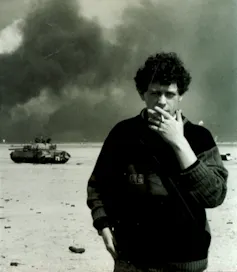
Subsequently, when I joined the BBC foreign news team covering the Gulf War of 1991, a young bilingual Palestinian resident of Kuwait City, Walid Abu Zeid became my fixer. He guided, translated and suggested many story ideas that could not have occurred to me. He also kept the Toyota Land Cruiser in which we travelled from Kuwait to Southern Iraq stocked with essential supplies. My colleagues and I took credit for the stories.
Risk and reward
Fixers such as Kushynova make possible connections between their countries or localities and international audiences. They provide the language skills and local expertise that allow visiting journalists to tell stories that will make impressions at home. They may be, often are – like Kushynova is reported to have been – aspiring correspondents themselves. Often they lack neither expertise nor insight, only professional status. In some cases, they may also work without the hazardous environment training and insurance cover that protects the international reporters and correspondents with whom they work.
Their work connects the global with the local. It is crucial – but for the fixers, it may also be frustrating. Nuances of local politics and culture that may be intrinsic to getting a full understanding of a story are sometimes ignored by international correspondents determined to please editors and audiences at home. Almost always the fixers remain in their home country when the international news caravan moves on. Their expertise is specific to their location. Some fixers may face criticism or worse in their home countries when their foreign employers leave to cover news elsewhere.
In 2016 and 2017, the Global Reporting Centre conducted a survey about the relationship between correspondents and fixers. More than 450 journalists from 70 countries contributed. The findings characterised the arrangement as one in which “a deep-pocketed foreign reporter” hires a local journalist in “an often-poorer country, to do his or her bidding”. The power dynamic of the relationship certainly rests with the correspondent – and ethical correspondents may recognise a problem while privately acknowledging that neither they nor their employer has any clear incentive to solve it.
Oleksandra Kushynova was not the first brave and dedicated fixer to die doing vital work that helped explain her country’s plight to the world. I fear it is forlorn to hope that she will be the last. But she should be remembered as not only bright and brilliant – but also as a member of a luckless tribe that deserves greater reward and recognition than it has ever received.

Tim Luckhurst has received research funding from from News UK and Ireland Ltd. He is a member of the Society of Editors and the Free Speech Union. His forthcoming work is a book for Bloomsbury Academic – Reporting the Second World War: Newspapers and the Public in Wartime Britain.
: The Conversation – Articles (UK)
Have you tried: Farking?