
When the Home Office left a group of people seeking asylum stranded at London’s Victoria Station last week, the scenes were stark. Hungry, cold and disoriented, they had been transported from Manston immigration centre, where 4,000 people were being crammed into a space built for 1,600.
Outbreaks of illness and reports of abuse are just part of the increasingly dire situation at Manston, and in the UK’s immigration system more generally.
The images brought to mind scenes from 2015-16 when unprecedented numbers of people fleeing conflict and poverty arrived by boat at Europe’s southern borders. They also echo the lines of refugees, freezing and hungry, who had made their way to eastern European borders, arriving at train stations in Hungary and later to the north in Sweden.
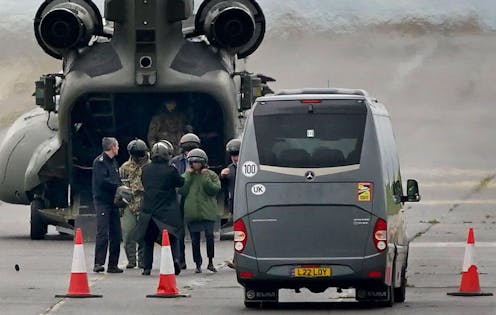
They are an extreme contrast with the images of Home Secretary Suella Braverman arriving at Manston by military helicopter – a patently unnecessary method of transportation for somewhere just a few hours’ drive from London.
But as disturbing as these images are, they come as no surprise. The Conservative government, in power for 12 years, has progressively militarised its approach to migrants and used spectacle to do so.
What is happening now is fundamentally a problem created by the government itself. As I wrote five years ago, every policy decision, every legislative shift, could have had other outcomes. Instead, by presenting situations that could have been managed as unmanageable, the government has been able to justify ever harsher border policies.
Creating a spectacle
Every aspect of Braverman’s recent visit to the Kent centre was calculated. The military imagery complemented her own choice of words to convey the message that Britain is being “invaded”.
This strategy is best described as “border spectacularisation”. This is the tactic of making a scene, drawing attention to immigration in a way that encourages the public to equate “migrant” with “illegal”. In Braverman’s approach there is an added aesthetic of military control, a grandiose symbol of invasion and protection when no such situation was present.
Read more: Suella Braverman’s talk of a refugee ‘invasion’ is a dangerous political gambit gone wrong
This strategy was central in a defining and controversial image of the Brexit referendum. The pro-Leave UK Independence Party, helmed by Nigel Farage, brought out a poster featuring queues of refugees and “breaking point” in big red capitals.
Farage might have been politically peripheral (if not publicly) when he stood in front of that image. But his message has nonetheless been adopted into policy. Bolstered by the Immigration Acts of 2014 and 2016, the Nationality and Borders Act 2022 has now made it almost impossible to legitimately seek asylum in the UK. It is a direct undermining of our pledge to uphold the 1951 Refugee Convention.
We should expect to see more of this as the government rallies to reduce the arrivals of people on small boats. Harsh measures need public consensus, and as history has taught us, there is no better way to do so than by creating a mood of risk and fear.
These are familiar strategies in other countries with ever stricter border policies. In 2017, Denmark’s former minister of immigration, integration and housing, Inger Støjberg, had to be evacuated by security guards during a visit she made to the Sjælsmark deportation centre. Tensions rose when some of the detainees, whose claims for asylum had been rejected, cornered her in her car.
Støjberg, who was later jailed for enacting illegal asylum policies, was instrumental in facilitating unlivable conditions for people seeking asylum. She made headlines with her comments that migrants were unwanted in Denmark, and would be made to feel that.
By 2021, Denmark had become the first country in Europe to consider offshoring its asylum process. Controversially, the prime minister and leader of the Social Democrats Mette Frederiksen – otherwise often lauded for progressive policies – has now implemented a “net zero” approach to refugees. This is the clear path Britain has also taken, with little regard for our international obligations on refugee rights.
Missed opportunities
Politicians have long seized on periods of significant instability to encourage anti-migrant sentiment. When the first British border control laws were formalised in the Aliens Act of 1905, the government’s aim was to reduce “undesirable” migration. The main targets were Jewish refugees fleeing pogroms in Russia, as well as other eastern European migrants. Xenophobia and antisemitism were effectively enshrined in policy.
Over the last century, war, famine and political instability have been the bedrock of border securitisation globally. This approach to immigration policy – which can be seen across the EU as well as in the UK – treats the movement of people across borders as a security threat rather than an opportunity for humanitarian assistance.
Central to border spectacularisation is that the situation being presented as unmanageable usually isn’t. The UK situation is a case in point. Since the 1980s in particular, successive British governments have sought to restrict immigration by conflating seeking asylum with criminalisation. More restrictive laws were passed by the New Labour government between 1997 and 2010 than in the nine preceding decades.
Our politicians speak now of “alternatives” to detention and addressing the increasing numbers of people arriving at Britain’s southern shores. But this country was already offered an alternative during 2015-16.
The German Chancellor at the time, Angela Merkel, and her French counterpart Francois Hollande proposed quotas to ensure that EU states – of which the UK was still one – could equally respond to increased refugee applications. But the UK deliberately ignored this opportunity for collaboration, and as a result went statistically largely unaffected by the greatest mass movement of people since the second world war.
Had the then-home secretary Theresa May agreed to those Franco-German proposals, the situation in the UK today might look different. Instead, 12 years of Conservative governance has pushed narratives that dehumanise vulnerable people, and turned the border into a spectacle. These tactics have failed for all parties, and the harms are resting firmly on people who have already faced persecution.

Victoria Canning has previously received funding from ESRC and The British Academy. She is affiliated with Statewatch.
: The Conversation – Articles (UK)
Have you tried: Diving with Sharks?