
Two-thirds of glacier ice in the Himalayas will be lost by 2100 if climate targets aren’t met:
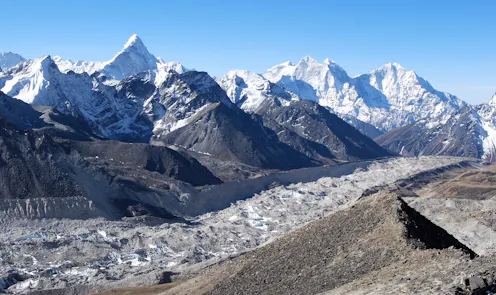
In the world of glaciology, the year 2007 would go down in history. It was the year a seemingly small error in a major international report heralded huge changes in our understanding of what was happening to the Himalayan glaciers.
Just one year after Al Gore’s documentary An Inconvenient Truth sparked conversations about anthropogenic (human-made) global warming, the Intergovernmental Panel on Climate Change (IPCC) published its 4th Assessment Report. This state-of-the-science summary was the gold standard to inform the world about climate change. The report contained one small but serious error – that all glaciers in the Himalayas would vanish by the year 2035.
The scandal sparked a flurry of new research, including my own, and we can now see that some Himalayan glaciers will survive into the next century. The latest data tells us that if we reduce our greenhouse gas emissions, then between one-third and one-half of glacier ice will be lost by 2100. If not, and we carry on with business as usual, then two-thirds of Himalayan glaciers will vanish by the end of this century.
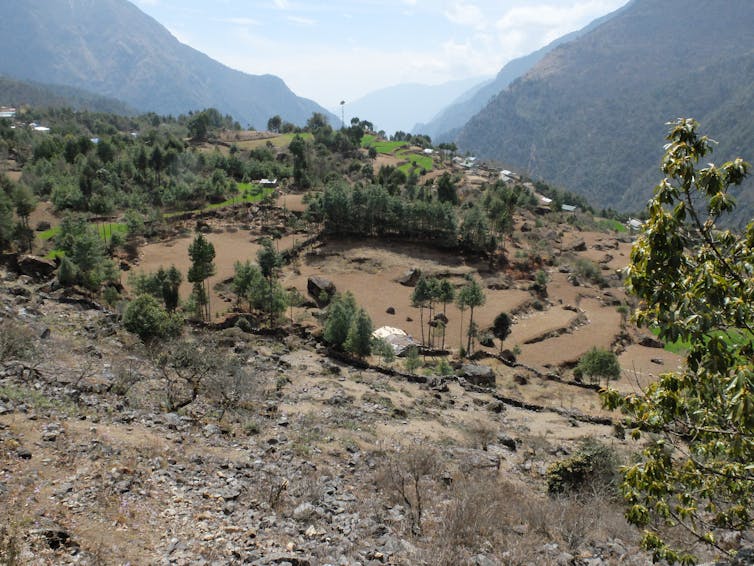
But how did such an error come to be presented as fact by a world-leading scientific organisation? This is a tale of repetitions and an apparently unintended typo lending credibility to an unfounded statement. The IPCC quoted a report from the World Wildlife Foundation, which had taken the Himalayan meltdown date from an interview in New Scientist. That interview quoted speculation by an Indian glaciologist, who apparently misquoted another scientist’s work predicting glaciers worldwide would shrink by 80% by 2350.
The IPCC did eventually apologise for their failure to identify this error. Although embarrassing, it did not undermine their core conclusions. The IPCC undertook to improve their peer-review process before their next report in 2013.
The Himalayas are sacred mountains. Their name in Sanskrit means “abode of snow”. But glaciers are a political issue in central Asia. Glacier-fed rivers provide water to over a billion people for food production and hydropower. India and Nepal in particular rely on glacier melt water to buffer seasonal droughts before the summer monsoon. These countries are rapidly industrialising and generally oppose limiting their carbon emissions.
After the IPCC report, the Indian government acted quickly to suppress panic with a controversial discussion paper presenting selective evidence showing that glaciers in northern India and Pakistan were stable or even expanding. However, the Karakoram glaciers in question benefit from greater winter snowfall and cooler summers as a result of global heating. How persistent this Karakoram anomaly will be remains unknown.
Resolving a Himalayan error
Glaciologists were left wondering what the fate of Himalayan glaciers would be. Little research was being done and data was scarce. Problems with accessing remote, high-elevation glaciers in politically unstable regions deterred fieldwork. Civil war in Nepal, the Taliban in Pakistan and suspicion of foreign scientists in China and India made these mountains difficult places to work.
Field observations and surveys suggested that glaciers had not noticeably changed. Glaciologists soon realised that changes in ice volume were hidden by rock debris on the surfaces of many large glaciers. So measurements of changes in glacier area were misleading and concealed the scale of ice loss.
Then, in the early 2010s, rapid advances in satellite Earth observation technology and declassification of Cold War satellite photographs opened a window into these remote mountains. The scale of glacier change across the Himalayas could be seen for the first time.
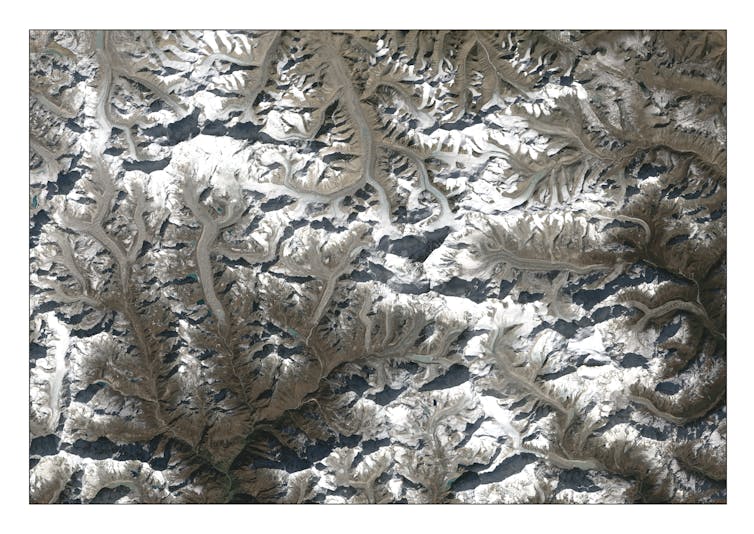
The new satellite data allowed glaciologists to measure changes in glacier volume over a 40-year period. This revealed that nearly all Himalayan glaciers were shrinking at a similar rate.
The future of Himalayan glaciers
New research shows that the rate at which glacier ice is lost from the Himalaya has doubled in the last 20 years and is similar to the rate of ice loss globally. Although extreme altitudes were thought to protect glaciers from climate change, we now know that high mountains are warming twice as fast as the rest of the planet.
The proliferation of data allowed glaciologists to train computer models to project how glaciers will change in the future. These models tell us that between one-third and one-half of glacier ice in the Himalaya will be lost by 2100. If we don’t act to keep climate change within the ambitious Paris Agreement target of 1.5? then two-thirds will be lost in the same period.
While the weakening of the summer monsoon and atmospheric pollution affect glacier life expectancy, rising global temperatures are causing Himalayan glaciers to shrink. These predictions are bad news for the one billion people who depend on glacier-fed rivers for water in spring at the start of the agricultural season.
As glaciers decline, droughts are becoming more frequent before the summer rains, putting intense stress on populations in southern and central Asia. Governments, including India’s, have now recognised the scale of the problem. To avoid a humanitarian crisis, the world must keep global heating within a range that will limit glacier loss.

Ann Rowan received funding from the UK Natural Environment Research Council for the EverDrill project.
: The Conversation – Articles (UK)
Have you tried: Farking?