
Traditional wrestling in Senegal – much more than a sport, it keeps culture alive:
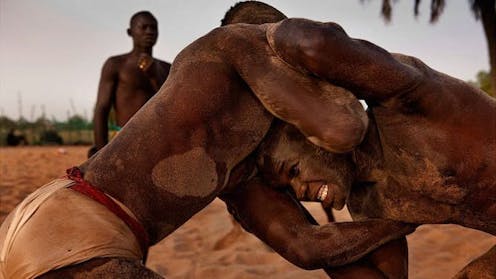
Traditional wrestling plays an important role in much of Senegalese society and is one of the country’s national sports.
Traditional wrestling is mostly practised in rural areas where it’s not just a sport, it has a profound social and cultural role. It’s being overshadowed by a very popular, modern professional wrestling. A synthesis of boxing and traditional wrestling, these matches are massive social events.
It’s particularly important within the Joola community, in southern Senegal, and the Serer community in central Senegal. Together these communities make up about 18% of the country’s population.
The practice is traditionally taught to young men in special schools during their initiation into adulthood.
All the information on how to wrestle has been passed down through oral history by griots – traditional West African troubadour-historians – and by the elders.
The young men learn about society, hierarchy, and the fundamental differences between the traditional roles of men and women. The training schools also bring together people from different communities. This means, particularly in rural areas, wrestling allows for friendly encounters between neighbouring villages.
Wrestling isn’t just a sport, it’s a valuable social heritage that must continue. It’s in decline because young wrestlers are attracted to the professional, modern forms.
Importance of oral history
Because wrestling has been passed down through oral history, there’s almost a total lack of written documents on it. As a specialist on wrestling, which I’ve researched at length, I want to highlight that all that we know about the history of traditional wrestling was told to us by the elders and griots.
According to the elders and griots, wrestling was a means of settling conflicts between kings through wrestlers. Aside from this, it was practised as a recreational sport.
Wrestling in the Serer community has some added cultural dimensions – it is also a literature, a ritual, and a festival. Wrestling is accompanied by different rhythms which change according to the wrestler himself and the participating group. It can be slow, silent, fast, jerky, fiery. It creates a story, encouragement, speaking directly to the wrestler, but also to all the participants.
Chants such as “The chests scream when a great wrestler goes down, let’s go, it’s already dark”, or “I’m a regular in the arena, but I won’t go around looking for talismans, my strength is enough” are often sung by their supporters.
Wrestling is not just a sport, it has a considerable socio-educational aspect.
Wrestling training schools exist for all young boys, and through it adults measured the boys’ courage, their will to win and their spirit of self-sacrifice. Because of this, it brings honour to a person’s village or region, and is an important form of social capital to safeguard.
Socially entrenched
Traditional wrestling is more than the sole individual that wrestles. There are five key social dynamics around wrestlers: the relationship between the wrestler and his entourage; the relationship between wrestling and family relationships; the relationship between wrestling and friendship; between the elders and wrestling; and finally the contribution of wrestling to bringing people together.
Traditional wrestling also matters to the community – it’s an expression of ethnicity, tribe or class. Wrestling in traditional society was a sign of the vitality of a particular community. This community rallies all its forces around a single character – the wrestlers – as its representative.
The relationship between the wrestler and his community is therefore key. There are three relationships in particular that stand out:
-
The wrestler-champion and his group or community: the wrestler draws his strength from this group which supports and encourages him in his preparation and during the fight. It’s believed that a champion who cuts himself off from his group loses part of his strength.
-
The age group: this represents young people of the same age. It is within this age group that the wrestler can measure his strength over others.
-
The role of the mother, the sister and the “scholars” (the community’s wise men) who felt mobilised in particular to protect their “son” and ensure his victory. Wrestlers will often wear their symbols, for instance wearing a sister’s loincloth means that the wrestler is fighting for the honour of the family.
Shift to professional wrestling
Traditional wrestling is part of Senegal’s cultural heritage, encompassing social integration and education, but its true form is dying out. Today, most people tend to focus on professional wrestling.
Apart from the Flag of the Head of State – a national wrestling tournament dedicated to the head of state and bringing together wrestlers from all regions of the country – which is organised by the National Management Committee (the body responsible for the administration of wrestling), traditional wrestling is absent from the country’s cultural policy projects and programmes.
The sports and culture ministries must invest in preserving and highlighting Senegalese traditional society, including traditional wrestling.
A version of this article was initially published in French. You can read it here

Ousmane Ba does not work for, consult, own shares in or receive funding from any company or organisation that would benefit from this article, and has disclosed no relevant affiliations beyond their academic appointment.
: The Conversation – Articles (AFRICA)
Have you tried: Visiting Port Elizabeth?