
Tracks in rocks tell us where ancient animals roamed in southern Africa:
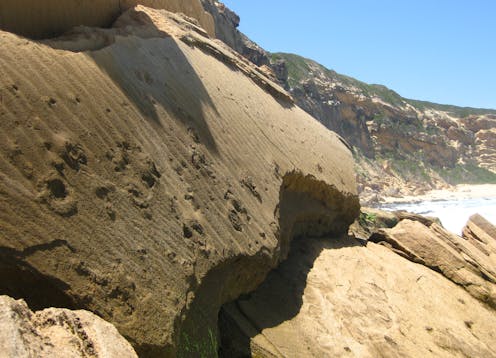
At first glance, they look like nothing more interesting than rocks. But to our research team, these two rocks – situated just 420 metres apart on a rugged, remote portion of South Africa’s Cape south coast – are fascinating and important pieces of ancient history.
The rocks are described in a paper based on research that’s part of a decade-long multi-disciplinary study along a 350km stretch of this particular coastline. It’s been rewarding work. We’ve identified more than 130 sites containing trackways made by vertebrates during the Pleistocene era, dating back to between 36 000 and 140 000 years ago.
We’ve also found 40 hominin tracks on the ceiling and side walls of a coastal cave. These may represent the first known example of humans jogging.
Now we can add Roberts Rock and Megafauna Rock to the list. They contain trackways and tracks made by elephant, rhino and antelope, as well as by long-extinct buffalo and horse species, that all roamed the area hundreds of thousands of years ago.
Tracksites like these are scientifically important. They can be thought of as a movie that can tell stories about prehistoric humans as well as animal behaviour, and how many species were in a place at a particular point in time. They also have heritage and aesthetic value. These rocks, and similar finds, are a reminder that it’s important to regularly survey and document southern Africa’s coastlines. Fossils and trackways can be recorded through cast replicas and detailed photographs. This will allow more people to “read the rocks” and decipher our past.
Ancient megafauna
The rocks that sparked our latest paper lie to the east of a small town in South Africa called Still Bay. The first rock was initially described in 2008; we later named it Roberts Rock in honour of Dr David Roberts, who discovered it.
Its 5 metre x 3.5 metre surface contained spectacular elephant trackways – the first to be reported from southern Africa. Over time we monitored its slow but steady demise. First it split in two, exposing many more tracks. By 2016 it had slumped into the sea, and was destroyed by wave action.
The second rock, measuring 5 metres x 5 metres x 2.5 metres, was arguably even more significant. In addition to numerous elephant tracks it contained probable single tracks of the extinct giant Cape horse (Equus capensis) and the extinct long-horned buffalo (Syncerus antiquus). We also identified a single track that was probably made by a rhinoceros.
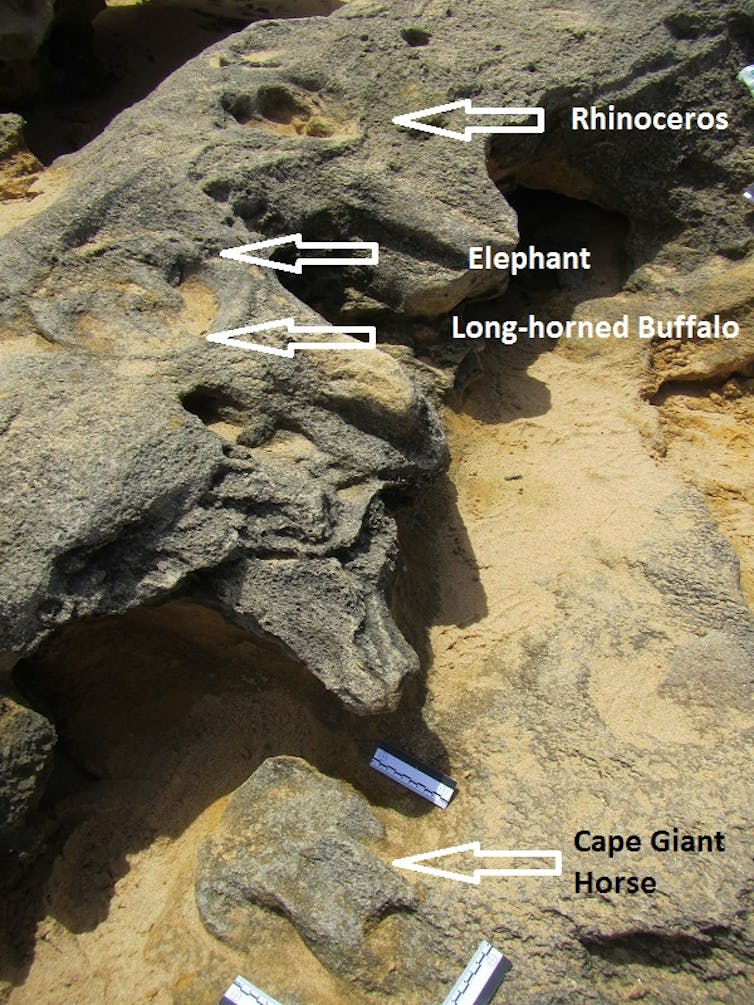
These four animals were all members of the megafauna – large creatures – that lived during the Pleistocene. Finding their tracks on a single rock was a surprise, and we named it Megafauna Rock.
The long-horned buffalo and giant Cape horse both went extinct between 10 000 and 12 000 years ago. At the time of discovery, these were the first probable rhinoceros and giant Cape horse tracks that had been identified. We have subsequently found further such sites. The long-horned buffalo track, meanwhile, confirmed our findings from another site in our study area: the tracks of this species are distinctive, usually being wider than they are long.
Both rocks contained tracks on multiple layers. This suggests repeated use of an area over time, and possibly that the rocks were close to a water source. Using the results from dated samples from sites nearby, we’ve inferred that most of the tracks in this area are between 116 000 and 128 000 years old.
These rocks are just two highlights in an area that’s remarkably rich in trace fossils, and which preserves some of the activities of the Pleistocene fauna in exquisite detail. All this provides a glimpse of Pleistocene dune life and suggests an area teeming with large mammals.
Another important element to this research is that the tracks along this coastline were made at the margin of the Palaeo-Agulhas Plain, which was alternately exposed and covered by the ocean during multiple Pleistocene sea level changes. When exposed, this plain, which at times was up to 100 km wide, could have provided an east-west migration corridor that supported large numbers of mammals. So, our studies can help to shed light on the climate and environmental conditions during the Pleistocene.
A vanishing heritage
One of the realities we’ve had to come to terms with, working on these coastal bluffs, is that the tracksites we find are ephemeral and unstable. High tides and storm surges batter the bluffs; many fragile sites are destroyed through erosion, while new ones appear.
An even larger rock has become exposed close to where Roberts Rock once stood. It contains multiple layers of elephant tracks, bird tracks, golden mole burrow traces and invertebrate traces – but it too is inexorably sliding down the unstable slope into the sea. There is little doubt that many other such sites have been exposed and destroyed without ever being witnessed or identified by humans.

Charles Helm does not work for, consult, own shares in or receive funding from any company or organisation that would benefit from this article, and has disclosed no relevant affiliations beyond their academic appointment.
: The Conversation – Articles (AFRICA)
Have you tried: Visiting Port Elizabeth?