
The arrival of BSI CMOS technology in Sony’s high-res full-framer didn’t necessarily mean what people expected.
 Carey Rose
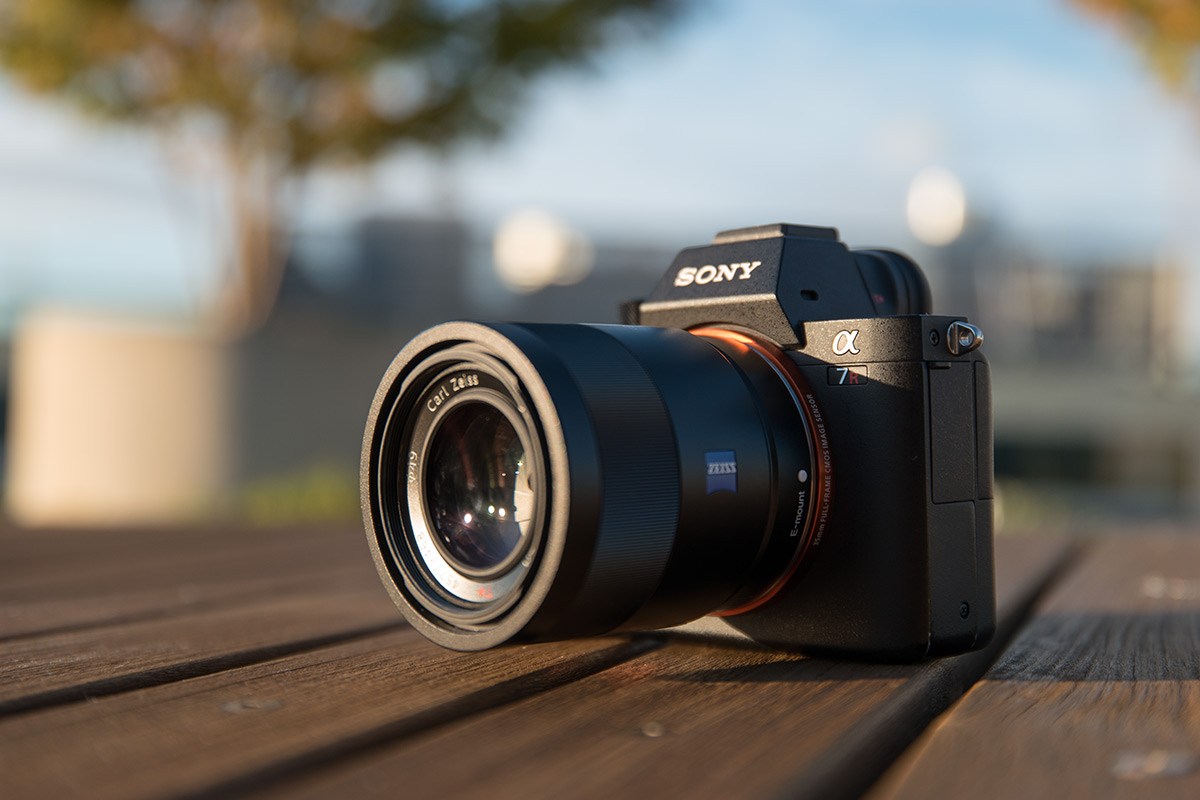
The Sony a7R II was the company’s fourth full-frame Alpha-series camera, coming less than two years after it unveiled the first full-frame mirrorless cameras, the original a7 and a7R.
2015’s Mark Two brought a host of improvements, not least the addition of in-body image stabilization and on-sensor phase detection, both of which had been absent from the original. It was also among the first ILCs to shoot 4K video, though this was over a year after Panasonic’s GH4, which got there first.
But it’s another of its features than made us want to feature it in Throwback Thursday: it was among the first large sensor cameras to use a BSI CMOS sensor. Not the first: that credit belongs to the short-lived Samsung NX1, but the first full-frame example and one from which, unlike the Samsung, other cameras followed.
Back-side illuminated sensors weren’t a new concept
Back-side illuminated sensors weren’t a new concept: Sony’s Semiconductor division had announced its first “Exmor R”-branded sensors some seven years earlier and they’d started to appear in compacts in 2009. So why, with all the promise of sensors with improved image quality, nearly twofold increases in sensitivity and lower noise, did this technology not arrive in large sensors sooner?
The simple answer was that there was less need. Even as Exmor R was being announced, Sony told us that its advantages would mainly be a benefit in small sensors with small pixels in which the circuitry makes up a large proportion of each pixel. In larger sensors, the circuitry interferes less and microlenses could direct light to the photosensitive region very effectively. This technology wouldn’t have such a big impact in larger sensors, we were told.
Sure enough, if we look back at the performance of the a7R II’s sensor, vs that of the original a7R, we don’t see much of a difference, until you get to very high ISO settings. And, as it turns out, much of that difference isn’t so much from the adoption of BSI technology as the move to a dual conversion gain design.
The main advantage of a BSI sensor in the a7R II wasn’t so much about the proportion of the pixel that was light sensitive (as played such a big role in the compact camera sensors) but in the fact that the light-sensitive region was right at the front of the silicon.
Putting the light-sensitive part of the pixel nearer the surface improves the acceptance angle of the pixel
Putting the light-sensitive part of the pixel nearer the surface improves the acceptance angle of the pixel: how extreme an angle the pixel can receive light from. This helped to mitigate the problem that Leica had tried to address with offset microlenses towards the corners of the sensor: making sure that the far corners of the sensor could capture light arriving at awkward approach angles.
This is less critical in APS-C cameras, as the lens is typically mounted a similar distance from the sensor but its corners aren’t so distant from its center. This is likely to be why, other than the Samsung, it would be another three years before BSI technology appeared in an APS-C camera, and even then with what was primarily a speed, rather than low-light benefit.
Sony’s a7R II was a big step forward for Sony’s full-frame lineup, but perhaps its most significant improvement wasn’t necessarily well appreciated at the time.
Loading gallery…
Follow DPReview to ensure our independent journalism reaches your feeds.



Our DPREVIEW Tribute:
After nearly 25 years of operation, DPReview closed on 10 April 2023. This difficult decision was part of the annual operating plan review that parent company, Amazon, shared earlier this year.
Over the course of 25 years, DP Review built up a reputation as being one of the most informative places to go for information about that new camera or lens you’re after. DP Review began as an independent reviews site based in the UK in 1998, the brainchild of Philip and Joanna Askey, but it was eventually purchased by Amazon in 2007 and relocated over to Seattle in the USA in 2010.
Cheers DPReview – thanks for the great work and content that guided photographers, videographers and techno junkies the world over!