
Thousands of unknown viruses discovered in baby poo – why this is not necessarily a bad thing:
An international team of scientists who spent five years studying the poo of 647 Danish babies found something astonishing. The nappy samples contained 10,000 species of virus – ten times the number of bacterial species in the same children. Most of the viruses had never been described before.
This may alarm many readers. Viruses haven’t exactly had a good reputation in recent years. But what many people don’t realise is that the overwhelming majority of viruses do not make people sick and do not infect humans or animals at all.
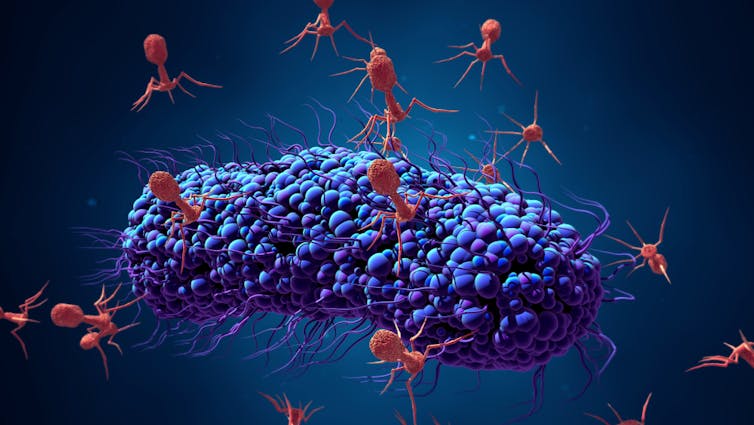
The viruses I’m referring to are bacteriophages. They exclusively infect bacteria and make up a large part of the human microbiome. It’s these bacteriophages that the researchers found so abundantly in baby poo. Indeed, around 90% of the viruses found in the nappies of the Danish babies were these bacteria killers.
The human gut microbiome is a complex collection of microorganisms, including bacteria, archaea, microbial eukaryotes and viruses. The viral component of the gut microbiome, or virome, is mainly made up of bacteriophages that help maintain a healthy and diverse microbiome.
Atlas
The researchers of this new study – a collaborative team from Denmark, Canada and France – looked at how many of these 10,000 viruses were new and how best to describe all this new viral diversity in an accessible form.
Putting all of them in a large table would be a rather boring read. Instead, they created an “atlas of infant gut DNA virus diversity”, where they grouped the viruses into new virus families and orders based on how similar the genomes were to each other. They found 248 families of which only 16 were previously known.
The researchers named the remaining 232 newly identified virus families after children who took part in the study, such as Sylvesterviridae, Rigmorviridae and Tristanviridae.
An interactive version of the atlas is available online.
Unique viromes
What is interesting about bacteriophages and other viruses in the gut is that every person has their own unique set, with almost no overlap between two different people.
While each gut virome is unique, it is also stable over time in adults, meaning you carry with you the same set of viruses as you age. But right after a baby is born, this virome is very different from that of an adult and it only stabilises after a couple of years.
When comparing the approximately 10,000 viruses of this new study with extensive reference virome collections of healthy adults, the researchers found that only about 800 of these viruses had been found before.
That means that when babies are born and have the first bacteriophages colonise their gastrointestinal tract, these “baby bacteriophages” don’t all stay there, but gradually get replaced with “adult bacteriophages”.
This replacement could be partially linked to the bacterial hosts these bacteriophages infect. For example, Bacteroides, Faecalibacterium and Bifidobacterium were the most prominent hosts that were predicted for the baby bacteriophages.
I’d like to highlight Bifidobacterium species here, which are very important for infant health. These bacteria help with the digestion of breastmilk and so are important early in life, but become less abundant as we age. So it makes sense that the viruses that infect Bifidobacterium are found more in babies and less in adults.
Conversely, the most abundant group of adult gut bacteriophages, members of the order Crassvirales were not as prevalent in baby poo, meaning children acquire these bacteriophages as they age.
With the addition of these 10,000 new virus species and the many new families, from just one group of several hundred Danish babies, it becomes clear that there’s more that we don’t know about the virome than what we do know. But the scientific community is working on it, one baby poo sample at a time.

Evelien Adriaenssens receives funding from the Biotechnology and Biological Sciences Research Council (BBSRC) and Medical Research Council (MRC). She is affiliated with the International Committee on Taxonomy of Viruses.
: The Conversation – Articles (UK)
Have you tried: Travelling to South Africa?
