
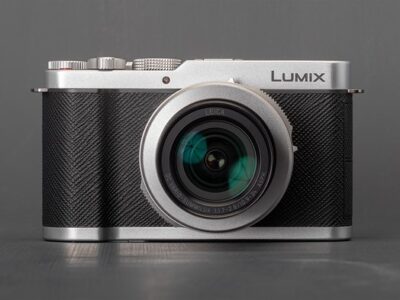
 |
| Photo: Mitchell Clark |
Our test scene is designed to simulate a variety of textures, colors, and detail types you’ll encounter in the real world. It also has two illumination modes, full even light and low directional light, to see the effect of different lighting conditions.
Shooting in Raw at its base ISO, the L10 captures a good amount of detail, on par with the Sony and Canon, and slightly more than the LX100 II. Despite using the same amount of sensor area as the LX100 II, it provides an image that’s 1EV cleaner thanks to its ability to gather more light by shooting at ISO 100 instead of 200. Likewise, it produces slightly less noise than its Type-1 peers, thanks to its 66% increase in sensor area.
This advantage continues through to higher ISOs, though if you find yourself shooting in the dark often, it’s worth considering the noise advantage that APS-C compacts like the Ricoh GR IV or Fujifilm X100VI provide, at the cost of less versatility thanks to their prime lenses. The L10’s JPEG engine does a decent job of retaining details while reducing noise, though the older cameras that act as its competition are decent in this regard, too.
 |
|||
| Standard Color Profile | L.Classic Neo | L.Classic | L.Classic Gold |
Where Panasonic’s processing has improved is when it comes to its JPEG colors. Overall, they’re pleasing and more punchy, and we’ve enjoyed them in the pictures we’ve taken with it outside of the studio. And if you don’t enjoy the colors in its built-in modes, it’s almost infinitely customizable thanks to the L10’s Real Time LUT system.
Dynamic Range
 |
|
The L10 provides plenty of latitude to shoot to preserve highlights, then brighten in post. Panasonic L10 | 75mm equiv. | F2.8 | 1/500 sec | ISO 100 | Edited to taste in Adobe Camera Raw |
The sensor used in the L10 has been shown to have great dynamic range in the other cameras we’ve tested that use it, and we’re happy to say the L10 is no exception. While its deepest shadows aren’t quite as clean as those of the cameras that use the sensor’s entire area, you still have plenty of room to exploit them. There’s perhaps not as much difference as we might expect from a camera that can combine high and low gain readout in a 16-bit space, vs the 12-bit, single-read approach from the LX100 II, but they should still be pretty flexible.
Exposure Latitude | ISO Invariance
Likewise, the sensor has very little read noise, giving you the option to choose an exposure, then lower your ISO to preserve highlights without having to worry about a ton of additional noise showing up in post when you raise the shadows. Shots at ISO 100 pushed 4EV will show a little more noise than shooting at ISO 1600 in the first place, but even by ISO 200 the difference isn’t particularly distinguishable.
Lens performance
When we reviewed the LX100 II in 2018, we said that camera’s 17MP sensor was showing the limits of the lens. With the L10 essentially using the same optics, paired with a higher-resolution sensor, that’s even more true today, with noticeable softness in the corners even when stopped down to F4 or 5.6 (though doing so provides noticeable improvement versus faster apertures like F2.8).
The bright, complex, foldable lenses on compacts are quite susceptible to sample variation, and we aren’t able to test multiple copies of the camera. Putting it in the studio scene also pits it against extremely high-quality primes, many of which are larger and heavier than the L10 in its entirety, and holds it to a higher standard than most would expect from their real-world shooting. In the process of shooting our sample gallery, we haven’t come across many situations where the lens felt inadequate for what we were trying to capture.

Our DPREVIEW Tribute:
After nearly 25 years of operation, DPReview closed on 10 April 2023. This difficult decision was part of the annual operating plan review that parent company, Amazon, shared earlier this year.
Over the course of 25 years, DP Review built up a reputation as being one of the most informative places to go for information about that new camera or lens you’re after. DP Review began as an independent reviews site based in the UK in 1998, the brainchild of Philip and Joanna Askey, but it was eventually purchased by Amazon in 2007 and relocated over to Seattle in the USA in 2010.
Cheers DPReview – thanks for the great work and content that guided photographers, videographers and techno junkies the world over!