
The night is full of animal life, but scientists know very little about it:

Human disturbance is rapidly changing the nature of the nocturnal world. Intensive farming, suburban spread, artificially lit cities, and continuously busy road systems mean daytime species are becoming increasingly active throughout the night. Ecologists suggest that the majority of land animals are either nocturnal or active across both the day and night.
Recent research has also shown that the night is warming considerably faster than the day. The stifling night-time heat experienced across Europe this summer is indicative of this, placing nocturnal animals under even greater stress.
The transforming night adds new sensory pressures concerning finding food, a mate, and navigating a world permeated by artificial illumination. Environmental change is severely threatening the ability of nocturnal animals to coexist with humans. The conservation of nocturnal species has therefore become urgent.
Despite the abundance of night-time life, the understanding of nocturnal species has evaded science throughout history. Physical restraints on human navigation in the dark are partially responsible for this. This scientific blind spot is referred to as the “nocturnal problem”.
The legacy of this inaccessibility remains a barrier to our understanding of nocturnal life today. However, given the environmental threat now facing the nocturnal world, this will have profound consequences should it remain unaddressed. A better understanding of nocturnal life is critical to ensure its effective protection.
The origins of the ‘nocturnal problem’
So how did the nocturnal problem arise and why does it still impede science?
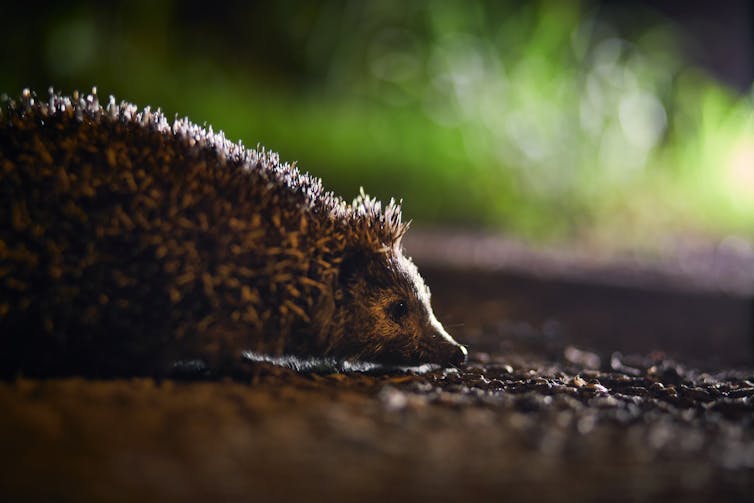
Constrained by their own reliance on vision, early scientists struggled to imagine the different ways in which animals might navigate in the dark. The myths that built up around familiar nocturnal creatures, such as hedgehogs, are evidence of historical attempts to fill the scientific gap.
The Greek philosopher Aristotle suggested that hedgehogs poached apples and carried them off on their spines. Such mythology was commonly included within Victorian natural history texts as an introduction to more factual descriptions of hedgehog anatomy, such as their capacity for smell and other bodily adaptations.
But even artificial illumination afforded very limited access. Illumination fundamentally changes the nature of the nocturnal world, with impacts on animal behaviour. A good example is the attraction of moths to street lights.
The historical debate surrounding how insect-eating bats navigate their dark world illustrates the problem. Numerous attempts have been made to understand bat senses. However, it was not until the late 1930s, more than 150 years after experimentation on bats had begun, that the scientists Donald R. Griffin and Robert Galambos identified echolocation – the ability to navigate via the emission and detection of sound signals.
Griffin would later describe the secrets of bat senses as a “magic well”, acknowledging the fundamental challenge of comprehending senses so different from our own.
But efforts to understand nocturnal senses could only take scientists so far. In 1940, American naturalist Orlando Park declared that the biological sciences suffered from a “nocturnal problem”, in reference to the continued inability to understand the nocturnal world. This was reflected in the more recent philosophical text of Thomas Nagel, which posed the question what it like is to like to be a bat?
Persistence of the nocturnal problem
Despite technological developments, including the introduction of infrared photography, aspects of nocturnal life continue to elude modern science.
While technology has afforded scientists a much better understanding of echolocation in bats, our way of thinking about bat senses remains limited by our own dependence on vision. When describing echolocation, scientists still suggest that bats “see” using echoes.
The elusive Australian Night Parrot was presumed extinct for much of the 20th century. Although they have been recently rediscovered, scientists remain unable to estimate their population size accurately while questions over the threats facing the species persist.
Despite an improvement in scientific research, nocturnal life remains understudied. In 2019, life scientist Kevin J. Gaston called for an expansion of research into nocturnal life. History shows us that when there are scientific gaps in knowledge about the night, cultures create their own truths to fill those gaps. The consequences of doing so may be significant.
The night is ecologically rich and efforts to fill these gaps in scientific understanding should be prioritised. The nocturnal world is threatened by environmental change, and its future depends on our commitment to getting to know the darkness.

Dr Andy Flack received funding for this research from the Arts and Humanities Research Council. The funding relates to the project 'Dark-dwellers as more-than-human misfits'.
Alice Would was a Research Associate on Dr Andy Flack's AHRC Leadership Fellows Project 'dark-dwellers as more-than-human misfits.'
: The Conversation – Articles (UK)
Have you tried: Visiting Port Elizabeth?