
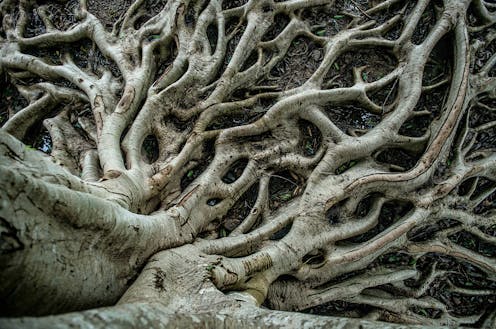
Plants have colonised the vast majority of the Earth’s surface. So what is the key to their success?
People often think of plants as simple, senseless life forms. They may live rooted in one place, but the more scientists learn about plants, the more complex and responsive we realise they are. They are excellent at adapting to local conditions. Plants are specialists, making the most of what is close by to where they germinate.
Learning about the intricacies of plant life is about more than inspiring wonder in people though. Studying plants is also about making sure we can still grow crops in the future as climate change makes our weather increasingly extreme.
Environmental signals shape the growth and development of plants. For example, many plants use day length as the cue to trigger flowering. The hidden half of plants, the roots, also use signs from their surroundings to ensure their shape is optimised to forage for water and nutrients.
Roots protect their plants from stresses such as drought by adapting their shape (branching to increase their surface area, for example) to find more water. But until recently, we didn’t understand how roots sense whether water is available in the surrounding soil.
Water is the most important molecule on Earth. Too much or too little can destroy an ecosystem. The devastating impact of climate change (as recently seen in Europe and east Africa) is making both floods and droughts more common. Since climate change is making rainfall patterns increasingly erratic, learning how plants respond to water shortage is vital for making crops more resilient.
Taking root
Our team of plant and soil scientists and mathematicians recently discovered how plant roots adapt their shape to maximise water uptake. Roots normally branch horizontally. But they pause branching when they lose contact with water (such as growing through an air-filled gap in the soil) and roots only resume branching once they reconnect with moist soil.
Our team found that plants use a system called hydrosignalling to manage where roots branch in response to water availability in the soil.
Hydrosignalling is the way plants sense where water is, not by measuring moisture levels directly but by sensing other soluble molecules that move with the water within plants. This is only possible because (unlike animal cells) plant cells are connected to one another by small pores.
These pores enable water and small soluble molecules (including hormones) to move together between root cells and tissues. When water is taken up by the plant root, it travels through the outermost epidermal cells.
The outer root cells also contain a hormone that promotes branching called auxin. Water uptake triggers branching by mobilising auxin inwards to inner root tissues. When water is no longer available externally, say when a root grows through an air-filled gap, the root tip still needs water to grow.
So when roots can’t take in water from the soil they have to rely on water from their own veins deep inside the root. This changes the direction of water movement, making it now move outwards, which disrupts the flow of the branching hormone auxin.
The plant also makes an anti-branching hormone called ABA in its root veins. ABA moves with the flow of water too, in the opposite direction to auxin. So when the roots draw down on water from the plants’ veins, the roots are also drawing the anti-branching hormone towards themselves.
ABA stops root branching by closing all the small pores that connect root cells – a bit like blast doors on a ship. This seals off root cells from each other and stops auxin freely moving with water, blocking root branching. This simple system allows plant roots to fine tune their shape to local water conditions. It’s called xerobranching (pronounced zerobranching).
Flower power
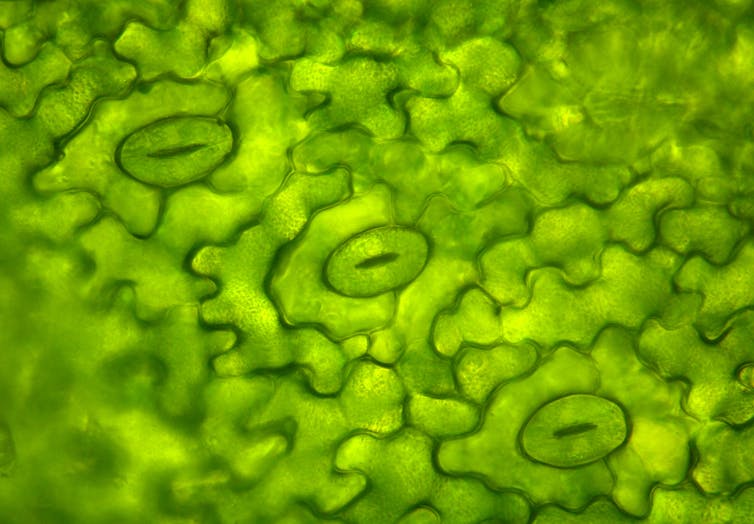
Our study also found that a plant’s roots use a similar system to reduce water loss as its shoots. Leaves stop water loss during drought conditions by closing micro-pores called stomata on their surfaces. Stomata closure is also triggered by the ABA hormone. Similarly, in roots ABA reduces water loss by closing nano-pores called plasmodesmata that link every root cell together.
Roots from tomato, thale cress, maize, wheat and barley all respond to moisture in this way, despite evolving in different soils and climates. For example, tomatoes originated in a South American desert, whereas thale cress comes from central Asian temperate regions. This suggests xerobranching is a common trait in flowering plants, which are over 200 million years younger than non-flowering plants such as ferns.
Roots from ferns, an early evolving land plant species, don’t respond to water in this way. Their roots grow more uniformly. This suggests flowering species are better at adapting to water stress than earlier land plants such as ferns.
Flowering plants can colonise a wider range of ecosystems and environments than non-flowering species. Given the rapid changes in rainfall patterns across the globe, the ability of plants to sense and adapt to a wide range of soil moisture conditions is more important now than ever.

Malcolm Bennett receives funding from UK Research Council BBSRC and hosts EU MCSA and EMBO fellow Poonam Mehra.
Poonam Mehra receives funding from EMBO and Horizon 2020
: The Conversation – Articles (UK)
Have you tried: Travelling to South Africa?