
Check out this Paternoster image:
Temple Bar in Paternoster Square
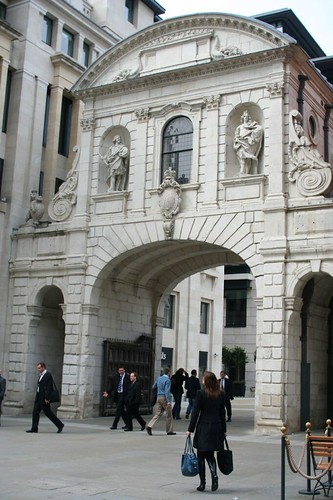
Image by madame_urushiol
Temple Bar is the barrier (real or imaginary) marking the westernmost extent of the City of London on the road to Westminster, where Fleet Street (extending westwards) becomes the Strand. Until 1878 this boundary was demarcated by a stone gateway.
In the Middle Ages, the authority of the City of London Corporation reached beyond the city’s ancient walls in several places (the liberties of London); to regulate trade into the city, barriers were erected on the major roads wherever the true boundary was a substantial distance from the old gatehouse. Temple Bar was the most famous of these, since traffic between London (England’s prime commercial centre) and Westminster (the political centre) passed through it. Its name comes from the Temple Church (an old complex once owned by the Knights Templar but now home to two of the legal profession’s Inns of Court), which is located nearby.
It has long been the custom that the king or queen stop at Temple Bar before entering the City of London, so that the Lord Mayor may offer him or her the City’s pearl-encrusted Sword of State as a token of loyalty. This picturesque ceremony has often featured in art and literature. However, the popular view that the monarch requires the Lord Mayor’s permission to enter the City is incorrect.
Today Temple Bar (like other major entrances to the City of London) is marked by a stone monument in the middle of the roadway, topped by a statue of a dragon, (commonly described as a "griffin"). The dragon comes from the City’s arms, where two of them feature as supporters.
It was moved to its current location in Paternoster Square in 2004.
Image automatically curated and published by www.free-mail.co.za – CLICK HERE to learn more about WP Robot for WordPress.
Have you tried: Sailing in Africa ?