
 |
|
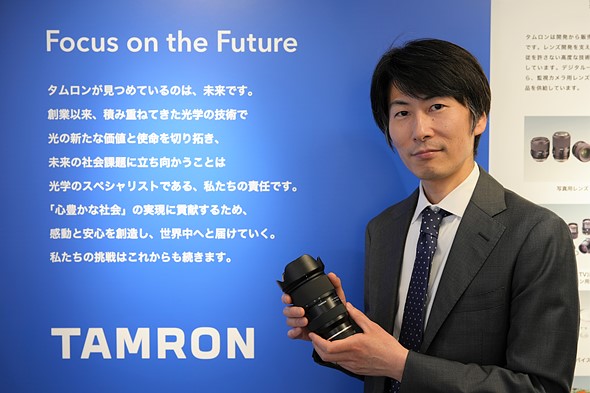
Kota Misawa, Manager, Marketing Planning Department, Tamron Imaging Products Business Unit Photo courtesy of Kota Misawa |
“Tamron is not a big company, so it’s a good point that we can discuss new products with the design department. It’s very easy to talk.” This small company dynamic is a crucial component to Tamron’s success, according to Kota Misawa, Manager of Tamron’s Marketing Planning Department, and one of the reasons the company has succeeded with unique lens designs.
Recent Videos
In an insightful interview with Mr. Misawa earlier this year, we delved into various topics, including the state of the camera market, the importance of designing unique lenses, and how Tamron is leveraging AI technologies to design better lenses.
State of the market
Misawa provides an optimistic overview: “The number of cameras sold last year was 101% compared to the previous year and 104% in value,” Misawa tells us. “And the number of lenses sold was 99% compared to the previous year and 107% in value. So we think we have hit the bottom and we predict the market to remain at the same level as last year.”
That’s reassuring to hear following some tough years for the camera industry, and it’s consistent with what we’ve heard from other industry executives. Focusing more directly on Tamron’s business, he highlights key factors contributing to the company’s success.
“The reason why our business is good is the lineup for our mainstay, Sony E-mount. We have expanded Fujifilm X-mount and Nikon Z-mount, and we have been able to release more than five products every year without delays. And all new models have sold well, so we were able to achieve good business results.”
 |
|
Misawa credits Sony’s E-mount for contributing to Tamron’s success but notes that the company has also expanded its offerings to Fujifilm X-mount and Nikon Z-mount, including this 35-150mm F/2-2.8 Di III VXD for Z-mount released in 2023. Image: Tamron |
Looking forward, he sees hybrid users as crucial to the market over the next several years. “We believe the driving force will be intermediate and above level users who not only take photos but also videos. We think they want to be able to switch smoothly between stills and video. That’s the key point for our next models.”
However, Misawa also acknowledges that some customer segments may deserve more attention.
“We have been able to release more than five products every year without delays. And all new models have sold well.”
“Judging from recent trends, we feel that we are not taking sufficient care of entry-level users, so we would like to continue to develop lenses for these users with good cost and performance.”
Developing unique lenses
Tamron’s success is partly due to its innovative approach to lens design, creating lenses that broadly fit into standard zoom categories but which don’t quite conform to the usual focal length ranges, which allows the company to strike a different balance between size, weight and capability. This includes models like its 28-75mm F2.8 Di III VXD G2 or 70-180mm F2.8 Di III VC VXD G2, which prioritize compact size in their design. According to Misawa, this is an intentional strategy.
“We want to give our users more options when choosing lenses. More than half of our mirrorless lenses are unique lenses. They play an important role and are very popular, so they’re very important to us.”
“We develop unique lenses that are different from conventional zoom lenses in order to meet the diverse needs of users, such as small size, lightweight design, and the ability to take pictures or videos with a single lens. We base designs on users’ needs and think about unique lenses. A 24-70mm F2.8 can’t achieve the small size.”
 |
|
Tamron sometimes creates lenses that broadly fit into standard zoom categories but which don’t quite conform to the usual focal length ranges, like this 28-75mm F2.8 zoom. Photo: Dan Bracaglia |
He explains that Tamron’s smaller scale enables this approach, allowing for easy collaboration between teams.
“Sometimes, we may say we want a lens to cover a specific focal length. Sometimes, we tell the design department that we need a certain size. Sometimes, we just tell them we need a ‘standard zoom lens,’ specify the size of the product, and ask them what kind of focal lengths we can achieve,” he says.
“Tamron is not a big company, so it’s a good point that we can discuss new products with the design department. It’s very easy to talk.”
“More than half of our mirrorless lenses are unique lenses. They play an important role and are very popular, so they’re very important to us.”
Are there any lenses that jump out to him as being particularly significant?
“Maybe the first generation 28-75mm F2.8. That was a new concept because that was a fast lens, but we changed the focal length from 24mm to 28mm and users accepted our concept.”
“That lens was controversial, even in our own company,” he tells us. “And some people were not confident that it would be accepted by users, so we were really relieved that it was.”
The role of AI and optical corrections in lenses
Misawa seems genuinely excited about how AI and machine learning have impacted photography in recent years. “The evolution of cameras is amazing, such as enhanced subject recognition through the use of AI and the inclusion of global shutters,” he tells us.
However, he wants you to know that it’s not just camera companies that are using these technologies. “At our company, we would like to take on new challenges in order to keep up with the evolution of cameras.”
“We’re already using AI technology to improve the performance of vibration compensation when shooting videos.”
He points to a particular example of how Tamron is already using AI to benefit lens design, even if users aren’t aware of it.
“AI in the camera doesn’t affect our lens functions or performance. But we’re already using AI technology to improve the performance of vibration compensation when shooting videos. When we created this vibration compensation mechanism, we tested people shooting video while working, and we tested how the camera shakes and the number of times it shakes. We used the test results to determine the best compensation handshake. So yeah, we can also use AI to improve our functions.”
 |
| Misawa explains that software corrections in lenses are used to achieve a particular design vision, such as a smaller or lighter lens. |
One component of lens design that has been polarizing for some photographers in recent years is the use of software corrections to improve lens performance. Misawa understands why some purists may not favor the practice but clarifies that using such corrections is done to achieve a specific product vision rather than as a crutch in the design process.
“We really focus on compact and lightweight design, so we are using software to achieve this main purpose. But whether it’s a good option or not depends on the lens and the concept of the product. If we are targeting people who really want real optical performance without correction, then we will produce that kind of lens,” he explains.
Misawa says it’s possible to achieve excellent optical quality at a reasonable price and that technology can contribute. But he stresses the importance of the human element.
“When developing new products, we must not forget the in-house know-how that we have accumulated over many years.”
This article is based on an interview conducted by Dale Baskin and Richard Butler at the CP+ expo in Yokohama, Japan. Responses have been lightly edited for clarity and flow.

Our DPREVIEW Tribute:
After nearly 25 years of operation, DPReview closed on 10 April 2023. This difficult decision was part of the annual operating plan review that parent company, Amazon, shared earlier this year.
Over the course of 25 years, DP Review built up a reputation as being one of the most informative places to go for information about that new camera or lens you’re after. DP Review began as an independent reviews site based in the UK in 1998, the brainchild of Philip and Joanna Askey, but it was eventually purchased by Amazon in 2007 and relocated over to Seattle in the USA in 2010.
Cheers DPReview – thanks for the great work and content that guided photographers, videographers and techno junkies the world over!