
Tackling climate change will require reforming the World Bank and IMF – here are two options:
A global transition to a low-carbon economy will require investments of at least US$ 4 trillion a year (£3.4 trillion) according to the implementation plan agreed at COP27 UN climate change summit in Sharm El-Sheikh, Egypt. Delivering this funding will involve nothing less than “a swift and comprehensive transformation of the financial system”, a UN bulletin reads.
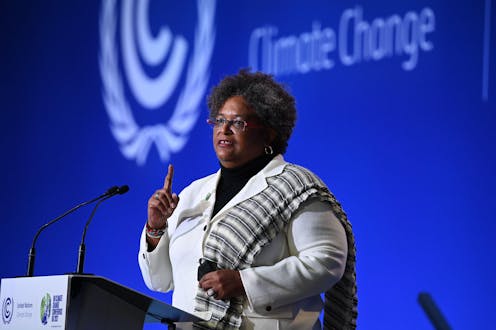
At the start of the conference, the prime minister of Barbados, Mia Mottley, proposed a way to kickstart this process by reforming two of the largest financial institutions: the World Bank Group and the International Monetary Fund (IMF). Her plan, known as the Bridgetown initiative, would mobilise more than US$ 1 trillion from the World Bank among other development lenders and US$ 500 million from the IMF.
Mottley’s proposed strategy is three-pronged. First, increase the volume of finance available to low and middle-income countries to address climate change. Second, hasten the disbursement of this money and make lenders offer more long-term financing, which is critical in maintaining investment. Third, allow countries recovering from disasters to pause their debt payments.
Mottley’s initiative follows claims that the World Bank and other major lenders are institutionally risk-averse, paralysing efforts to raise money to build the solar and wind farms which can replace fossil fuels and the defences which can help countries adapt to extreme weather and sea-level rise. This concurs with some findings in my own research.
Why are these two Washington-based institutions so important for tackling climate change – and how might their strategies need to change?
The right climate for investment
The World Bank and IMF have served two different purposes since their origin in 1944. Both provide funding to low and middle-income countries, but the World Bank mostly funds infrastructure projects, such as wind farms. The IMF typically offers budget support in case of emergencies such as a shortage of foreign currency or an inability to fund government spending.
The World Bank disbursed more than US$ 60 billion in 2022. This amount can be increased in two ways.
First, high-income countries could bring fresh funds to the World Bank. The organisation would in turn use this to offer grants and loans to low and middle-income countries with a zero interest rate (or close to). But this process is open to political influence which might prioritise objectives other than mitigating climate change, like expanding primary education.
Second, the World Bank could act without receiving additional capital from governments. Instead, it would borrow from financial markets and use these funds to lend to low and middle-income countries. In the short term, this would meet the demands from delegates and activists at COP27 that the World Bank give more loans and take more risk. But this is not a long-term solution. Issuing debt may increase the World Bank’s cost of financing, which would eventually be passed on to those borrowers.
This option may ultimately backfire. The Bridgetown initiative proposes more more flexible lending standards which may erode the capital of the World Bank. This is not an abstract hypothesis – the African Development Bank came close to shutting down in 1995 as a result of similar practices.
Overall, I am excited for the new role that the World Bank and IMF could play in coming years. But these two organisations will not meet popular demands to finance climate projects without a large and sustained funding programme by high income countries.
Don’t have time to read about climate change as much as you’d like?
Get a weekly roundup in your inbox instead. Every Wednesday, The Conversation’s environment editor writes Imagine, a short email that goes a little deeper into just one climate issue. Join the 10,000+ readers who’ve subscribed so far.

Nicola Limodio has held consulting positions at the World Bank and International Monetary Fund. He has received funding from the World Bank, the International Growth Center and the PEDL and STEG initiatives at CEPR.
: The Conversation – Articles (UK)
Have you tried: Farking?