
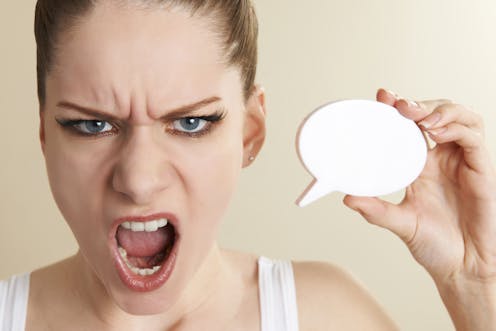
“Skalk,” I cursed in Kelvak. It’s my favourite language to curse in – there is nothing as satisfying as the harsh consonants and default imperatives of the primary Kelvaki language.
This quote is by the main character in sci-fi novel The Widening Gyre by Michael R. Johnston. Writers like Johnston who invent alien profanity rely on their intuitions about what sounds offensive here on Earth.
We wanted to explore whether there are universal sound patterns in profanity. So we designed a series of studies involving speakers of different languages and found surprising patterns in how swear words sound across the world.
The idea that the sounds in such words contribute to their offensiveness violates a linguistic principle: that the relationship between the sound of a word and its meaning is arbitrary.
Some language experts believe this principle is a defining feature of language. For example, it is hard to discern anything windowlike about the sounds in “window”. The word has completely different sounds in other languages, from fenêtre in French, to ???? (“shubak”) in Arabic, and ???? (“chalon”) in Hebrew.
Nevertheless, there are cases, such as onomatopoeia, where words do sound like what they mean (think of the “buzz” of a bee). Likewise, people associate the sound i with small size. And the word for nose is more likely to contain the nasal sound n in different languages than would be expected by chance.
Some researchers argue swear words have sounds that contribute to their offensiveness. Philosopher Rebecca Roache suggests that “the ‘quick and harsh’ sound of swear words … plausibly adds drama to the gleeful thrill of taboo-breaking”.
The most popular theory is that plosives (consonant sounds made by completely blocking the flow of air as it leaves the body, such as p, t and k) allow an emphatic expression of anger or frustration. US-based cognitive scientist Benjamin Bergen argued that ending a swear word with one of these sounds is useful as they “are precisely the type of word you might want to cut short and mumble into your beard.”
A 2010 Canadian study compared sounds in English swear words with those in carols and lullabies. It found swear words had a higher proportion of plosive sounds and fewer sonorant sounds (speech sounds with a nasal, gliding quality) such as l and w.
But this could be an oddity of English. Occasionally you can find a concordance between a sound and a meaning in one language but not others. For example, more than a third of English words beginning with “gl” relate to vision or light, such as “glisten” and “glow”, however, this association emerged randomly and is specific to English.
What we learned
In our first study, we investigated whether some sounds in the swear words of distantly related languages appear more or less frequently than you’d expect.
We recruited fluent speakers of languages from several different language families: Hebrew, Hindi, Hungarian, Korean and Russian, and asked them to give us a list of the worst swear words in their language (some participants reported really enjoying this). Then we compared the sounds in these swear words to those in control words.
We did not find any evidence that plosives were particularly common in swear words. This suggests that any abundance of plosives in swear words might be restricted to English and related languages. But we did discover that a group of sounds called “approximants” (which are created with slight obstruction to the airflow, such as l, r, w, and y) rarely featured in swear words across our set of languages.
Then we conducted a “sweardar” experiment. We created pairs of “foreign” pseudo-words that differed in just one sound (such as yemik and chemik). One member of each pair contained an approximant and the other a control sound, for example, ch. We played them to 215 speakers of a variety of languages (Arabic, Chinese, Finnish, French, German, and Spanish). Their task was to guess which of the two pseudo-words was a swear word.
We reasoned that if approximants are less suitable for swearing, people would be less likely to think the pseudo-words with an approximant were swear words than the matched control words. And that is what our results showed. People consistently judged the foreign words without the approximant to be the swear words.
This made us wonder whether you can make a swear word less offensive by weaving approximants into it. To investigate this hypothesis, we returned to English to look at “minced oaths”. Minced oaths are sanitised versions of swear words formed by altering one or more sounds. For example, changing “damn” to “darn”.
We tested whether the minced forms of English swear words have more approximants. Our results showed that they did, more than twice as many. So, part of the reason “frigging” seems more appropriate for use in polite company than “fucking” may be because it contains an approximant sound, r.

Strong language
Cussing is regulated by law in many countries. Some words are deemed so offensive they are restricted to late night shows. But swearing can be good for us.
Read more: The power of swearing: how obscene words influence your mind, body and relationships
Swearing aloud increases pain tolerance and boosts physical performance.
Part of what gives swear words their potency is the taboo subjects they refer to. The usual suspects include excretion and sex. However, our research suggests the sounds in swear words may also play an important role. Our results indicate swear words do have universal sound patterns – on our planet at least.
As to the wider universe, the jury is out. According to The Hitchhiker’s Guide to the Galaxy, the rudest word in the universe is “Belgium”, which contains an approximant.

Ryan McKay receives funding from the NOMIS Foundation.
Shiri Lev-Ari does not work for, consult, own shares in or receive funding from any company or organization that would benefit from this article, and has disclosed no relevant affiliations beyond their academic appointment.
: The Conversation – Articles (UK)
Have you tried: Travelling to South Africa?