
Concerns over the spread of squirrelpox have increased after a sick red squirrel was found in Bangor, Wales, in late November.
It’s not the first time an outbreak has happened in the area – back in 2020/21, the disease caused a loss of 70%-80% of its red squirrel population. Such major outbreaks are devastating and lead to dramatic and ongoing red squirrel declines.
Conservationists have a formidable task to ensure that similar losses do not happen again. The current national strategy is simple: cull grey squirrels in areas where red squirrels persist. However, there is no single, straightforward way to safeguard the future of this native mammal at the moment.
It is the grey squirrel which carries squirrelpox virus infection, but it does not cause them obvious harm. When they were first introduced from North America during the Victorian era, grey squirrels brought the virus to Britain and Ireland.
Grey squirrels compete for resources with native red squirrels, which is a species with little immunity to the virus. The infection produces extensive skin lesions around the eyes, muzzle and mouth, on the digits and around the genitalia. The sores become infected by bacteria and are a major source of viral particles which contaminate the environment.
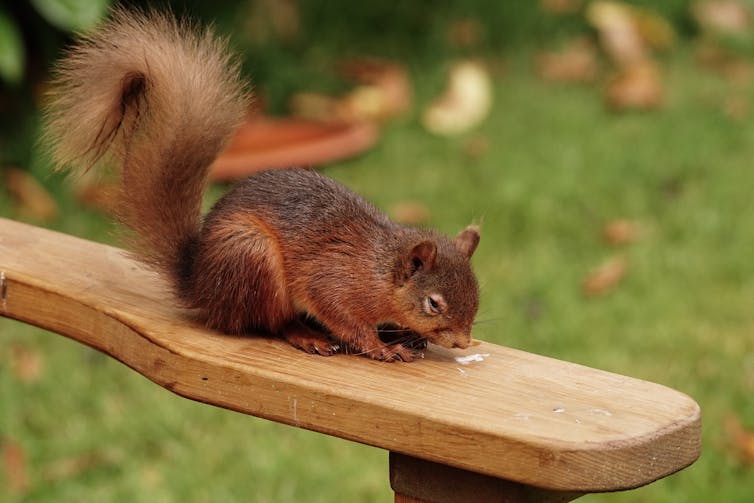
This increases the likelihood of sick red squirrels spreading infection to other reds. Squirrelpox leads to death within three weeks of infection.
Does culling work?
On the island of Anglesey, off the northern coast of Wales, culling between 1998 and 2013 led to the eradication of grey squirrels. As those efforts steadily reduced grey squirrel numbers, the proportion of remaining greys exposed to squirrelpox virus and showing antibodies progressively dwindled to zero, revealing that the virus eventually disappeared from their population.
With fewer hosts to infect, eventually the infection was simply unable to spread between hosts. Although red squirrels were reintroduced before the grey squirrel eradication was completed, the steady decline in levels of infection among grey squirrels explains why no diseased reds were found on the island.
Across Wales, an estimated 1,500 red squirrels may remain. Whereas there were only 40 on Anglesey in 1998, today there are perhaps 800.
In 2009, red squirrels were first recorded on the Gwynedd mainland having crossed the narrow Menai Strait from Anglesey. This population expanded but since 2017, there have been repeated squirrelpox outbreaks there.
The problem with culling outside of a closed environment like an island is that, to be effective, control has to be coordinated over ever-larger areas, which is expensive and time-consuming. Sporadic or localised mainland grey squirrel culling simply leads to rapid re-invasion.
Red squirrels also naturally return to the habitats from where greys are removed. This inevitably leads to mixing and continued risk of infection.
Birth control
So what more can be done? A complementary, non-lethal population control method is being developed. This is an oral contraceptive bait which, if consumed, makes grey squirrels infertile. It would be deployed in hoppers designed to only allow grey squirrels access.
Although this is an exciting prospect, research suggests effective use would require grey populations to be reduced first by culling, before the contraceptive is presented. Using bait will also require coordination between a multitude of landowners, not all of whom may wish to be involved or pay for control.
It is therefore an important part of a future solution, but not a simple panacea.
Pine marten to the rescue?
Another interesting possibility could be to use pine martens to control the grey population. The pine marten is being reintroduced into many parts of Britain including woodlands adjacent to Anglesey. The occasional individual has been detected on the island too.
Pine marten predation is more pronounced upon grey than red squirrels, and this fact could lead to the suppression of the squirrelpox pathogen.
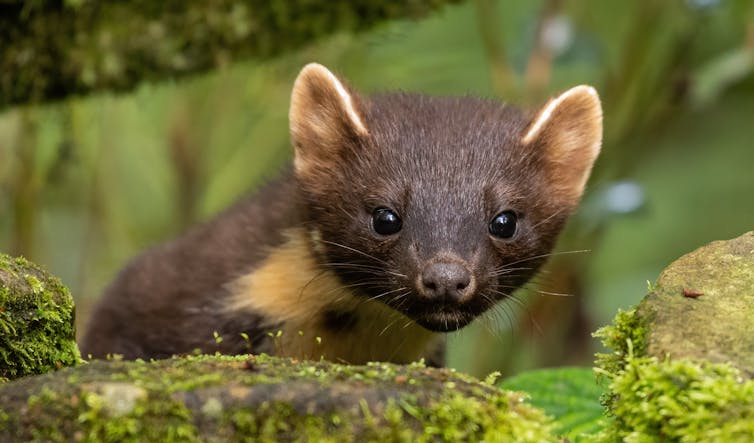
Recent mathematical modelling has reinforced the potential role for this native predator in reducing the impact of invasive grey squirrels and the infectious diseases they harbour. Research by myself and colleagues suggests that grey squirrels would decline if pine martens are reintroduced, and often their numbers would then be insufficient for the virus to be maintained.
One uncertainty is exactly how much of an effect this predator would have, because it is omnivorous and hunts a wide variety of prey. When vole populations are high, for example, pine martens may focus their hunting on this prey, and less on grey or red squirrels. Nevertheless, pine marten recovery is likely to be a positive contribution to grey squirrel management and our modelling predictions are dramatic.
Unfortunately, both this and commercial contraceptive use are only likely to assist in the medium to long term. Consequently, we are currently left with expensive ongoing local culling programmes.
A vaccine is essential
A big gap in our ability to fight squirrelpox comes from the fact there is currently no vaccine available for the disease. The Wildlife Ark Trust funded a vaccine development programme, but insufficient funding meant this research stopped a decade ago.
With no way to inoculate red squirrels against the pox virus, we can do little in the face of inevitable future squirrelpox outbreaks such as that which occurred near Bangor. It is to our collective shame that research halted because of insufficient funding and political will.

I have given long standing and public support for the Wildlife Ark Trust vaccine appeal.
: The Conversation – Articles (UK)
Have you tried: Visiting Port Elizabeth?