
South Africa’s military is set for personnel reforms. Why it matters:
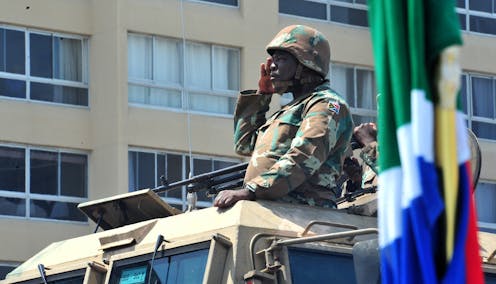
South Africa has the 26th most powerful military in the world, up from 32nd in 2012. It is ranked second in Africa, after Egypt. But, analysts have for years warned that the country’s military is in a state of critical decline. The defence ministry and military leaders have lamented the debilitating cuts to its budget over the years.
The South African National Defence Force (SANDF) is an amalgamation of the former apartheid-era South African Defence Force, the armies of the four former “independent homelands” – Transkei, Ciskei, Venda and Bophuthatswana – as well as the armies of the liberation movements, the African National Congress and the Pan Africanist Congress.
They formed the new South African National Defence Force in 1994. This swelled the ranks of the forces, necessitating a process of rightsizing and the introduction of a flexible service system. This entailed short, medium and long term contracts for staff. Most got medium to long term contracts. Failure to provide appropriate exit mechanisms when contracts expired, contributed to increasing expenditure on personnel. It also led to an ageing force and a failure to rejuvenate the forces.
The declining defence budget has eroded the operating and capital expenditure of the military, leaving insufficient funds for the replacement of equipment, maintenance and infrastructure. As such, only a fraction of the air force is operational, for example.
The financial distress at Denel, the state-owned defence, security and related technology company, has added to the problems. The key supplier to the South African military, both as manufacturer and for the overhaul, maintenance, repair, refurbishment and upgrade of equipment, fell victim to corruption.
The military’s vehicles have deteriorated, and the military does not have enough air or ground capability to protect itself and secure the country’s borders. Reduced funding for the infantry, air defence artillery, air combat, maritime combat and special operations has eroded the effectiveness of the SANDF.
Personnel costs
This, and an excessive wage bill have led to claims that the South African Defence Force is no longer a warfare outfit, but a welfare organisation. The organisation needs to rightsize as a top priority to be fit for purpose.
Salaries are the biggest expenditure, consuming 62.6 % of its R146.3 billion budget for 2022/23. But, this is not totally out of line with the global norm. For example, the defence forces of Nato countries spend an average 51.72% on personnel. Only five – Estonia, Latvia, Luxembourg, Norway, and the United Kingdom spend 40% or less on personnel. Four spend more than 70% of their budget on personnel costs – Belgium, Greece, Montenegro, Portugal and Slovenia.
This year, the SANDF has been granted R91.3 billion (US$ 6 billion) for the compensation of employees over three years. An additional R1 billion (US$ 66 million) has been allocated for employee initiated severance packages, with another R800 million (US$ 56million) available the following year, subject to satisfactory progress. Whether this is enough is uncertain, but it will enable the military to implement staff reforms. This will free up funds for technology and equipment over the medium term.
Over the years, rising personnel costs and unwillingness by politicians to lay off people have resulted in imbalances caused by rank inflation. Rank inflation refers to having too many people in the senior ranks disproportionate to the numbers in the lower ranks. This makes the cost of the top band personnel excessive. Senior personnel often end up doing work that should be done by juniors.
Human resource reforms are required not only to save money, but to rejuvenate the military by bringing down its median age. The average age of an SANDF infantry soldier is 37 years, whereas it should ideally be between 25 and 30 years, for example.
Retrenching soldiers without adequate compensation has been a long-term problem for the government. The additional funding announced in the 2022 national budget will make it possible to offer severance packages to ageing staff, and those who are unfit for duty.
But, there’s a downside.
Offering severance packages might result in an exodus of the remaining skilled personnel, further reducing the capacity of the SANDF. Care should be taken to ensure that key staff are retained when laying off people.
The SANDF is not massively overstaffed for its numerous roles. The current size of the defence force is 73153 members. The problem is the high salaries, some staff not being fit for purpose, and the imbalance in the ratio of the senior and junior ranks. This, coupled with expanding missions, have led to overstretch to the point where the military can no longer meet its obligations within the current budgetary constraints.
Restructuring the forces
Addressing the defence force’s structure is the first step in mitigating its state of decline. Changes to the force structure and design are the next most critical tasks.
The SANDF needs to rebalance its capabilities to perform its core constitutional functions of defending the country against external aggression. In addition, it’s constantly required to perform such non-core functions as helping to fight crime, and helping to combat the COVID-19 pandemic and dealing with political violence. This is a big ask.
The military lacks the necessary ability, flexibility and adaptability to respond to various national and regional emergencies at short notice. To get this right, there needs to first be agreement about what its priorities should be, given the budgetary constraints as well as obsolete and ageing equipment. Should the SANDF be repurposed to support peace and stability efforts in the region, for border protection, public order functions, and disaster relief as priorities?
These matters were debated at a mini symposium in 2020. The military leadership was urged to consider short, medium and long-term challenges and come up with ways to fix them. Nothing has been forthcoming. This is unacceptable given the current security threats facing the country, from both instability in the region and within the country.
South Africa needs a clear national security policy that sets out its security architecture as well as the role of the military. There appears to be a lack of political will, or capacity to provide this guidance.
The violence that rocked the country in July 2021 highlighted the importance of the military having a rapid response unit to support the police and to respond to regional threats. For all these functions, military personnel must be adequately trained, equipped, and funded to protect the country.
This requires a better balance between the full-time forces, reservists, volunteers and private security. Russia’s invasion of Ukraine shows how important it is to have full-time force and a territorial defence capability consisting of volunteers as well as a reserve force in case extra capacity is suddenly needed.
Conclusion
While South Africa is unlikely to face the same conventional threat as Ukraine, it faces a number of unconventional threats. These include terrorism and violent extremism that threaten regional stability. Trans-border crime, illegal immigration and gangsterism are another cause for concern. There are also threats to internal stability emanating from the country’s developmental problems of poverty, inequality and unemployment.
The country needs a force that is flexible, well-equipped, prepared and trained to deal with a range of contingencies. It needs to be ‘packaged’ more optimally. By this I am not advocating the ‘re-militarisation’ of society, but for a better use of the military to serve the citizens of South Africa.

Lindy Heinecken does not work for, consult, own shares in or receive funding from any company or organisation that would benefit from this article, and has disclosed no relevant affiliations beyond their academic appointment.
: The Conversation – Articles (AFRICA)
Have you tried: Visiting Port Elizabeth?