
South Africa is failing to ride the digital revolution wave. What it needs to do:
Workplaces are adopting new forms of advanced automation at a rate that suggests a digital revolution in the making.
Digital technologies such as sensorisation, networked data analytics, and artificial intelligence make it possible to collect data along the entire chain of production and consumption activities. They also enable the data to be used for a host of other purposes. These include shaping markets and industries, offering benefits like reducing production costs and time to market, and increasing product and service quality.
But it is a revolution that is playing out unevenly, across and within countries. This has consequences for the competitiveness, inclusiveness and sustainability of economies.
Countries have varying capacities to optimally harness and integrate these digitalised technologies. Preconditions for uptake include, firstly, reliable enabling infrastructures. This includes connectivity and energy. Secondly, there need to be foundational capabilities, such as digital skills.
Middle-income countries such as South Africa are finding these conditions tough to meet. This is because they have been affected by premature de-industrialisation – a lack of diversification and relative shrinking of their production structure.
Our research shows that South Africa’s adoption and diffusion of digital technologies has been slow and uneven. The research, and an ongoing digital survey, sheds light on the patterns of adoption and the factors influencing them.
We surveyed 516 firms in three key sectors. These were manufacturing, engineering and related services, the chemicals industry and the fibre processing and manufacturing sector.
South Africa has structural constraints that have limited the development and diffusion of skills and capabilities beyond some scattered islands of innovation. The constraints include limited productive diversification, its energy system and a high rate of unemployment.
But the country has potential for more rapid progress. First, it needs to take some crucial steps. It needs better resourced training institutions and more digital upskilling. It needs a more enabling infrastructure such as high speed broadband. It also needs a coherent digital industrial policy framework that enables a new industrial ecosystem.
What the research shows
Our research highlights the potential of advanced digital technologies to drive socially inclusive and environmentally sustainable industrial development. We also identified pockets of the South African economy where this is happening.
Some mining firms, for example, have made processes more efficient and reduced waste. Predictive maintenance uses data analysis to identify problems before they cause production failures.
In the metal-machinery value chains, some foundries are using artificial intelligence to predict sub-surface defects and reduce internal scrap and rework rates. This has had a hugely positive impact on three fronts: reduced energy usage, the environment and competitiveness.
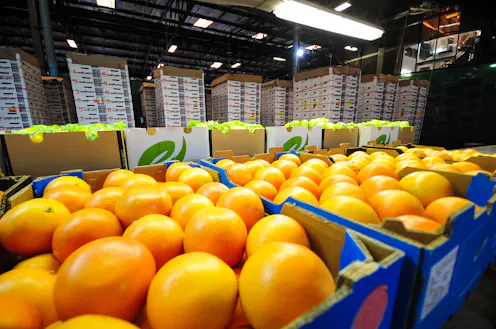
In agriculture, some producers are using digital technologies such as blockchain and radio frequency identification tags. These give farms and their “cold chains” a competitive advantage in the export of high-value fresh fruits. This “industrialisation of freshness” is making it possible for intensive agriculture to expand. The result is more and better jobs.
But the effective use of digital technologies requires reliable digital infrastructure. And firms need skills at all levels. These include programming, web and application development, digital design, data management, visualisation and analytics. Analytics need a strong foundation in literacy, numeracy, and information and communication technologies.
Firms also need the ability to coordinate technological change along chains of activities.
To identify what would enable progress in digital industrialisation, we assessed digital readiness and adoption patterns at both sector and firm level. We found a mixed bag.
A mixed bag
Many of the firms we sampled still use of manual and semi-automated technologies. A smaller group are fully automated and ICT enabled. The full adoption of advanced digital technologies remains very limited.
This was the case in four key business functions: supplier relationships, product development, production management and customer-client relationships.
The picture was mixed, too, across the three sectors that we sampled. Firms in the manufacturing, engineering and related services sector are more ready than others. They have adopted digital system-enabled technologies in the four business functions. Not so for firms in the fibre processing and manufacturing and the chemical industries.
The limited adoption of technologies – and the slow and uneven diffusion – suggest that the process of change will be challenging. But firms expressed the intention to start using more technologies in their production and other structures. They also intend investing in advanced digital technologies.
Policy framework
A broader digital industrial policy framework would help South Africa accelerate digital industrialisation and get training institutions better resourced and aligned
Our survey suggests it should have six related priorities:
-
improved cost, speed, and reliability of ICT infrastructure (bandwidth)
-
digital skills policy
-
digital technology policy
-
financing and investment
-
linkages to development policy
-
economic regulation, competition policy and data.
It should aim to shape a new industrial ecosystem that allows participants to seize opportunities. Key to this is enhancing government capacity to implement and enforce industrial policy. And ensuring more effective cooperation with the private sector.
Overall, digital industrialisation will raise potential trade-offs and new conflicts in the economy. These span issues such employment and new skills requirements as well as need for industrial restructuring. There is also a concern that digital technologies will increase the existing divide between large and small firms. In turn, this will reinforce existing concentration in the economy. That would be bad for re-industrialisation.
A digital industrial policy must therefore ensure that benefits are distributed across different types of firms, their employees, and broader society.
This challenge is certainly not unique to South Africa. Other middle-income economies are facing the same difficulties. They also face the need to work out how to incorporate digital disruption within their existing policy instruments.
The research on which this article is based was conducted through the Industrial Development Think Tank at the University of Johannesburg. The research was later incorporated into a book, Structural Transformation in South Africa: The Challenges of Inclusive Industrial Development in a Middle-Income Country

Antonio Andreoni received funding from the Department for International Development (DFID), African Climate Foundation and Gatsby Africa.
Elvis Avenyo is affiliated with the Centre for Competition, Regulation and Economic Development (CCRED) and DST/NRF South African Research Chair in Industrial Development, University of Johannesburg, Johannesburg, South Africa.
: The Conversation – Articles (AFRICA)
Have you tried: Visiting Port Elizabeth?