
Social media continues to censor women’s health posts as pornography – and it may cause serious harm:
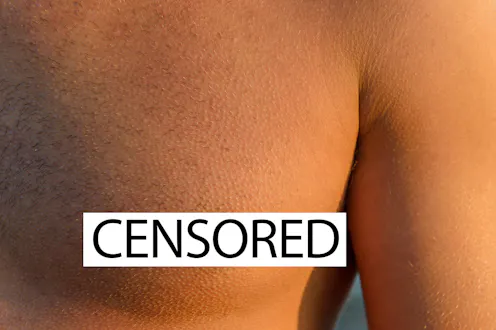
What’s the difference between men’s nipples and women’s? How about men’s pubic hair and women’s?
Well, on social media, at least, the difference seems to be that women’s nipples and pubic hair are considered pornographic and subject to censorship – no matter what the context. Even if it’s a social media post about health issues, such as periods and breast cancer.
Over the last few years, there have been numerous reports of censorship of women’s posts about issues from sexual health to breastfeeding and cesarean sections.
This is sad, but not surprising: women’s bodies are often perceived as sexual, regardless of circumstances.
Breast campaigns classified as porn
There’s something particularly shocking about treating a breast cancer awareness campaign as pornography. Think about how the woman sees her breast in that moment. She is worried that she may have a life threatening disease. She is concerned about her health.
The labelling her image as pornography overrides the woman’s own view of her body and replaces it with an outsider’s view. It treats her body as an object for the sexual pleasure of the viewer. Feminists call this sexual objectification.
In the case of the breast cancer awareness campaign, the clash between the woman’s perspective of her body and pornography classification is stark. This makes it easier to see what is going wrong.
Sometimes it can be more difficult to recognise objectification.
Consider, for instance, the improvement in attitudes towards breastfeeding in public.
In a 2015 Start for Life poll, 72% of people said they supported breastfeeding in public.
Nonetheless, some people still see breastfeeding as sexual and research from 2022 shows that this perception continues to deter some mothers from breastfeeding in public. Again, this involves prioritising how a viewer may see women’s bodies over the woman’s own attitudes and aims.
However, as social media censorship shows, there’s still significant stigma around women’s bodies – and it’s harmful.
Researchers have explored the effects of objectification on women’s mental health. Studies have found that women may begin to view their own bodies primarily as objects for the use of others, and to see themselves as failures if they do not match up to whatever is currently regarded as the “ideal” body shape. Common effects include shame, anxiety, depression, disordered eating and reduced productivity.
‘Vagina’ and ‘vulva’ are dirty words
This view that women’s bodies are sexual regardless of context is so dominant that the algorithm does not recognise alternative reasons for talking about or showing women’s bodies. The algorithm does not recognise that content about women’s bodies may be aimed at women. Women thus lose out on the opportunity to talk about their own bodies or to find out information about their bodies.
In 2023, a campaign from period products brand Bodyform was muted by social media for “sexual content”.
The campaign didn’t feature any nakedness but did include the correct anatomical terms for women’s body parts, including “vagina” and “vulva”. In response to being shadow-banned, the brand went on to highlight a list of forty words relating to women’s health that are regularly censored on social media – the list includes “clitoris”, “discharge”, “menopause”, “miscarriage” and “polycystic ovary syndrome”.
In 2022, the Center for Intimacy Justice studied 60 women’s health companies and found all of their ads were rejected on both Meta and Instagram over the previous three years, with almost half of those companies having their accounts suspended during the period. But in several instances, the ad policies only penalised content related to women and nonbinary people’s sexual health, while men’s sexual wellness brands were approved.
Philosopher Kate Manne argues that even when we push back against the shame many women feel about their bodies, we often end up unintentionally entrenching the idea that women’s body exist for others.
Body positivity is the idea that you should see your body as beautiful no matter what shape it is. Body neutrality suggests that we should aim to feel neutral about how our bodies look. Manne offers instead body reflexivity: my body is for me, and my perspective on it is the only one that matters.
It may seem obvious that my body is for me. But women grow up being told in so many subtle ways that there body is primary an object for others. Against that background, body reflexivity is a radical idea.

Fiona Woollard was part of the Better Understanding the Metaphysics of Pregnancy (BUMP) project funded by European Research Council. She has also received funding from the Arts and Humanities Research Council; the Economic and Social Research Council (through the University of Southampton ESRC Impact Acceleration Account); the Southampton Ethics Centre and the Mind Association. She is an ordinary member of the Labour Party as a private citizen.
: The Conversation – Articles (UK)
Have you tried: Travelling to South Africa?