
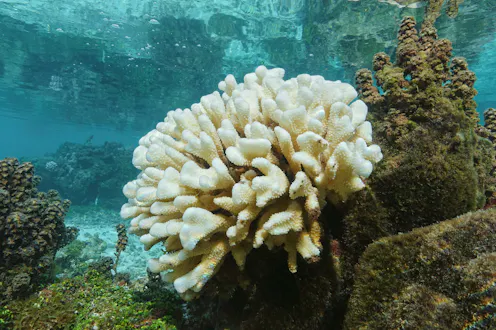
Coral reefs, like sprawling cities of the sea, support an estimated 25% of all plants and animals in the ocean. Worldwide, 1 billion people depend on these ecosystems for food, income and coastal protection.
Unfortunately, coral reefs are dogged with endless sources of stress, from climate change and pollution to overfishing and unsustainable coastal development. The outlook for corals and the reefs they build is not good: without drastic action on greenhouse gas emissions scientists predict that conditions in tropical coastal waters will become inhospitable to corals by the year 2100. If we want coral reefs in our future, we need to be proactive.
Scientists, conservationists and local communities are working to recover unhealthy reefs. There are many options for doing this: encouraging coral sex in the lab to produce enormous batches of coral larvae that can be released into the wild, for example, or selectively breeding and genetically engineering specimens to create stress-resistant “super corals”.
Although coral restoration has become a multi-million dollar business, many restoration projects fail to transform the ecosystem’s long-term prospects, wasting time and resources and raising questions about the ethics of simply putting corals “back out to die”, as Ian Enochs, a US marine biologist who heads the National Oceanic and Atmospheric Administration’s reef monitoring programme in the Atlantic Ocean and Caribbean Sea recently described it.
In our new paper, we propose a new way of thinking about coral restoration: making environmental conditions, such as temperature and nutrient levels, the determining factor for whether reef restoration should go ahead. This might seem obvious, but our survey of academic research on coral restoration from 1984 to 2022 suggested these questions have been neglected.
Reefs of tomorrow
Coral restoration so far has been highly reactive. Efforts have focused on recovering reefs in areas where they have previously been, despite those reefs having recently died. When the cause of a dead reef is distinct and known, such as a one-off pollution event, this might be an appropriate response (so long as the cause of death has been removed).
But degraded coral reefs are more often the result of stress that is not easy to deal with, such as marine heatwaves caused by climate change or vast coastal developments. It’s no surprise that efforts to restore reefs in areas plagued by these problems often fail – the original issue is still present.
We think there are two ways to give coral reef restoration projects the best possible chance of success. First, when restoring corals to a reef that has died, do so with an in-depth knowledge of the area’s environmental conditions – both as they exist today and as they are expected to in future. This information can indicate which coral species are most sensible to use, how they should be grown, when to plant them in the wild and how to attach them to the seabed.

Option two is to nurture new coral reefs in areas where they have not been historically present, but where environmental conditions in coming years and decades may be favourable. We might find these areas at the edges of where coral reefs are currently found. Other areas may emerge as the resolution of environmental monitoring improves.
Go with the flow
Innovation in coral restoration is evidently needed; a host of ethical, political, economic and ecological questions need addressing. It’s time to ensure these decisions are grounded in a robust bedrock of environmental knowledge – to break the restoration cycle of failure we are locked into.
We must recognise that, although a coral reef used to be in a particular place, it might now (or in the near future) be more effective to “restore” that reef elsewhere. Coral restoration could become more goal-oriented and forward-looking.
There are technical limitations to measuring environmental conditions and predicting what they will be like in future. Nevertheless, this fresh outlook allows us to work with environmental change rather than fight against it. If successful, it could help coral reef ecosystems endure for future generations to enjoy.

Don’t have time to read about climate change as much as you’d like?
Get a weekly roundup in your inbox instead. Every Wednesday, The Conversation’s environment editor writes Imagine, a short email that goes a little deeper into just one climate issue. Join the 30,000+ readers who’ve subscribed so far.

Heidi Burdett receives funding from the Vetenskapsrådet (Swedish Research Council) and Formas (Swedish Research Council for Sustainable Development).
Gavin Foster receives funding from European Research Council (Advanced Grant #884650 Microns2Reefs).
Tessa M Page receives funding from the European Research Council (Advanced 332 Grant #884650 Microns2Reefs).
: The Conversation – Articles (UK)
Have you tried: Visiting Port Elizabeth?