
Pumpkin waste: three ways to stop your leftover lantern becoming a Halloween horror story:
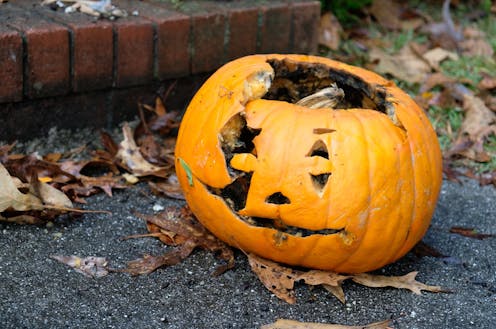
This Halloween, around 18,000 tonnes of pumpkins will go to waste in the UK alone. That’s because, of the 30 million purchased each year, about half go entirely uneaten. That’s £27 million worth of edible food. The global costs will be far higher, once we add in the waste in the US and other countries where pumpkin carving is also a Halloween tradition.
The money spent on buying pumpkins is only a fraction of the true cost. When a pumpkin is wasted, the water, energy and labour used to grow and distribute it is also wasted.
For every kilo produced, around 260 grams of carbon dioxide equivalent greenhouse gases are emitted. Then when a pumpkin decomposes in a landfill it emits methane, which is a more potent greenhouse gas than carbon dioxide.
Growing pumpkins also requires plenty of water. When pumpkin leftovers are discarded, the freshwater used in their production is also wasted. The importance of freshwater reserves was well recognised in summer 2022 when much of the UK had hosepipe bans.
In a world where 2 billion people are malnourished, despite the fact that food systems could sustainably feed the total world population, and where families turn to food banks even in wealthy countries, wasting perfectly edible pumpkin is immoral.
Despite all this, we can still make a difference this Halloween. As an academic expert in circular food supply chains, I know how important it is to avoid wasted food, and I have studied how to ensure leftover food is put to use. So I know that people can eliminate these negative impacts of pumpkin waste by simply using leftover pumpkins. Here are the three practical methods.
Cakes, bread, soups and coffee
According to a survey of 3,000 Britons, only 42% knew that the inside of a pumpkin is edible. Repurposing leftovers in cooking and beverages can be one of the simplest ways to use up leftovers.

There are numerous recipes on the internet for cupcakes, bread, puree or soup. There are tasty coffee and mocktail recipes, or you can use your creativity to build your pumpkin cocktails with your favourite ingredients. However, it is crucial to remember that leftover pumpkin should be stored in the fridge and will last for a few days.
Masks, scrubs and soap
Not everyone feels comfortable using leftovers in food, and luckily, leftover pumpkins can be used for other purposes, such as do-it-yourself projects at home. Pumpkin is high in iron, potassium, and copper, as well as vitamins A, B2, C, and E, making it an excellent beauty ingredient.
You can use the leftover pumpkins for face masks, body scrubs and soap as do-it-yourself projects. You can even use it to make candles as well.
Feed some plants or animals
If you don’t want to hassle with the leftover and carved pumpkins, you can always donate them – zoos, farms and community gardens often welcome pumpkin donations. They can use it as compost material or animal snacks.

A recent study showed that if a person is aware that their actions will have a negative impact on the environment, they will try to adopt pro-environmental behaviour. Similarly, sharing the pro-environmental behaviour on social media sets examples and influences others to be more sustainable.
In this case, the pro-environmental behaviour will be using the leftover and carved pumpkins. You can adopt one of the above-mentioned practical ways and post the result on social media.
As I found in my own research, creating and using hashtags, as well as publicising your efforts on social media, will motivate your family and friends to join you. The more the better. Because, in the end, every attempt to eliminate waste is worthwhile.

Don’t have time to read about climate change as much as you’d like?
Get a weekly roundup in your inbox instead. Every Wednesday, The Conversation’s environment editor writes Imagine, a short email that goes a little deeper into just one climate issue. Join the 20,000+ readers who’ve subscribed so far.

Ebru Surucu-Balci does not work for, consult, own shares in or receive funding from any company or organization that would benefit from this article, and has disclosed no relevant affiliations beyond their academic appointment.
: The Conversation – Articles (UK)
Have you tried: Sailing in Africa ?