
Amputation can have a devastating effect on a person’s body image and sense of self. The use of prosthetic limbs may help, but when it comes to their appearance, options are often limited.
The choice, if there is one, usually comes down to either a prosthesis with a realistic appearance that helps users hide the limb loss, or a mechanical version which offers greater functionality, but is more easily noticeable.
To address this gap between function and appearance, some companies and designers) are now working on “expressive prostheses”. These are prosthetic limbs where the design focuses on the appearance, with the aim of highlighting the user’s identity.
The idea is that by transforming prostheses into accessories, expressive versions can help users make positive statements about themselves. They may also be able to question notions of normalcy about the human body, and help eliminate stigmatisation.
A recent research project explored the effects of a “co-design” approach between prosthetic makers and users in developing personalised covers. The project reported that amputees found involvement in the design process a positive experience, and the benefits extended beyond an “expression of identity, supporting confidence and a potential to create a positive image of disability”.
Another study looked into preferences towards prosthetic limbs with a realistic or non-realistic appearance. It found that prostheses with a high level of human likeness were considered by non-users to be more attractive than those with a more mechanical appearance.
But the reverse was true for the prosthetic users themselves, who preferred prostheses with robotic designs, perhaps because of their greater functionality.
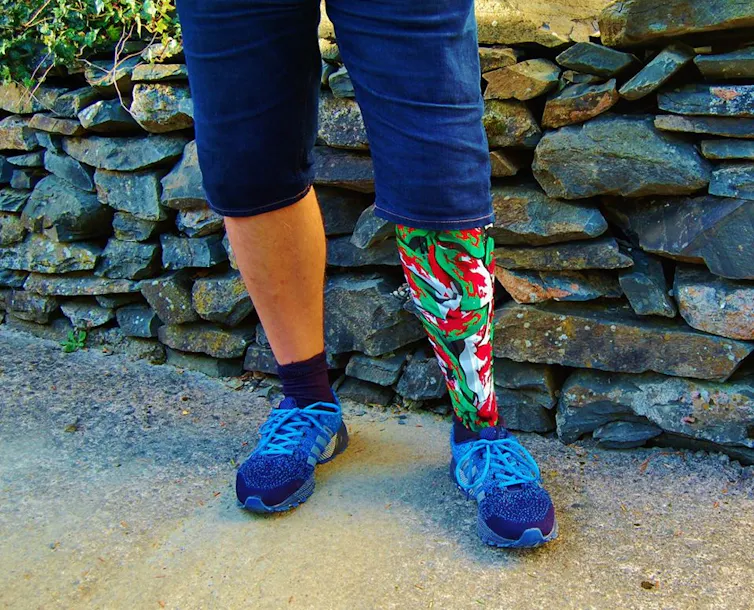
This is where expressive prostheses can come in. Researchers have also argued that such prostheses could help to alter society’s attitudes towards prosthetic users, where notions of disability and impairment can have negative connotations.
We know culture plays a major role in people’s attitudes towards disability. Specifically, research shows that in individualistic societies like the US and the UK, where people tend to value personal identity and individual goals, attitudes towards disabilities are less stigmatised than in collectivist societies like China and Greece, where the emphasis is on maintaining group harmony.
Talking points
My own study aimed to explore the effects of the appearance of prostheses in different cultures. To do this, I spoke to users in the UK as an individualistic culture, and in Greece as a collectivist one.
All participants stated that expressive prostheses were more attractive than conventional ones, and improved their self-confidence. They also mentioned that expressive prostheses were useful as conversation starters with non-users, providing an opportunity to discuss limb loss with other people.
James, for example, a 56-year-old British man who uses two lower replacement limbs, said that an expressive version “allows the user to make a statement” and “would be a good talking point”.
A common experience of a certain awkwardness around approaching people with limb loss also emerged. Margaret, a 19-year-old Greek woman who has an upper limb prosthetic said: “I think (expressive prostheses) might help people who are more open minded feel more comfortable to open themselves to others who present a difference”.
Sebastian, a 47-year-old British lower limb prosthetic user, pointed out that the use of expressive prostheses had a “fundamental difference” on people’s reactions towards him and his prosthesis. He said they had the potential to provoke a more positive response compared to other types of prosthetic.
The interviews also highlighted the importance of culture on the formation of people’s attitudes. Two of the Greek participants for example, suggested that expressive prostheses may actually increase stigmatisation as they may be perceived as being used by people with limb loss to draw attention to themselves.
One thing my research demonstrates is the need to take culture into account during the design of prostheses (and other medical products, such as wheelchairs or hearing aids) to avoid increased stigmatisation.
But it also provides evidence of the largely positive effects of expressive prostheses on users’ self-confidence and how they are treated in society. The next step, I hope, is that great design – and talented designers – will be more widely valued in the manufacture of medical products, for everyone’s benefit.

Anna Vlachaki does not work for, consult, own shares in or receive funding from any company or organisation that would benefit from this article, and has disclosed no relevant affiliations beyond their academic appointment.
: The Conversation – Articles (UK)
Have you tried: Diving with Sharks?