
 |
| Photo: Charles Brooks |
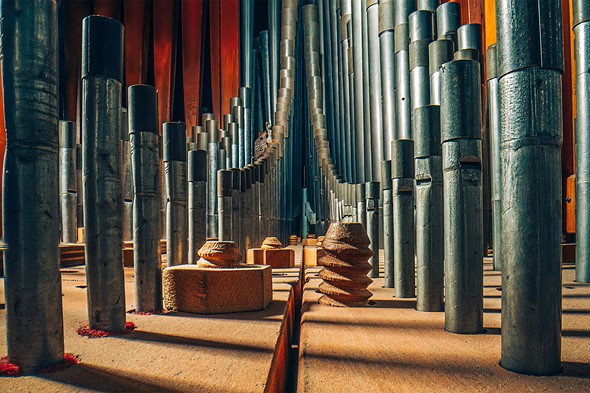
The photo above may look like a city or some sort of industrial plant, but it’s not: it’s actually the inside of a pipe organ, photographed by Charles Brooks. It’s one of the many pictures he’s taken from the inside of musical instruments, a process that’s substantially more complicated than it may seem, especially since he’s often working with rare, historically significant objects.
Charles Brooks spent much of his career as a principal cellist, traveling to perform with renowned orchestras from China to Chile and Brazil. But beyond his music, he also has experience with photography, going back to when he was young. It was a natural combination, then, when he stepped back from playing and picked up his camera. The project that kicked things off for him was when he started capturing the inside of instruments. Brooks was kind enough to talk with me over video chat, sharing his background, what drives him, and unique insight into his Architecture of Music series.
 |
|
“The inside of a heavily restored Double Bass by Charles Theress, circa 1860, one of the finest bass makers in the history of the instrument. Photographed in Wellington, New Zealand, with the aid of it’s present owner Matthew Cave.” Photo: Charles Brooks |
Brooks had been living in New Zealand and photographing musicians when COVID-19 happened, which quickly brought things to a halt. During that time, though, he noticed that since musicians couldn’t play, they were sending off their instruments for repair. As a result, workshops were filled with fantastic instruments, sparking an idea. Brooks said he had seen a few photographs of the inside of instruments before, including some taken for the Berlin Philharmonic, but those always looked like parts had been removed to create the images. He wanted to find a way to photograph the inside of instruments with everything intact.
 |
|
Inside a 2021 Selmer Paris Saxophone. Photo: Charles Brooks |
Luckily for Brooks, Laowa had released its first probe lens not too long before. His first attempt was on a cello, an instrument he is very familiar with. “That wasn’t too hard, since you can take the spike at the bottom off and getting the probe lens in is easy,” he explained. He said he thought it was a nice shot, so he decided to see if he could sell a few and posted it on Reddit. It blew up there, so Brooks started scheming how to continue with other instruments, including smaller ones.
He quickly realized the Laowa probe lens was too big for most instruments. To fix this, the first thing he did was use a heat gun to melt off the waterproof casing to make it a bit smaller (though he doesn’t recommend others do this). That allowed him to photograph pianos, but what he really wanted was to capture the inside of a Stradivarius violin. Violins only have a 5mm hole at the bottom, which is much too small for anything except medical cameras (called scopes), which are not made for high-resolution photography. And so began the rabbit hole that Brooks has found himself going down.
 |
|
“Inside a French violin crafted by Nicolas Augustin Chappuy in 1770. This violin was brought to New Zealand by Le Violin Rouge luthiers (Auckland). They will spend the next year or two restoring it. It’s a stunning old instrument that has been unplayed for quite a while and needs careful care and attention to bring it back to a playable state.” Photo: Charles Brooks |
Brooks says he started by buying 20 to 30 adapters that allow you to attach medical scopes like endoscopes or arthroscopes to cameras. These introduced many problems, though. First, they are made to cover tiny sensors. You could adapt it to a full-frame camera, but most of the resulting image would be black. So he had to find a combination of adapters and magnifiers. “I sort of stacked them on top of each other to get that image circle as large as I could,” he said.
 |
|
“This remarkable photo captures the interior of the first violin I successfully photographed. Initially, it was presented to me as a Hopf, but I believe it is actually a 19th-century replica. This particular violin has been played but never repaired or opened since its creation, a rarity for an instrument of this age. This photograph marks the first time anyone has seen the inside of this violin.” Photo: Charles Brooks |
Unfortunately, every time you add more glass, it degrades image quality. Making things more complicated, “these scopes are so small, they’re right at the limits of diffraction,” Brooks explained. “So even if you do blow it up, you’re going to get a larger image, but it’s not necessarily going to give you any more data. It’s just a bigger blurry image.” He spent a lot of time playing around with adapters and magnifiers and talking to the manufacturers to see what he could do.
In the end, Brooks decided to use the Micro Four Thirds Panasonic Lumix G9 II with his scope setup. “That’s as large as I could get it magnified without it sort of falling to pieces,” he explained. Then, he uses the high-res mode to get larger images, which especially helps because there’s still some vignetting he needs to crop out.
Unfortunately, figuring out the camera and adapter combination didn’t solve everything. He explained that with all the magnification, he was shooting at roughly the equivalent of F250, meaning there was essentially no light. His solution was to use a bunch of flashes at the highest power possible, but that adds a lot of heat, and old instruments don’t tolerate heat well. To keep these expensive instruments safe, he has to ensure that the varnish doesn’t get over 28°C. So, he constantly measures the temperature and pauses between each shot to keep everything cool.
 |
|
A photograph of the inside of a Geminhardt Elkhardt Alto Flute, which is the result of combining 960 individual images. Photo: Charles Brooks |
After lots of trial and error, Brooks landed on a process involving a combination of focus stacking and panoramic stitching. He uses the probe to rotate around the inside of the instrument, almost like a clock. However, the probe only focuses on roughly 2mm at a time. He wants it all in focus so that it doesn’t look like a classic macro shot, so he’s taking 20 to 30 images to get it all in focus. He also takes dark frames, like astrophotographers, to prevent hot pixels. Plus, given that the probe lens isn’t made for photography, the light transmission isn’t even across the frame. So, he photographs a piece of paper to identify where the vignetting starts, determining where he needs to take additional photos to compensate.
 |
|
“Deep inside the action (the moving parts) of one of the world’s finest grand pianos. Fazioli make around 100 of these instruments a year, each handcrafted with over 8000 individual parts. Shot with a Lumix S1R and a Laowa Probe lens, 100 images at various focal distances have been stacked together for sharpness from front to back, giving a distinct architectural appearance reminiscent of a concert hall or film set.” Photo: Charles Brooks |
If you’re thinking that sounds like a lot of images, you’re right. Brooks says that there isn’t a single final image with fewer than 100 shots stacked together, and some have more than 1,000 individual frames stacked. It’s an incredibly time-consuming and technical process, both while shooting and in post-production.
Every part of his process is intentional because he doesn’t want the images to look like miniatures. The focus stacking helps him avoid the typical aesthetic of macro photography by reducing the amount of background blur and focal compression. Creating an image that looks like it was taken with an ultra-wide-angle lens also results in leading lines we associate with normal-sized things, like streets and buildings, which tricks your brain into thinking the subject is not small. He also uses lighting to make it look like the sun is shining down, emphasizing the feeling that you are standing inside something. Finally, when Brooks displays prints, they are massive, adding to the feeling that you are inside a grand structure. For example, one upcoming show will have prints that are five by seven meters (16 x 23′).
 |
|
“This is a photograph showcasing the interior of one of the world’s most exceptional violas, a magnificent 1619 creation by Nicolò Amati. The instrument is on a long-term loan from The Adam Foundation to the New Zealand String Quartet. It is presently being played by Gillian Ansell, a founding member of the quartet, and one of the greatest viola players to emerge from New Zealand.” Photo: Charles Brooks |
His unique way of photographing the instruments is part artistic and part documentary. He’s photographing some of the finest instruments in the world. While they may look the same on the outside, with finely polished finishes and pristine surfaces, inside is a historical record. His photographs reveal the maker’s marks, repairs, signatures and imperfections from use or cleaning the instruments. Because of this, he has no plans to slow down and has a list of famous instruments he’d like to photograph someday. You can see more of Brooks’ photographs and read stories behind some of the instruments on his website.

Our DPREVIEW Tribute:
After nearly 25 years of operation, DPReview closed on 10 April 2023. This difficult decision was part of the annual operating plan review that parent company, Amazon, shared earlier this year.
Over the course of 25 years, DP Review built up a reputation as being one of the most informative places to go for information about that new camera or lens you’re after. DP Review began as an independent reviews site based in the UK in 1998, the brainchild of Philip and Joanna Askey, but it was eventually purchased by Amazon in 2007 and relocated over to Seattle in the USA in 2010.
Cheers DPReview – thanks for the great work and content that guided photographers, videographers and techno junkies the world over!