
A nice South African Music image:
Prague Landmarks
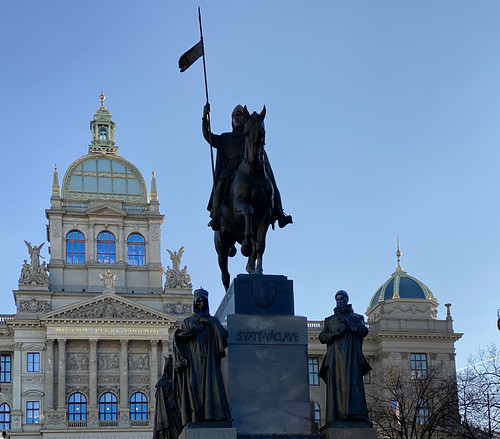
Image by A.Davey
In the background is the Historical Building of the Czech National Museum (1891). The foreground is occupied by the bronze equestrian statue of St Wenceslas (1913/1924).
About the Museum
The National Museum in Prague was founded on April 15, 1818. It was founded by Count Sternberk, the first president of the Society of the Patriotic Museum who served as the trustee and operator of the museum. The early focus of the museum was natural sciences, partially because Count Sternberk was a botanist, mineralogist, and eminent phytopaleontologist, but also because of the natural science slant of the times, as perpetrated by Emperor Joseph II of Austria.
The museum was originally located in the Sternberg Palace. When the venue became too small to house the museum’s collections, the museum relocated to the Nostitz Palace. It too had insufficient capacity, which led to the construction a new museum building in Wenceslas Square.
The museum did not acquire historical objects until the 1830s and 40s, when Romanticism arose. The institution of the museum was increasingly seen as a center for Czech nationalism. Serving as historian and secretary of the National Museum in 1841, František Palacký tried to balance natural science and history, as he described in his Treatise of 1841.[citation needed] However, it was not until nearly a century later that the National Museum’s historical treasures equaled its collection of natural science artifacts.
The museum brought about an intellectual shift in Prague. The Bohemian nobility had, until this time, been prominent, both politically and fiscally, in scholarly and scientific groups. However, the National Museum was created to serve all the inhabitants of the land, lifting the stranglehold the nobility had had on knowledge. This was further accelerated by the historian František Palacký, who in 1827 suggested that the museum publish separate journals in German and Czech.[citation needed] Previously, the vast majority of scholarly journals were written in German, but within a few years the German journal had ceased publication, while the Czech journal continued for more than a century.
In 1949, the national government took over the museum and detailed the museum’s role and leadership in the Museum and Galleries Act of 1959. In May 1964, the Museum was turned into an organization of five professionally autonomous components, which included the Museum of Natural Science, the Historical Museum, the Naprstek Museum of Asia, African, and American Cultures, the National Museum Library, the Central Office of Museology. A sixth autonomous unit, the Museum of Czech Music, was established in 1976.
The Main Building of the National Museum (Historical Building) is located on the upper end of Wenceslas Square and was built by prominent Czech neo-renaissance architect Josef Schulz from 1885 – 1891. Prior to the museum being constructed, there had been several noblemen’s palaces located at this site. With the construction of a permanent building for the museum, a great deal of work, which had previously been devoted to ensuring that the collections would remain intact, was now put toward collecting new materials.
The building was damaged during World War II in 1945 by a bomb, but the collections were not damaged due to their removal to secured storage sites. The museum was reopened after intensive repairs in 1947, and in 1960, exterior night floodlighting was installed, which followed a general repair of the facade that had taken place in previous years.
During the 1968 Warsaw Pact intervention, the main facade was severely damaged by strong Soviet machine-gun and automatic submachine-gun fire. The shots made numerous holes in sandstone pillars and plaster, destroyed stone statues and reliefs, and also caused damage in some of the depositories. Despite the general facade repair made between 1970 – 1972 the damage still can be seen because due to the use of lighter sandstone to repair the bullet holes.
The main museum building was also damaged during the construction of the Prague Metro in 1972 and 1978. The opening of the North-South Highway in 1978 on two sides of the building resulted in the museum being cut off from city infrastructure. This also led to the building suffering from an excessive noise level, a dangerously high level of dust and constant vibrations from heavy road traffic.
Due to the major reconstruction, the museum was closed between 7 July 2011 and 28 October 2018.[5] Seven million items had to be relocated to the museum’s depositories, in what has been dubbed the biggest moving of museum collections in Czech history.[6] In February 2019, the museum’s dome was opened for the first time, which also serves as a view of Prague. The eastern courtyard was also opened and was for the first time roofed, during reconstruction. Since November 2019, the underground corridor connecting the Historical Building to the New Museum Building is newly accessible.
It was partially opened on 28 October 2018. Full completion of reconstruction was planned for 2019. Permanent exhibitions will gradually be opened to visitors in 2020–2021.
en.wikipedia.org/wiki/National_Museum_(Prague)
About the Statue
The sculptural group was made by Josef Václav Myslbek.
The monument was created in 1887 -1924, the bronze equestrian statue of St Wenceslas is 5.5 m high, the height with the pike is 7.2 m and the weight is 5.5 t. The statue is hollow, assembled out of casts based on a plaster model.
The army stallion Ardo was a model for the horse.
The monument was later completed with Czech patron saints – when looking from the front there is a statue of St Ludmila on the left, behind it there is a statue of St Agnes (originally hermit St Ivan), on the right front there is the statue of St Prokop and behind it there is a statue of St Adalbert.
The monument was unveiled in 1913 (not fully completed yet), the last statues of St Adalbert and St Agnes were installed only in 1924. The pedestal is made of polished granite. Alois Dryák participated in the architectural decoration of the monument and Celda Klou?ek in the ornamental decoration.
The sign on the monument: "St Wenceslas, Leader of the Czech Lands, our Prince, do not let us die nor those yet to come."
www.prague.eu/en/object/places/1878/statue-of-st-wenceslas
Image automatically curated and published by www.free-mail.co.za – CLICK HERE to learn more about WP Robot for WordPress.
Have you tried: Diving with Sharks?