
Pfizer’s ultra-cold vaccine could be difficult to distribute:
The excitement that greeted the news of a vaccine candidate that may be highly effective against COVID-19 was indeed something to behold. If the final results show anything like the numbers quoted in the press release, then the world can indeed be pleased and the scientists behind the scenes very proud of themselves.
One complicating factor will be the maintenance of the cold chain. Vaccines are fragile products: they need to be stored at specific temperatures, and some are sensitive to light and need to be transported in dark glass vials. These precise conditions must be maintained throughout the vaccine journey, right until the point when you’re in the GP surgery with your sleeve rolled up and the nurse opens the fridge door to extract the required immunisation.
As an example, let’s say you live in rural Ghana, in West Africa, and the vaccine itself is coming from the UK. The cold chain will have to cover that vaccine leaving the UK manufacturing site, being loaded onto a vehicle and driven to a storage site near the airport, shifting on the aeroplane to Ghana, storage in or near Accra (the capital city), transport to a rural district health centre, and then potentially further transport in a vehicle, or even on foot, across difficult terrain to physically get to a remote population.
That final stage is something healthcare workers in Ghana and all low and middle-income countries do many times a year – for example, with polio vaccination campaigns – and it can be heroic and sometimes dangerous work. Wherever we live in the world, these people deserve our thanks.
Healthcare workers in these settings are well-practised at delivering vaccines everywhere, but you can see the number of separate steps where the cold chain has to be maintained. Essential kit may include a portable fridge in the back of a 4×4, or a cool bag that is carried by hand. Those cool bags may contain “freezer packs” that keep the products sufficiently cool for at least a few hours so that the vaccines don’t spoil.
Eighty below
The Pfizer/BioNTech vaccine needs to be stored at -80?C, which is tricky. This is not an insurmountable problem, but it poses extra logistical challenges. It requires specialist equipment known as “ultra low temperature freezers”. These are typically found in specialist research facilities or biobanks.
Since most routine vaccinations require refrigeration or freezing at much lesser temperatures, a GP practice in the UK is unlikely to already have that facility, let alone a health centre in rural Ghana.
Governments the world over will now be wondering how many of these freezers they’ll need to buy. And at a cost of a few thousand pounds per unit, plus running costs of maybe £500-£750 per year, the bill could get large very quickly. This kind of financial outlay may also be beyond rural Ghana and other resource-poor settings. It’s not just the cost of buying the vaccine itself that we need to think about.
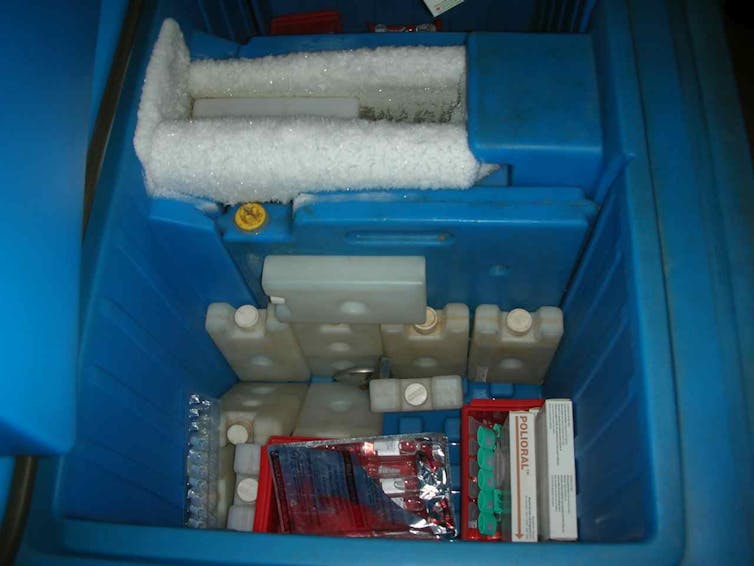
Over the next six to 12 months, we hope that we’ll end up with several different vaccines. They will all have slightly different advantages and disadvantages, including considerations of effectiveness, safety, number of doses, cost and storage requirements. It may be that in high-income countries, vaccinating vulnerable populations with a product that requires two doses and -80? storage is workable. In sub-Saharan Africa, a more useful product may potentially be one that needs one dose and has a less stringent cold chain, even if overall vaccine effectiveness is slightly lower.
The short and medium-term future for COVID-19 vaccine development looks very exciting. However, success in clinical trials is still a long way from the endgame of a highly effective immunisation distributed to all corners of the globe. For now, we await further development with hope, but perhaps also more than a little expectation.

Michael Head has previously received funding from the Bill & Melinda Gates Foundation, and the UK Department for International Development.
: The Conversation – Articles (UK)
Have you tried: Sailing in Africa ?