
People stay vigilant to the threat of malaria, even when infections fall:
Since the turn of the century great strides have been made to reduce the burden of malaria in sub-Saharan Africa. But the disease, spread by the Anopheles mosquito, still remains a major threat: in 2015 there were an estimated 212 million cases worldwide, according to the most recent World Malaria Report.
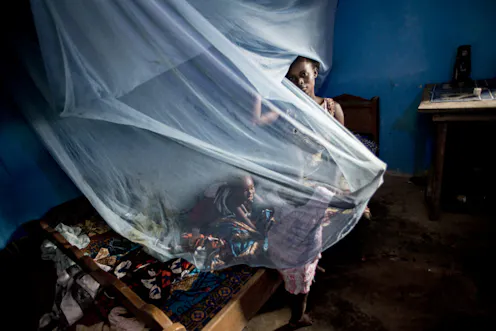
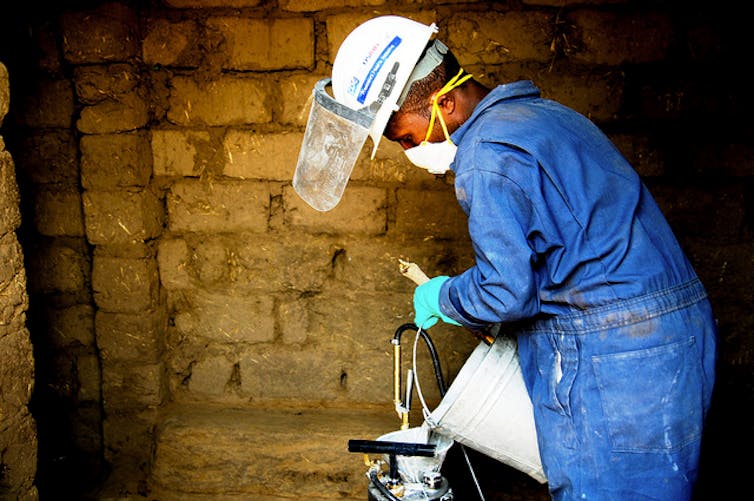
Malaria can be prevented in several ways, in particular by sleeping under an insecticide-treated bed net and spraying homes with an insecticide.
Bed nets are a commonly used prevention method while indoor residual spraying is only done in specific high risk areas. In 2015, about 53% of the at-risk population in sub-Saharan Africa slept under an insecticide treated net. In the same period, 3.1% of the population at risk of contracting malaria in the region had their homes protected.
Bed nets are distributed through mass campaigns and at antenatal and child vaccination clinics. But of course people can decide not to use the nets, even if they receive one. Indoor residual spraying on the other hand is a public intervention carried out by national governments with the help of international organisations.
Our study explores the effect of malaria risk in the area and of indoor residual spraying on individual decision to use bed nets. We focus on nine countries in sub-Saharan Africa in which malaria is endemic: Angola, Burundi, Cameroon, Liberia, Madagascar, Malawi, Mozambique, Tanzania and Uganda. Our data combines information on household behaviours and characteristics from the Demographic and Health Survey data with information on malaria prevalence from the Malaria Atlas Project.
An eradication plan
The World Health Organisation has set an ambitious goal of controlling and eradicating the disease by 2030. This includes reducing malaria cases and mortality rates by at least 90% and eliminating malaria in at least 35 countries by 2030.
But for eradication campaigns to be successful the relationships between malaria prevalence, indoor residual spraying and individual bed net usage are crucial.
Numerous studies have evaluated the effectiveness of bed nets and indoor residual spraying as malaria prevention interventions.
But there are two points that may have been overlooked. The first is whether the risk of getting malaria – malaria prevalence in the area – has any effect on individual bed net usage. The second is whether bed nets are used in houses that are covered by an indoor residual spraying programme.
Our study investigates these two questions. Firstly, we ask whether the risk of being infected in an area influences people to use their bed nets. When the prevalence of the disease decreases in the area, does bed net usage decrease proportionally or more than proportionally?
Secondly, we investigate what effect spraying has on people using the nets: do people substitute the nets with spraying? Does a publicly provided intervention reduce the likelihood of people using the nets?
In most regions, bed nets are the main tool in the fight against malaria. If people are using bed nets less because they no longer see malaria as a threat, eradicating the disease may become impossible.
Our results show that as malaria prevalence falls, people reduce their bed net usage. Spraying does not reduce the proportion of people who chose to use a bed net. In fact, spraying increases the use of bed nets.
A clear message
One possible explanation for the increased use is that as governments and organisations go through houses spraying the insecticide, the households receive the message – either explicitly or implicitly – that malaria is a real threat and that one should do what they can to prevent it.
Individual responses to malaria risk and spraying programmes mean that international efforts to control the disease will not be hampered, as is feared. And it means that the global health community can continue its quest to eradicate malaria in the next 13 years.

Gabriel Picone receives funding from the Fogarty International Center for this project.
Bénédicte Apouey received funding from the Fogarty International Center — a branch of the United States government's National Institutes of Health — for this project.
Robyn Kibler does not work for, consult, own shares in or receive funding from any company or organisation that would benefit from this article, and has disclosed no relevant affiliations beyond their academic appointment.
: The Conversation – Articles (AFRICA)
Have you tried: Visiting Port Elizabeth?