
 |
|
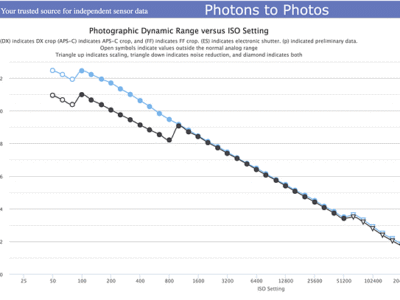
The dynamic range data for the Sony a7 V (black) gives a hint to how it’s delivering its excellent results in mechanical shutter mode (blue). Image: Photos to Photos |
Dynamic range data for the Sony a7 V makes clear that the benefit of partially stacked CMOS isn’t just speed: it’s the ability to deliver higher dynamic range.
Bill Claff has just published his DR figures for the Sony a7 V, making an impressive showing and revealing what’s going on behind the scenes, both of the Sony and the recent Panasonic S1II.
Partially stacked sensors are essentially conventional BSI chips with more complex readout circuitry around the edge (the sensor itself isn’t stacked). The Nikon Z6III showed this could bring a speed advantage over existing BSI sensors but the Panasonic S1II and Sony a7 V show that there’s much more they can do.
Unlike existing dual conversion gain sensors, which could use either a low gain (high capacity) setting for low ISO and a high gain (lower noise but lower capacity) mode for high ISOs, the new sensors can do both, at the same time. So you can capture the full capacity of the low gain mode but combine the cleaner shadow data of the high gain mode.
For years, we’ve seen dismay that the advances in sensor tech weren’t giving an IQ improvement. Well here’s the step forward in IQ we’ve all been waiting for’
This process, which we suspect involves sample-and-hold capability in the more complex readout circuitry, takes longer than reading out just a single mode. As a result, it can only be conducted in mechanical shutter mode, where the physical shutter stops any more light accumulating, giving you as much time as you need to read the sensor.
The publication of the e-shutter data for the Sony makes this clear: in e-shutter mode you see the now-familiar shape of a dual conversion gain sensor, but in mechanical shutter mode the low ISO DR is boosted: essentially extending the shadow benefit of the high gain mode back up into the low ISO range. Panasonic’s S1II does the same thing.
 |
|
Compare the results of the Panasonic S1II (orange) with that of the Nikon Z6III, which uses a similar sensor but appears to always use only either its low or high gain mode, and you see the same pattern. We strongly suspect the S1II’s e-shutter data would overlap very closely with the Nikon’s. Image: Photons to Photos |
For years now, we’ve seen dismay expressed that the advances in sensor tech were only giving a speed benefit, rather than an IQ improvement. And those speed improvements were often mischaracterised as solely benefiting video. Well here’s the step forward in IQ we’ve all been hoping for, in addition to the speed boost we see in the single gain readout mode.
What does this mean for the a7 V?
The upshot for the Sony is that dynamic range looks excellent in mechanical shutter shooting but you have to give up that DR boost when you switch to any of the e-shutter modes. So, while the Sony still outputs 14-bit files in these modes, there may not be the DR advantage over the Canon EOS R6 III’s 12-bit output that some commenters have been (perhaps prematurely) crowing about.
The good news is that Bill had initially marked the a7 V’s data as having noise reduction in it. He’s now removed this designation as the signal processing he was observing appears to be the combination of the two readout modes, rather than anything murky goings on in the shadows.
Do I need all this DR?
This is certainly a step forward for the industry, and one that doesn’t come with the significant costs of a fully stacked sensor design, so it’s likely to come to a wider range of cameras.
It’s worth keeping in perspective, though. DR numbers do not represent image quality as a whole, and there’s nothing to suggest that there’s been a big boost in IQ across the whole tonal range of the images. The improvements will primarily be in the shadows, adding editing flexibility for things like daybreak and sunset landscapes.
For a lot of photographers, DR differences were worth considering when some models produced Raw files with relatively little opportunity to exploit shadow capture, beyond what was already present in the JPEGs. But once you reach a threshold of ‘good enough’ for your style of shooting, any further increase is nice to have but for an increasingly small number of your images, rather than an every-shot benefit.
It’s definitely a step forward, though, and if more people start to utilize the capabilities of HDR screens to make their work more striking and lifelike and more often use more of their captured DR, then that will only increase the value of this breakthrough.
Thansk to Horshack, Bill Claff and Robert Newman for their work, insight and feedback on this technology.

Our DPREVIEW Tribute:
After nearly 25 years of operation, DPReview closed on 10 April 2023. This difficult decision was part of the annual operating plan review that parent company, Amazon, shared earlier this year.
Over the course of 25 years, DP Review built up a reputation as being one of the most informative places to go for information about that new camera or lens you’re after. DP Review began as an independent reviews site based in the UK in 1998, the brainchild of Philip and Joanna Askey, but it was eventually purchased by Amazon in 2007 and relocated over to Seattle in the USA in 2010.
Cheers DPReview – thanks for the great work and content that guided photographers, videographers and techno junkies the world over!