
 |
| Photo: Richard Butler |
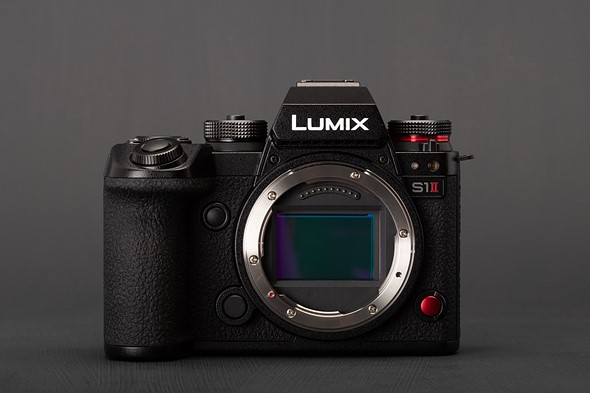
With the release of the S1II, Panasonic became the second company to market a camera with a “Partially Stacked” sensor, which uses more sophisticated readout circuits to get data off the sensor faster than possible with existing BSI designs. (Though not nearly as fast as fully Stacked designs allow.) We’ve had the chance to put it in front of our studio test scene to see how it performs in terms of image quality and dynamic range.
Our test scene is designed to simulate a variety of textures, colors, and detail types you’ll encounter in the real world. It also has two illumination modes, full even light and low directional light, to see the effect of different lighting conditions.
The S1II performs well at shooting our test scene, providing great image quality. Looking at base ISO Raws, the S1II captures similar levels of detail as the other 24MP full-frame cameras on the market*, though Panasonic’s JPEG engine doesn’t seem to get rid of quite as much moiré artefacting as Nikon or Canon’s.
Speaking of that JPEG engine, we’ve been pleased with Panasonic’s colors for a while now, and the S1II is no exception; like the rest of its competition and the company’s previous cameras, its colors are solid.
At mid ISOs to high ISOs the S1II’s noise levels are competitive. Its JPEG engine does an admirable job of reducing noise while still retaining detail.
* The S1II’s price puts it in competition with much slower, but higher-resolution cameras like the Sony a7CR and Panasonic’s own S1RII; if you care more about image quality than speed, that’s worth noting.
Dynamic Range
The S1II provides a good amount of dynamic range, giving you room to pull your shadows up without the detail being overwhelmed by noise. However, given the lack of chroma noise visible in our tests, it seems like there may be some noise reduction going on, either in ACR or in-camera. Either way, there’s plenty to be squeezed out of the files, with no nasty surprises, though you will see the effects of a little extra read noise if you’re shooting at base ISO to maximize dynamic range.
Exposure Latitude | ISO Invariance
This is still a relatively new sensor, but it seems like Panasonic is getting a lot out of it. The S1II’s image quality is very similar to other 24MP full-frame cameras with much slower burst rates and less capable video specs. Speaking of, be sure to stay tuned: tomorrow we’ll be taking a look at video stills from the S1II.

Our DPREVIEW Tribute:
After nearly 25 years of operation, DPReview closed on 10 April 2023. This difficult decision was part of the annual operating plan review that parent company, Amazon, shared earlier this year.
Over the course of 25 years, DP Review built up a reputation as being one of the most informative places to go for information about that new camera or lens you’re after. DP Review began as an independent reviews site based in the UK in 1998, the brainchild of Philip and Joanna Askey, but it was eventually purchased by Amazon in 2007 and relocated over to Seattle in the USA in 2010.
Cheers DPReview – thanks for the great work and content that guided photographers, videographers and techno junkies the world over!