
Oscars 2020: Why people are talking about visual effects:
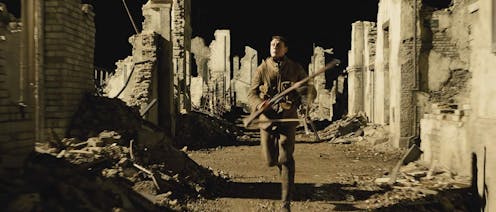
As the presentation of the 2020 Academy Awards approaches, there has been a lot of buzz around the visual effects category. Two films – Sam Mendes’s 1917 and Martin Scorsese’s The Irishman have, in particular, attracted a lot of attention for the tricks they use to immerse the viewer in the characters and storyline.
The first film to win an award for visual effects, in the first ever Oscars ceremony in 1929, also won best picture. American special effects artist and film director Roy Pomeroy won for Wings, a first world war movie featuring breathtaking realistic dogfight sequences. His work still looks amazing, given the tools he had to work with. In the 90 years since he won his award, though, visual effects have become ever more sophisticated.
Big bangs theory
If we take a look at the films that are nominated for Best Visual Effects in this year’s Academy Awards, we see five very different types of film. Star Wars: The Rise of Skywalker is the continuing sci-fi saga of the battle between the Jedi and the Sith. A set of tried-and-tested visual effects techniques were used in the film.
This included the return of a fully digital replacement for Princess Leia using pieces of old footage of the late Carrie Fisher and computer-generated elements to create a complete character that blended seamlessly into the new narrative. Most of the environments were created in the computer and then composited with actors’ performances against a green screen that allows backgrounds to be replaced with digital sets.
Avengers: Endgame, is the final episode of a comic book-based world of superheroes and their enemies in one final, epic battle. Green screens played a huge part in this film as well, allowing intricate digital environments to play their part in the storytelling.
As you’d expect there are plenty of pyrotechnics, explosions and battle scenes that were made with animated digital characters.
Rumble in the jungle
The Lion King, a computer-generated remake of the Disney classic, originally animated, on the whole, by hand in 2D. Many of the techniques used in this movie were originally developed for the making of the 2016 remake of Jungle Book which, like The Lion King, was reworked as a fully digital film – apart from Mowgli who was played by a real boy.
In The Lion King, director John Favreau developed a technique that he felt would inform the animation of the animals in a far more realistic way than how animation is traditionally created. Rather than simply recording voice actors in a sound booth, he put them in a studio and filmed them acting together so that animators had nuanced reference to work with to ensure the tiniest of reactions were captured in the creatures’ performances.
Virtual reality also played a big part in the making of the film. Camera operators were able to use digital sets to see the environments and move digital cameras in a realistic way.
Forever young
The Irishman jumps between present-day action and as far back as the 1950s, made more complicated by the fact that the characters are played by the same actors. The point of difference is that prosthetics and makeup weren’t used, but stars including Robert De Niro and Al Pacino were “de-aged” using computers, using images of the actors from photographs and previous films to build “digital masks” in the computer that replaced the actor’s real faces.
This meant that De Niro who plays the lead role was, at 74 when filming began, playing the role of a man in his 30s and by the end of the film the same man in his 80s. How successfully is something that has been hotly debated – but nobody can doubt the expertise with which the artists carried out their task.
Spot the joins
The final film nominated is the first world war epic 1917, co-written, produced and directed by Sam Mendes. Loosely based on a story Mendes was told by his grandfather, the film relies on a single shot depiction of the entire narrative, following the main character on his journey to get a message to the front line. This technique, also used in 2015’s best picture winner, Birdman, required meticulous planning to ensure that the cuts that occurred were invisible to the viewer.
Camera moves were choreographed to allow two scenes that were filmed in the same location at different times to be taken into the computer and “stitched” together as if they were one complete shot. Doing this over and over enabled the illusion of one continuous sequence.
Like many films though, 1917 used a host of other visual effects techniques that were unseen. This is often regarded as the pinnacle of success in visual effects – an effect that can’t be seen versus one that is smacking you in the face with a large, wet fish.
Appliance of science
Some of the nominated movies need visual effects to create worlds and creatures that don’t exist, while some employ tricks to enhance the cinematic experience and the ability of the filmmaker to tell their story. All of them use the technical expertise of visual effects artists to bring the director’s vision to the screen.
And there’s a great deal of scientific knowhow that goes into creating cinematic illusion. The movie that won the visual effects award in 2014, Interstellar, involved recreating the appearance of a black hole. To do this, visual effects artists worked with scientists to accurately model the phenomenon. The results were so advanced that scientists have since cited its importance to their ongoing work.
This scientific knowledge underpins flawless visual effects production. Not only does a visual effects artist need to know how their tools work, they need to be able to understand the science that informs the visuals we see on the screen. Human and animal anatomy, lighting, pyrotechnics, fluid simulation, mechanical engineering and robotics are just a few of the scientific disciplines that add strings to a visual effects artist’s bow.
So, when we talk about visual effects and the people who create them, remember the science that supports almost everything they do. Every frame is looked at in minute detail, so much so that the casual viewer might never understand the hours that go into making one of these films look the way they do and allow us to sit back and enjoy the story.

Chris Williams does not work for, consult, own shares in or receive funding from any company or organization that would benefit from this article, and has disclosed no relevant affiliations beyond their academic appointment.
: The Conversation – Articles (UK)
Have you tried: Visiting Port Elizabeth?