
 |
|
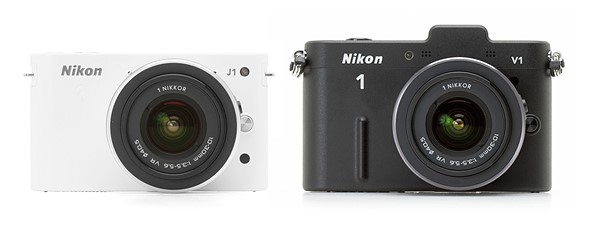
Nikon’s 1 J1 (left) and V1 (right), were an attempt at selling interchangeable lens cameras to people that would never consider a DSLR, and were packed with technologies that would become widely adopted in later years. Photo: Richard Butler |
If I were to ask you which was the first brand to bring on-sensor phase detection to a mirrorless camera, would you remember that it was Nikon? How about the first cameras to feature dual conversion gain sensors? Yup, again it was Nikon. In fact both these breakthroughs, which have become near essential technologies in modern mirrorless cameras first debuted in the same models: the Nikon 1 V1 and 1 J1.
In fact these cameras also marked the first appearance of the Type 1 (13.2 x 8.8mm) sensors, so were significant in a number of ways.
To me the Nikon 1 highlights that it wasn’t clear, early on, who Mirrorless was going to be for, and what it was meant to achieve. Nikon was the fifth brand to enter the mirrorless market, at a time when Olympus and Panasonic were using Four Thirds sized sensors and Samsung and Sony were offering APS-C cameras. It wasn’t obvious what role these cameras were going to play: primary cameras for photographers, secondary cameras to work alongside a DSLR system or primary cameras for people who weren’t ever going to buy a DSLR.
 |
|
With the small retractable kit lens (another innovation that’s become commonplace), the Nikon 1s could let you take better images than contemporary compact cameras, but in an easier-to-bring-with-you package than a DSLR. Nikon 1 V1 with Nikkor 1 10-30mm F3.5-5.6 @ 12.7 mm | 1/500 sec | F5.6 | ISO 100 |
Nikon said it was targeting that third group, presumably in an attempt not to undermine its own DSLR sales. But even then, the V1 and J1 didn’t give coherent messages about whether they were supposed to be point-and-shoots or cameras you were expected to take some control over. And the prices: $649 for the J1 and $849 for the V1 each bundled with a 10-30mm zoom were higher than the asking price of the Panasonic GF3, which launched for $599 with a lens.
There was much about them that was impressive: their fast-readout sensors gave a taste for where autofocus on Mirrorless cameras was going. Their continuous AF, in particular, was significantly ahead of the pack, as was their ability to shoot Raws at up to 60fps.
However, their interfaces were frustratingly simplistic, with limited customization if you wanted to take control, yet their auto exposure and ISO systems often selected shutter speeds that would almost guarantee subject motion blur, undermining their appeal to beginners.
Read our original Nikon 1 V1 / J1 review
That wasn’t the only drawback. The rather unambitious F3.5-5.6 and F3.8-5.6 zooms rather blunted the image quality potential of sensors that were impressively fast but pretty noisy, even for their size (dual conversion gain was a necessity, rather than a nicety for their Aptina sensors).
 |
|
It’s fair to say Nikon was bullish about the performance of the 1 Series Presentation slide: Nikon UK |
Nikon did eventually introduce two more photographer-focused lenses: an 18.5mm F1.8 (50mm F4.9 equiv) arrived a year later for around $200, with a ?$900 32mm F1.2 (87m F3.3 equiv) hitting the shelves another eight months hence. But that’s a lot of money just to get access to the camera’s full photographic abilities.
The alternative was an FT-1 adapter that let you mount F-mount lenses on the 1 series cameras. But anyone who’s questioned how many of Nikon’s lenses make sense with the 1.5x crop of APS-C will not have found the situation any better with the 2.72x crop imposed by what Nikon called its ‘CX’ format.
[embedded content]
The Nikon 1 cameras prompted one of DPReview’s first forays onto YouTube, apparently before we’d worked out how to set up microphones or choose appropriate outfits for appearing on camera.
Nikon stuck with the 1 series for another few years: the last Nikkor 1 lenses were launched in March 2014, with the Sony-sensored Nikon 1 J5 bringing down the curtain on the whole affair a year later. With the benefit of hindsight, a small-sensor Mirrorless system looks like a difficult sell, but you can’t blame Nikon for trying to appeal to an audience that didn’t want the bulk and inconvenience of a DSLR.
 |
|
Nikon wasn’t alone in creating a small-sensor mirrorless system it later abandonned. Photo: Andy Westlake |
Nikon didn’t give up on Type 1 as a format, developing a trio of photographers’ compacts in 2016 that were promoted and then withdrawn at the eleventh hour. But who knows, maybe these false-starts meant Nikon was able to get up-and-running that bit quicker, when it finally decided the mirrorless was the future for its core audience.

Our DPREVIEW Tribute:
After nearly 25 years of operation, DPReview closed on 10 April 2023. This difficult decision was part of the annual operating plan review that parent company, Amazon, shared earlier this year.
Over the course of 25 years, DP Review built up a reputation as being one of the most informative places to go for information about that new camera or lens you’re after. DP Review began as an independent reviews site based in the UK in 1998, the brainchild of Philip and Joanna Askey, but it was eventually purchased by Amazon in 2007 and relocated over to Seattle in the USA in 2010.
Cheers DPReview – thanks for the great work and content that guided photographers, videographers and techno junkies the world over!