
Nuclear fusion record broken – what will it take to start generating electricity? Podcast:
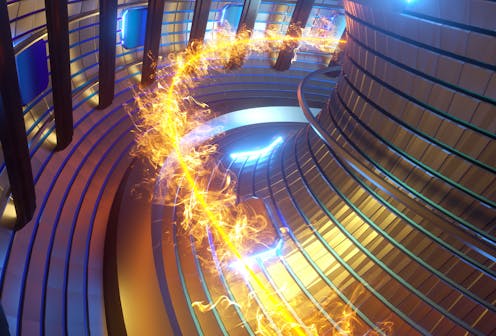
Scientists at a nuclear fusion lab in the UK just broke the world record for the amount of energy produced in a single fusion reaction. In this episode of The Conversation Weekly, we ask two experts what this means, and how long it’ll take before we can switch on the world’s first nuclear fusion power plant.
And we talk to a social psychologist about new research into the societal pressure some people feel to be happy.
Scientists first demonstrated the ability to fuse two atoms in lab experiments in the 1930s. Nuclear science has come a long way since then, but we still haven’t managed to harness the energy produced by nuclear fusion to generate electricity.
In early February, scientists at the Joint European Torus (JET) lab in Oxfordshire in the UK announced they’d broken the world record for the amount of energy produced in a nuclear fusion experiment. They produced 59 megajoules of heat energy in a single fusion “shot” that lasted for five seconds. This doubled the previous world record set by JET in 1997, but was still only enough to heat about 60 kettles of water.
So how excited should we be about the latest news? How much closer does this world record take us to getting electricity from fusion power – and what would success mean for the planet’s future energy mix?
Read more: Nuclear fusion: how excited should we be?
The JET experiment is the world’s biggest nuclear fusion device. It uses an approach called magnetic confinement to fuse nuclei at very high speeds and temperatures inside a doughnut-shaped container called a tokomak.
Livia Casali, assistant professor in nuclear engineering at the University of Tennessee, Knoxville in the US, says the latest result from JET confirms some of the choices made for the fusion reactors of the future – particularly around the materials used to line the inside walls of the tokomak. “These results also confirm that we can achieve fusion energy using a deuterium and tritium fuel mix, which is the same fuel mix that we are planning to use for future fusion devices,” she says.
In particular, JET’s results are a proof of concept for ITER, a huge fusion reactor under construction in southern France and due to be ready by 2026.
“To make a fusion reaction is very easy, but that doesn’t mean that we’re able to produce energy,” says Angel Ibarra Sanchez, a research professor in fusion technology at the Centre for Energy, Environmental and Technological Research in Madrid, Spain’s national fusion laboratory.
Like JET, ITER won’t produce electricity – that will only happen once a demonstration reactor is built. Ibarra says the hope is that the first demo fusion reactor in Europe will be available around 2050. If these demo reactors are shown to work, he predicts the first generation of fusion power reactors could arrive in the 2060s or 2070s. “It will probably not be much faster than this,” he says.
Once fusion power arrives, Ibarra believes the energy it will generate – which releases no carbon dioxide and is dubbed “clean energy” – will be transformational. But he warns us not to pin all our hopes on fusion. “To think that the energy production in the future will be based in a single type of energy sources is not feasible. It’s not realistic,” he says. Instead, Ibarra thinks the energy mix of the future should be “a mix of solar energy, wind energy, and hopefully fusion energy”.
In our second story in this episode, we find out that living in a country that scores highly on global happiness rankings might not be all that it’s cracked up to be. Brock Bastian, professor of psychological sciences at the University of Melbourne in Australia, just co-authored new research showing increased social pressure to feel happy in countries that come top of these rankings. And for some people, this social pressure can be linked to poor mental health. “When a lot of people seem to be doing well and happy, it can exacerbate for some people those feeling of low mood,” says Bastian.
Read more: Research finds countries that focus the most on happiness can end up making people feel worse
And finally, Eric Smalley, science and technology editor at The Conversation in Boston, recommends some recent analysis on the technology dimensions of the unfolding Ukraine war.
Read more: What are false flag attacks – and could Russia make one work in the information age?
This episode of The Conversation Weekly was produced by Mend Mariwany and Gemma Ware, with sound design by Eloise Stevens. Our theme music is by Neeta Sarl. You can find us on Twitter @TC_Audio, on Instagram at theconversationdotcom or via email. You can also sign up to The Conversation’s free daily email here.
Newsclips in this episode are from BBC News and the UK Atomic Energy Agency/Culham Center for Fusion Energy.
You can listen to The Conversation Weekly via any of the apps listed above, download it directly via our RSS feed, or find out how else to listen here.

Angel Ibarra Sanchez receives funds from EURATOM, MICINN and the Junta de Andalucía. He is Director of the IFMIF-DONES Consortium, a public body in charge of managing the Spanish contribution to IFMIF-DONES. Livia Casali is a member of the American Physics Society and the Italian Physics Society.
Brock Bastian receives funding from the Australian Research Council.
: The Conversation – Articles (UK)
Have you tried: Diving with Sharks?