
Nobel prize in physics awarded for work unveiling the secrets of electrons:
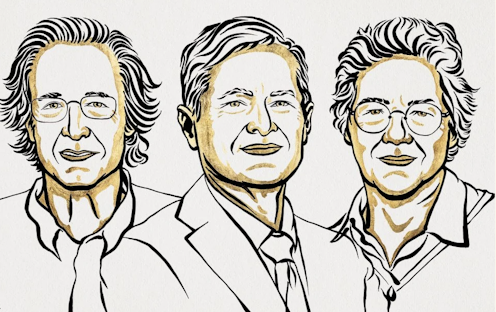
The 2023 Nobel prize in physics has been awarded to a trio of scientists for pioneering tools used to study the world of electrons.
Electrons are sub-atomic particles that play a role in many phenomena we see every day, from electricity to magnetism. This year’s three Nobel physics laureates demonstrated a way to create extremely short pulses of light in order to investigate processes that involve electrons.
Pierre Agostini from The Ohio State University in the US, Ferenc Krausz from the Max Planck Institute of Quantum Optics in Germany and Anne L’Huillier from Lund University in Sweden will share the prize sum of 11 million Swedish kronor (£822,910).
Changes in electrons typically occur in a few tenths of an “attosecond”, which is a billionth of a billionth of a second. In order to study such brief events, special technology was needed.
The laureates developed experimental methods that produced pulses of light so short that they are measured in attoseconds. These could then be used to study the fleeting dynamics of electrons in physical matter – something that wasn’t previously possible.
The attosecond pulses, the shortest flashes of light ever produced, sparked a revolution in photonics – the science of light waves. They were used to take snapshots of electrons in different physical systems, such as in atoms, chiral molecules – molecules that are mirror images of one another – and very tiny nanoparticles among others.
The laureates have all contributed to enabling the investigation of such processes. For the first time, these quick pulses allowed scientists to match up the time scale of their observations to the natural, very fast time scales at which electron dynamics occurred.
This achievement required significant innovations in laser science and engineering – innovations that this year’s Nobel laureates worked on for decades.
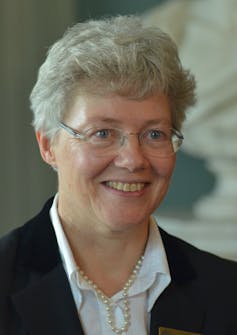
L’Huillier discovered a new effect that arose as the result of interactions between laser light and atoms in a gas. This interaction could be used to produce pulses of ultraviolet light that were each a few hundred attoseconds long.
Agostini and Krausz took this discovery even further. In 2001, Agostini was able to produce short light pulses and measure their width. The series of bursts produced using something called the RABBIT technique lasted just 250 attoseconds.
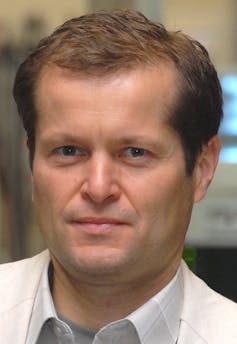
At around the same time, Krausz developed a different experimental approach, using it to successfully isolate a light pulse that lasted 650 attoseconds.
The two approaches developed by Agostini and Krausz form the basis for much attosecond research carried out today.
Exciting applications
There are some exciting potential applications for these attosecond pulses.
They could be used to study previously unknown physical phenomena in different types of material.
A spin-off area known as ultra-fast switching could also one day lead to the development of very fast-working electronics.
Attosecond pulse science could also find uses in medical diagnostics. By exposing a blood sample to a very fast pulse of light, scientists can detect tiny changes in the molecules in that sample. This could lead to a new way of diagnosing disorders, including cancer.
Our team at King’s has been working to combine the resolution on physical processes that attosecond pulses enable with novel advances in quantum information processing. This would create pulses of quantum light at the attosecond time scale that could have applications in quantum computing.
The award of the Nobel prize in this field inspires us to redouble our efforts to break novel ground. We wish our colleagues continued success, and we are eager to see what they will surprise us with next.

Amelle Zaïr receives funding from EPSRC, STFC XFEL hub and The Royal Society.
: The Conversation – Articles (UK)
Have you tried: Visiting Port Elizabeth?