
Nigeria needs more veterinary doctors but getting them is a big challenge:
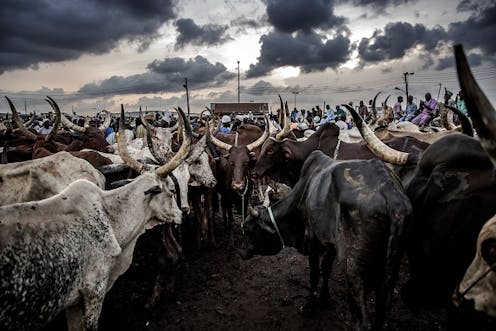
A government official in Gombe State, north east Nigeria, recently lamented the dearth of veterinary doctors in the state. He said the state had only eight veterinary doctors and around a million farm animals. But the problem is not peculiar just to Gombe.
The Veterinary Council of Nigeria has 9,000 registered members, but only 3,500 are actively practising veterinarians. The rest are in different professions or no longer in the country. According to the council, Nigeria requires a minimum of five veterinarians per local government area for effective containment of disease outbreaks and monitoring. With 774 local government areas, this means Nigeria requires 3,870 veterinarians to work solely at that level. There aren’t enough in active practice even for this requirement.
Veterinary doctors have an important role to play in agricultural production, disease prevention, wildlife conservation and the health of animals in the security sector, as well as caring for pets.
Having taught veterinary medicine in Nigeria for 21 years, I have observed some of the challenges students face, and have considered ways to increase the number of qualified vets in the country.
How veterinary training started in Nigeria
The first veterinary education facility in Nigeria was established in 1923. It is now called the National Veterinary Research Institute and concentrates on vaccine production. Its premises also host a school training students for diplomas in animal health. This qualifies them to assist veterinarians.
The first batch of licensed veterinary graduates in Nigeria was produced in 1947. A report in 1949 recommended establishing a veterinary school at Ibadan but this lacked funding and at the time the country was focused on the struggle for independence. By 1954, there were only 39 veterinary surgeons on the register of the Veterinary Council of Nigeria and most of these were expatriates. It was not until 1967 that the next batch of locally produced veterinary graduates emerged, from the joint efforts of the University of Ibadan and Ahmadu Bello University, Zaria.
More Nigerian universities now offer veterinary medicine. There are nine of them presently. University of Benin is seeking approval from the National Universities Commission to establish a veterinary school. A school is also in the works for a newly approved Federal University of Agriculture, Zuru, Kebbi State.
Most of these faculties can only cater for fewer than 100 students each. Their capacities differ. The older ones graduate between 70 and 100 per session while younger ones graduate between 30 and 50.
Demands of studying veterinary medicine
Aside from the limited training capacity available, the demands of this course place some limits on the number of graduates.
The first thing a veterinary student needs is a deep rooted interest, love and passion for animals.
The academic requirements for admission to the course are higher than for many other courses. Students need the same school leaving marks as for courses like human medicine, pharmacy and physiotherapy.
The veterinary student must be resilient and ready to persevere. The course is rigorous, with a high workload and a lot of reading. It takes discipline to study many animal species in detail. In my experience, about a tenth of the students at each level withdraw after failing to meet all the criteria.
It’s a costly course too. According to the National Universities Commission, training a veterinary student costs the federal government about N950,000 per year. For the six year training programme it’s a total cost to government of N5,700,000 (about US$ 15,000) for each vet student. While tuition is free in federal universities offering vet studies, students pay for their upkeep and costs like accommodation and field trips. This is difficult for some students to pay.
Government funding is crucial if the number of veterinary graduates is to increase. The huge financial implication may be the reason no university run by a state government has ventured into training veterinary students.
Full scholarships and loans from government and the private sector would help. Automatic offers of employment for top graduates would also encourage students.
Opportunities in Nigeria
There’s a wide range of opportunities for work in veterinary science in Nigeria. Much of this work is of national importance, in that it has a bearing on food security, economic development and integrated healthcare.
The first is animal production. Recent estimates indicate that Nigeria has 18.4 million cattle, 43.4 million sheep, 76 million goats and 180 million birds (poultry).
Clinics for small animals like dogs and cats are another option, as is wildlife conservation.
The Federal Ministry of Agriculture has a quarantine unit, where animals coming through air and land borders are checked to prevent the introduction of disease.
State ministries of agriculture also have to manage, treat, contain and report on animal diseases.
Some veterinarians work on teams researching human diseases, especially where they involve pathogens of animal origin.
Security agencies such as the police, army and Nigeria Security and Civil Defence Corps need vets to look after dogs used in crime detection, crowd control and rescue operations, and horses used in ceremonial parades.
Veterinary scientists also work in institutions like the National Veterinary Research Institute to identify disease causing agents and produce vaccines. Another is the National Animal Production Research Institute.
Drug safety and food safety are additional areas of work.
Veterinary doctors are resilient
Veterinary graduates are trained to work under pressure, giving them attributes that are in demand in many spheres of the economy. Recently one of our students became a commercial airline analyst, crediting his training with sharpening his business acumen.
While vets are in high demand across sectors, it would be more beneficial to the country if they stayed in the profession.

Adekayode Sonibare does not work for, consult, own shares in or receive funding from any company or organisation that would benefit from this article, and has disclosed no relevant affiliations beyond their academic appointment.
: The Conversation – Articles (AFRICA)
Have you tried: Diving with Sharks?