
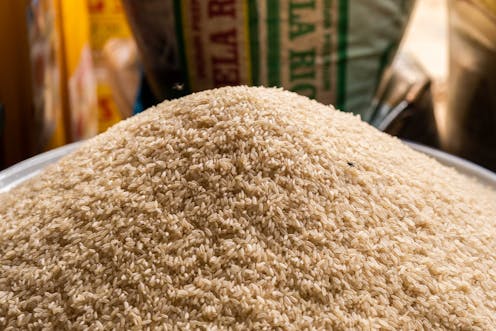
Rice is one of the staple foods globally, ranking third after wheat and maize in terms of production and consumption. It contributes over 20% of the total calorie intake of the human population.
In sub-Saharan Africa rice ranks fourth in production after sorghum, maize and millet. Nigeria is the continent’s leading rice producer and produces over 46% of west Africa’s harvest.
The country is also a big consumer. Nigeria is one of the world’s largest markets for parboiled rice, consuming on average US$ 4 billion worth of it each year.
With production of 5.4 million metric tonnes in 2022 and consumption of almost 7 million metric tonnes, Nigeria had to import the shortfall.
There are various reasons it’s difficult for Nigeria to produce all the rice it needs. High inflation and production costs, insecurity, policy uncertainty, and artificial scarcity caused by middlemen are some of them. Also, some consumers prefer the imported varieties.
Another major reason is water scarcity. The soil for rice cultivation should ideally be slightly wet and this can be achieved by rainfall or irrigation. In parts of Nigeria there’s already a shortage of water for drinking, so people don’t use this precious resource on a thirsty crop.
A possible solution to the problem is to use wastewater for irrigation. Around the world, the idea is growing that wastewater can be a resource rather than something to be discarded.
As a researcher working on wastewater treatment for reuse to increase rice production, I believe Nigeria ought to embrace the idea. It could boost rice production and enhance food security. It would also help in achieving the Sustainable Development Goal of zero hunger before 2030.
In this article I offer five steps towards this.
Wastewater for irrigation
Information is scanty on the amount of wastewater generated in Nigeria but Lagos, the most populous state, produces 350 million gallons (1.3 billion litres) of wastewater daily.
If one-quarter of that water were to be recycled for rice production, nearly 75% of Nigeria’s rice shortage would be eliminated. This is based on an estimated average water applied of 450mm, and maximum consumptive water use of 3.35mm/day to produce 1.36 tonnes per hectare from a rice field in Ibadan, south-west Nigeria.
In many parts of the world, especially in developing countries such as China, India and Mexico, wastewater has become an important source for agricultural irrigation. It is estimated that 20 million hectares of cropland are irrigated with wastewater globally, accounting for nearly 10% of the irrigated agricultural land.
Israel recycles nearly 90% of its wastewater and uses most of it for irrigation. Europe recycles 60% of its wastewater. Most African countries, except Egypt, Morocco and Algeria, are yet to tap into the benefits of wastewater treatment for reuse, especially for agriculture.
Different methods of wastewater treatment have been tried for use in irrigation with various degrees of success. The most cost-effective is treatment using plants, known as phytoremediation. This process uses various types of plants to remove, transfer, stabilise or destroy contaminants in soil and wastewater. It is economically feasible, environmentally and eco-friendly, prevents erosion, and improves soil fertility.
Nigerian rice production
Based on my research I suggest Nigeria could increase rice production by following these steps.
1. Identify reliable sources of wastewater supply
For wastewater to be a major alternative source of water for rice irrigation, it has to be reliable and dependable. So, the first step is to identify sources and ascertain their reliability. Rice has to be irrigated for a minimum of 90 days (depending on the variety).
2. Structured harvesting of wastewater
There needs to be an organised way of collecting wastewater. In an organised society, waste is collected strategically and sorted to make processing and recycling relatively easy.
3. Wastewater treatment using phytoremediation
Phytoremediation is the use of plants and associated soil microbes to reduce the concentrations or toxic effects of contaminants in the environment. It is widely accepted as a cost-effective environmental restoration technology.
All the different categories of wastewater (domestic, industrial and so on) should be treated before administering to plants, except aquaculture wastewater, which already has nutrients that are beneficial to rice crop growth. Extreme caution must be taken when using wastewater for irrigation, especially on some vegetables and fruits that tend to accumulate contaminants that could harm human health.
4. Increase rice cultivation using wastewater for irrigation
Administering the treated wastewater into rice fields in a pre-determined manner and quantity is necessary for growth and optimum yield. Irrigation scheduling can ensure rice cultivation all year round irrespective of climatic variability.
5. Increase land under cultivation using irrigated wastewater
Rice is cultivated on about 3.7 million hectares of land in Nigeria, representing 10.6% of the 35 million hectares of land under cultivation, out of a total arable land area of 70 million hectares. Out of the 3.7 million hectares under rice cultivation, 77% is rain-fed. The area could be tripled (11.1 million hectares) using treated wastewater. This would lead to higher grain yield, which would increase availability, lower prices and ensure self-sufficiency.

Christopher Oluwakunmi Akinbile receives funding from The World Academy of Sciences (TWAS) and Tertiary Education Trust Fund (TETFund). Christopher Oluwakunmi Akinbile works at the Federal University of Technology Akure, Nigeria
: The Conversation – Articles (AFRICA)
Have you tried: Farking?